
[Paper Review] A Survey for Foundation Models in Autonomous Driving
This survey reviews how foundation models—especially large language models, vision foundation models, and multi-modal models—are applied to autonomous driving, outlining taxonomy, methods, limitations, and future directions.
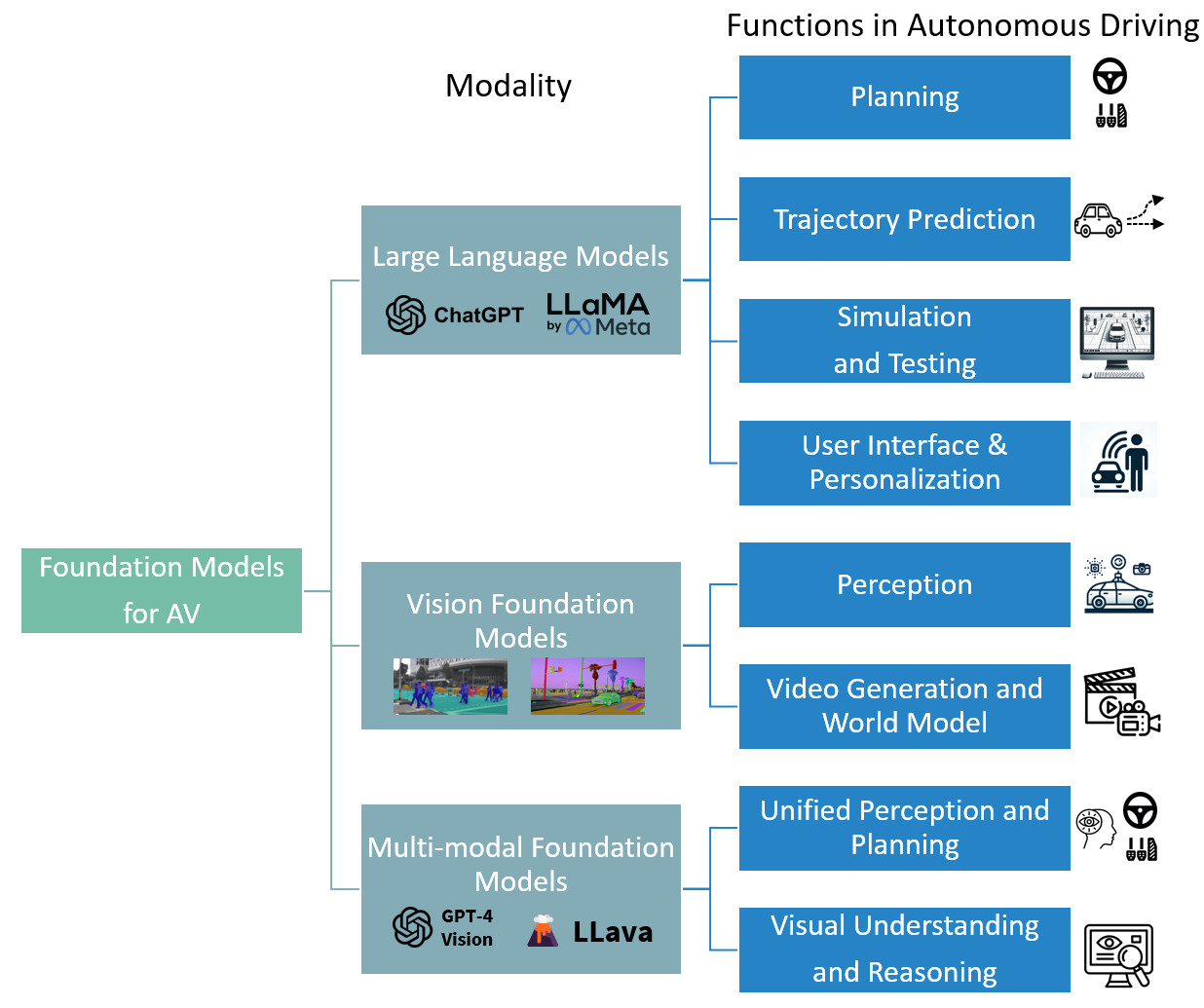
The advent of foundation models has revolutionized the fields of natural language processing and computer vision, paving the way for their application in autonomous driving (AD). This survey presents a comprehensive review of more than 40 research papers, demonstrating the role of foundation models in enhancing AD. Large language models contribute to planning and simulation in AD, particularly through their proficiency in reasoning, code generation and translation. In parallel, vision foundation models are increasingly adapted for critical tasks such as 3D object detection and tracking, as well as creating realistic driving scenarios for simulation and testing. Multi-modal foundation models, integrating diverse inputs, exhibit exceptional visual understanding and spatial reasoning, crucial for end-to-end AD. This survey not only provides a structured taxonomy, categorizing foundation models based on their modalities and functionalities within the AD domain but also delves into the methods employed in current research. It identifies the gaps between existing foundation models and cutting-edge AD approaches, thereby charting future research directions and proposing a roadmap for bridging these gaps.
Motivation & Objective
- Survey the role of foundation models in autonomous driving (AD) across perception, prediction, and planning.
- Analyze how large language models, vision foundations models, and multi-modal models are adapted for AD tasks.
- Identify gaps between foundation models and existing AD approaches and propose future research directions.
- Propose a taxonomy of foundation models for AD based on modalities and functional roles.
Proposed method
- Categorize foundation models by modality (LLM, vision, multi-modal) and function in AD.
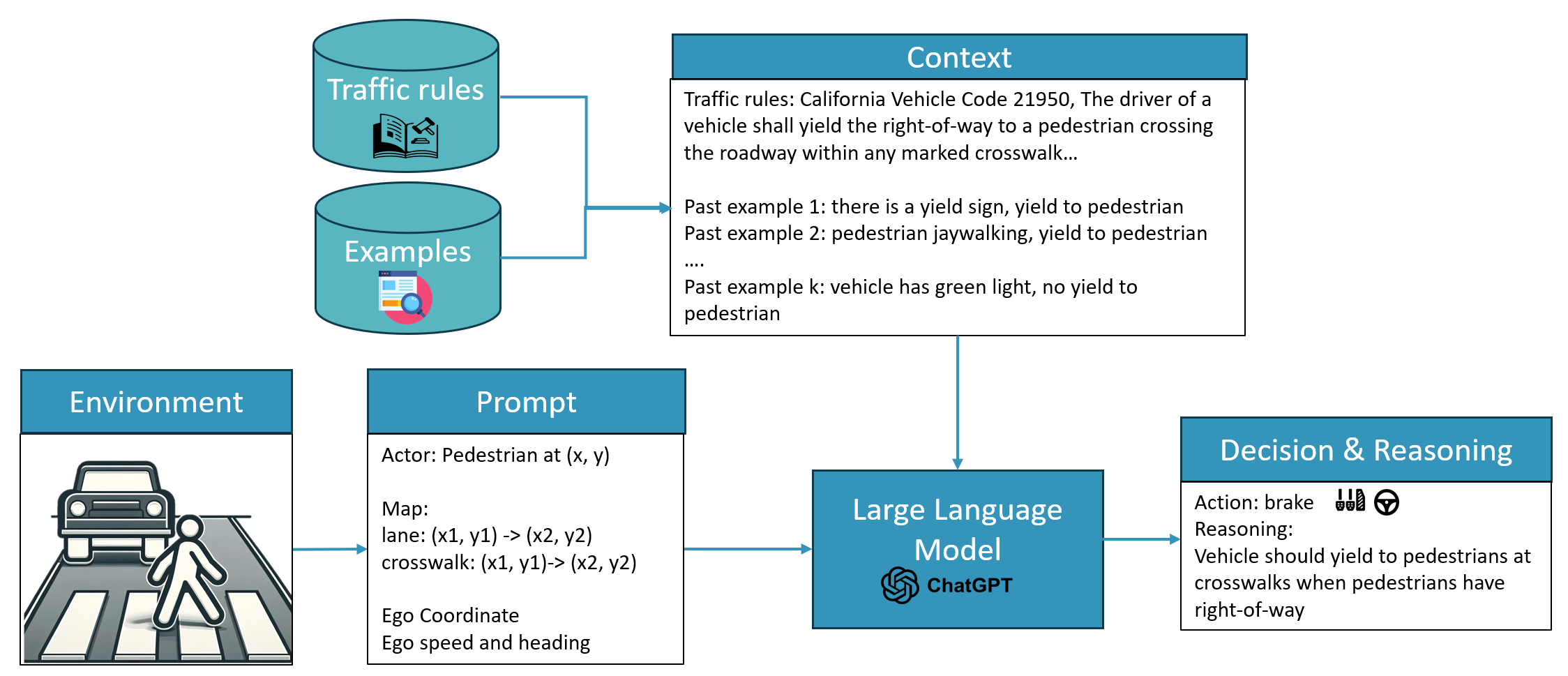
- Summarize key techniques: prompt engineering, in-context learning, fine-tuning, reinforcement learning with human feedback, and visual instruction tuning.
- Discuss applications in planning, prediction, perception, simulation, and testing.
- Review limitations such as hallucination, latency, and perception dependencies, and outline future research directions.
Experimental results
Research questions
- RQ1How are large language models leveraged for reasoning, planning, and interaction in autonomous driving?
- RQ2What roles do vision and multi-modal foundation models play in perception, prediction, and decision-making for AD?
- RQ3What are the main limitations and gaps preventing real-world deployment of foundation models in autonomous driving?
- RQ4What roadmap and research directions can bridge foundation models with current AD systems?
Key findings
- LLMs enable reasoning, planning, and user interaction in AD through descriptive environment prompts and structured prompts.
- Vision foundation models are applied to 3D perception, video generation, and domain adaptation for AD scene understanding.
- Multi-modal foundation models support visual understanding, spatial reasoning, and unified perception-planning, with instruction tuning used to adapt models to AD tasks.
- There are notable limitations including hallucination, latency, reliance on upstream perception, and a sim-to-real gap for AD applications.
- The paper proposes a staged road map: gradually collect domain-specific data, incorporate 3D data and lidar, and perform human-in-the-loop alignment for safety.
Read this paper
Open the full text in the Nubint reader and ask about any passage as you read.
Read this paper on NubintThis review was generated by AI from the original paper. Please check the paper before citing it.