
[Paper Review] A Survey of AI-generated Text Forensic Systems: Detection, Attribution, and Characterization
This survey presents a comprehensive taxonomy of AI-generated text forensic systems, categorizing methods into detection, attribution, and characterization to combat misinformation. It synthesizes existing techniques, identifies key challenges, and outlines future research directions for improving forensic accuracy and intent understanding in the face of evolving LLM capabilities.
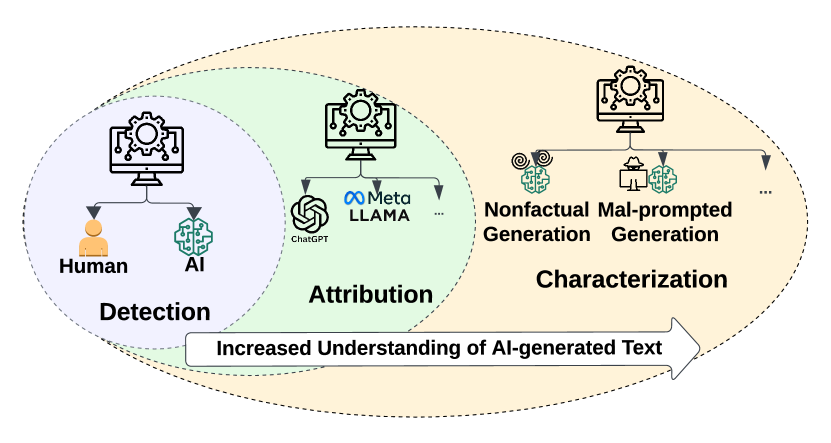
We have witnessed lately a rapid proliferation of advanced Large Language Models (LLMs) capable of generating high-quality text. While these LLMs have revolutionized text generation across various domains, they also pose significant risks to the information ecosystem, such as the potential for generating convincing propaganda, misinformation, and disinformation at scale. This paper offers a review of AI-generated text forensic systems, an emerging field addressing the challenges of LLM misuses. We present an overview of the existing efforts in AI-generated text forensics by introducing a detailed taxonomy, focusing on three primary pillars: detection, attribution, and characterization. These pillars enable a practical understanding of AI-generated text, from identifying AI-generated content (detection), determining the specific AI model involved (attribution), and grouping the underlying intents of the text (characterization). Furthermore, we explore available resources for AI-generated text forensics research and discuss the evolving challenges and future directions of forensic systems in an AI era.
Motivation & Objective
- To address the growing threat of large language models (LLMs) generating high-quality, deceptive text at scale, which undermines information integrity and democratic processes.
- To provide a structured taxonomy of AI-generated text forensic systems, organizing research into three core pillars: detection, attribution, and characterization.
- To identify critical challenges in forensic systems, including model fine-tuning, model variants, and coordinated AI agents that evade current detection mechanisms.
- To guide future research by highlighting emerging needs such as causality-aware modeling and knowledge-augmented LLMs for improved intent characterization.
- To compile and evaluate available resources and benchmarks for forensic research, supporting reproducibility and progress in the field.
Proposed method
- Proposes a three-pillar framework: detection (distinguishing AI from human text), attribution (identifying the source LLM), and characterization (understanding the intent behind the text).
- Classifies detection methods into zero-shot and supervised approaches, with subcategories including statistical cues (e.g., GLTR, DetectGPT), stylometric features, and PLM-based models.
- Categorizes attribution techniques by source type—specific model family (e.g., proprietary vs. open-source) or individual model—using zero-shot or supervised learning.
- Introduces characterization as a higher-level analysis, grouping texts by intent such as misinformation, factual inconsistency, or persuasive propaganda.
- Integrates knowledge graphs and causal reasoning to enhance forensic interpretability and intent understanding, particularly for characterization.
- Reviews existing benchmarks like Synthetic Lies, AI-botnet, and LLM-misinfo to evaluate system performance and generalization.
Experimental results
Research questions
- RQ1How can forensic systems effectively detect AI-generated text across diverse LLMs and generation styles?
- RQ2To what extent can forensic systems accurately attribute AI-generated content to specific LLM families or individual models?
- RQ3What are the most effective methods for characterizing the underlying intent of AI-generated text, such as misinformation or propaganda?
- RQ4How do model fine-tuning, model variants, and coordinated AI agents challenge current forensic detection and attribution capabilities?
- RQ5What role can causality-aware and knowledge-augmented LLMs play in improving the interpretability and accuracy of forensic characterization?
Key findings
- Detection systems based on statistical cues (e.g., GLTR, DetectGPT) and PLM-based models (e.g., RoBERTa, Grover-detect) show strong performance in distinguishing AI from human text, especially in zero-shot settings.
- Supervised detection methods using stylometric features and structural patterns (e.g., sequence-level entropy, attention patterns) achieve high accuracy, particularly when trained on diverse LLM outputs.
- Attribution systems can successfully identify model families (e.g., GPT vs. Llama) and even specific models (e.g., GPT-3.5 vs. GPT-4) using zero-shot or fine-tuned approaches, though model variants complicate this task.
- Characterization systems are emerging as critical for intent understanding, with frameworks like FActScore and Factcheck-GPT evaluating factual consistency, while others analyze persuasive or deceptive intent.
- The rise of model fine-tuning and AI agent coordination poses significant challenges, as these can obscure source attribution and enable sophisticated misinformation campaigns.
- Future forensic systems must evolve toward causality-aware and knowledge-augmented LLMs to explain *why* a text was generated and predict alternative generation paths, enabling deeper intent analysis.
Read this paper
Open the full text in the Nubint reader and ask about any passage as you read.
Read this paper on NubintThis review was generated by AI from the original paper. Please check the paper before citing it.