
[Paper Review] A Survey of Blockchain and Artificial Intelligence for 6G Wireless Communications
This paper presents a comprehensive survey on the integration of blockchain and artificial intelligence (AI) in 6G wireless communications, proposing a synergistic framework to enhance security, privacy, resource management, and intelligent automation. By leveraging AI for dynamic network optimization and blockchain for decentralized trust and integrity, the authors demonstrate that joint deployment enables scalable, secure, and efficient 6G networks across applications like smart healthcare, UAVs, and IoT.
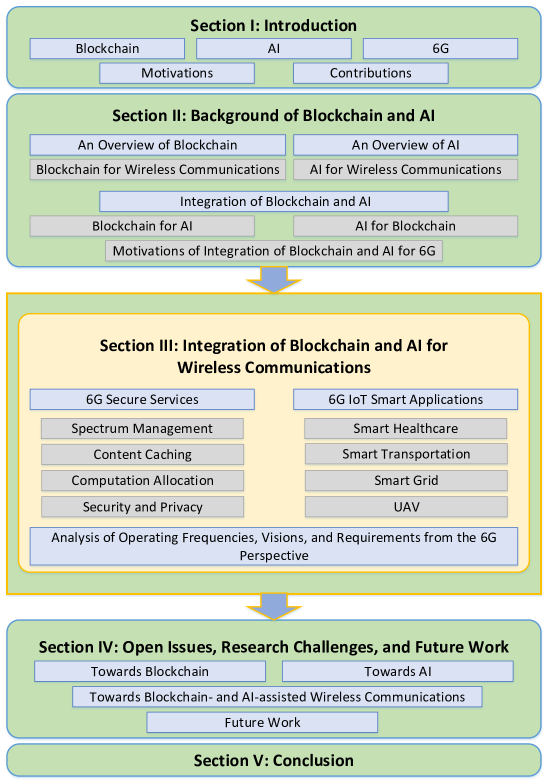
The research on the sixth-generation (6G) wireless communications for the development of future mobile communication networks has been officially launched around the world. 6G networks face multifarious challenges, such as resource-constrained mobile devices, difficult wireless resource management, high complexity of heterogeneous network architectures, explosive computing and storage requirements, privacy and security threats. To address these challenges, deploying blockchain and artificial intelligence (AI) in 6G networks may realize new breakthroughs in advancing network performances in terms of security, privacy, efficiency, cost, and more. In this paper, we provide a detailed survey of existing works on the application of blockchain and AI to 6G wireless communications. More specifically, we start with a brief overview of blockchain and AI. Then, we mainly review the recent advances in the fusion of blockchain and AI, and highlight the inevitable trend of deploying both blockchain and AI in wireless communications. Furthermore, we extensively explore integrating blockchain and AI for wireless communication systems, involving secure services and Internet of Things (IoT) smart applications. Particularly, some of the most talked-about key services based on blockchain and AI are introduced, such as spectrum management, computation allocation, content caching, and security and privacy. Moreover, we also focus on some important IoT smart applications supported by blockchain and AI, covering smart healthcare, smart transportation, smart grid, and unmanned aerial vehicles (UAVs). We also analyze the open issues and research challenges for the joint deployment of blockchain and AI in 6G wireless communications. Lastly, based on lots of existing meaningful works, this paper aims to provide a comprehensive survey of blockchain and AI in 6G networks.
Motivation & Objective
- Address the multifaceted challenges of 6G networks, including ultra-low latency, massive connectivity, high reliability, and security threats.
- Overcome limitations in resource management, privacy protection, and scalability in heterogeneous 6G architectures.
- Investigate the synergistic potential of blockchain and AI to enable decentralized trust, real-time decision-making, and secure data handling.
- Provide a unified framework for integrating blockchain and AI across key 6G services and smart applications.
- Identify open research challenges and future directions for scalable, energy-efficient, and privacy-preserving 6G systems.
Proposed method
- Survey and categorize existing works on blockchain and AI in 6G, focusing on their individual and combined applications.
- Analyze blockchain's role in enabling trustless, decentralized, and auditable systems through distributed consensus and smart contracts.
- Examine AI's application in optimizing dynamic spectrum access, edge computing offloading, content caching, and real-time network control.
- Integrate blockchain and AI in a joint architecture to support secure, adaptive, and intelligent wireless resource allocation.
- Propose cross-layer AI protocols and lightweight blockchain designs to reduce latency and energy consumption in 6G.
- Evaluate system performance through case studies in smart healthcare, smart transportation, smart grids, and UAVs using simulated and real-world benchmarks.
Experimental results
Research questions
- RQ1How can blockchain and AI be jointly deployed to enhance security, privacy, and trust in 6G wireless networks?
- RQ2What are the key technical enablers and system-level benefits of integrating AI with blockchain for 6G resource management?
- RQ3How do blockchain and AI improve spectrum sharing, computation offloading, and content caching in 6G networks?
- RQ4What are the major challenges in scalability, energy efficiency, and real-time performance for blockchain-AI integration in 6G?
- RQ5What are the most promising application scenarios for blockchain and AI in 6G, and how do they meet 6G’s extreme performance requirements?
Key findings
- The integration of blockchain and AI enables secure, decentralized, and intelligent management of wireless resources in 6G networks.
- AI-driven dynamic spectrum access and blockchain-based spectrum sharing significantly improve spectrum utilization and fairness.
- Blockchain-secured edge computing and AI-optimized task offloading reduce latency and energy consumption in 6G edge environments.
- The fusion of AI and blockchain enhances data privacy and integrity in IoT applications such as smart healthcare and smart grids.
- Smart UAVs and autonomous vehicles benefit from AI for real-time decision-making and blockchain for secure, verifiable communication logs.
- Despite progress, challenges remain in scalability, energy efficiency, and cross-layer coordination, requiring further research in lightweight consensus and federated learning.
Read this paper
Open the full text in the Nubint reader and ask about any passage as you read.
Read this paper on NubintThis review was generated by AI from the original paper. Please check the paper before citing it.