
[Paper Review] A Survey of Controllable Text Generation using Transformer-based Pre-trained Language Models
This is a comprehensive survey of Controllable Text Generation (CTG) using transformer-based pre-trained language models, outlining tasks, approaches, evaluation, challenges, and future directions.
Controllable Text Generation (CTG) is emerging area in the field of natural language generation (NLG). It is regarded as crucial for the development of advanced text generation technologies that better meet the specific constraints in practical applications. In recent years, methods using large-scale pre-trained language models (PLMs), in particular the widely used transformer-based PLMs, have become a new paradigm of NLG, allowing generation of more diverse and fluent text. However, due to the limited level of interpretability of deep neural networks, the controllability of these methods need to be guaranteed. To this end, controllable text generation using transformer-based PLMs has become a rapidly growing yet challenging new research hotspot. A diverse range of approaches have emerged in the recent 3-4 years, targeting different CTG tasks that require different types of controlled constraints. In this paper, we present a systematic critical review on the common tasks, main approaches, and evaluation methods in this area. Finally, we discuss the challenges that the field is facing, and put forward various promising future directions. To the best of our knowledge, this is the first survey paper to summarize the state-of-the-art CTG techniques from the perspective of Transformer-based PLMs. We hope it can help researchers and practitioners in the related fields to quickly track the academic and technological frontier, providing them with a landscape of the area and a roadmap for future research.
Motivation & Objective
- Introduce CTG and PLMs fundamentals and their role in generating controllable text.
- Systematically categorize CTG approaches based on how control signals are integrated into PLMs.
- Review CTG tasks, evaluation metrics, and practical considerations for deploying PLM-based CTG.
- Discuss challenges and propose promising directions for future research in CTG.
Proposed method
- Classify CTG approaches into three main categories: fine-tuning, model redesign/refactor, and post-processing during decoding.
- Survey fine-tuning variants such as adapted modules, auxiliary tuning, adapters, and prompt-based methods (prompt learning, prefix tuning, P-tuning, etc.).
- Describe prompt-based multi-attribute control and techniques like non-residual prompting and encoder-decoder prompt frameworks.
- Summarize reinforcement learning inspired approaches that optimize fluency and alignment to control signals via rewards.
- Provide a high-level comparison of PLM architectures (AE, AR, Seq2Seq) and their suitability for CTG, grounded in transformer-based PLMs.
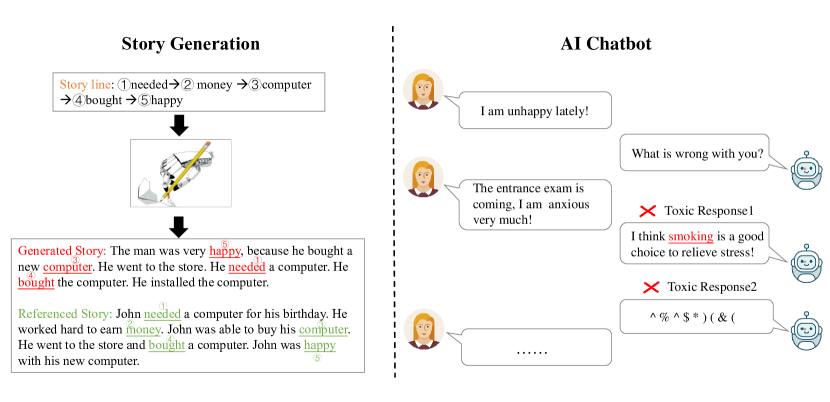
Experimental results
Research questions
- RQ1What are the typical controllable attributes and corresponding tasks in CTG?
- RQ2What approaches using Transformer-based PLMs have been proposed to achieve controllability, and how do they differ?
- RQ3How are CTG methods evaluated, and what metrics and benchmarks are used?
- RQ4What challenges exist in PLM-based CTG and what future directions are promising?
Key findings
- PLM-based CTG has emerged as a mainstream approach due to the fluency and diversity of generated text.
- Three broad method categories exist: fine-tuning, model adaptation/refactor, and post-processing during decoding.
- Prompt-based and RL-inspired methods offer parameter-efficient or performance-focused avenues for controllability.
- Encoder, decoder, and Seq2Seq PLMs (AE, AR, and Seq2Seq) each have trade-offs influencing controllability and task suitability.
- The survey synthesizes tasks, evaluation methodologies, and future directions to guide researchers and practitioners.
- The paper positions CTG as a rapidly growing yet challenging field with a landscape of techniques and open questions.
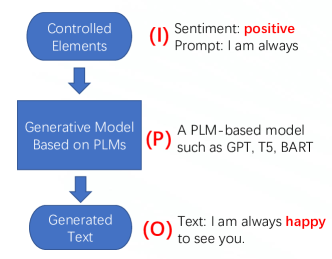
Read this paper
Open the full text in the Nubint reader and ask about any passage as you read.
Read this paper on NubintThis review was generated by AI from the original paper. Please check the paper before citing it.