
[Paper Review] A Survey of Distance-Based Vessel Trajectory Clustering: Data Pre-processing, Methodologies, Applications, and Experimental Evaluation
This survey presents a comprehensive analysis of distance-based vessel trajectory clustering, focusing on data pre-processing, trajectory similarity measurement, and clustering algorithms. It demonstrates that trajectory compression significantly improves clustering efficiency and accuracy, while interpolation offers minimal benefit, highlighting compression as a key enabler for scalable maritime traffic analysis in intelligent transportation systems.
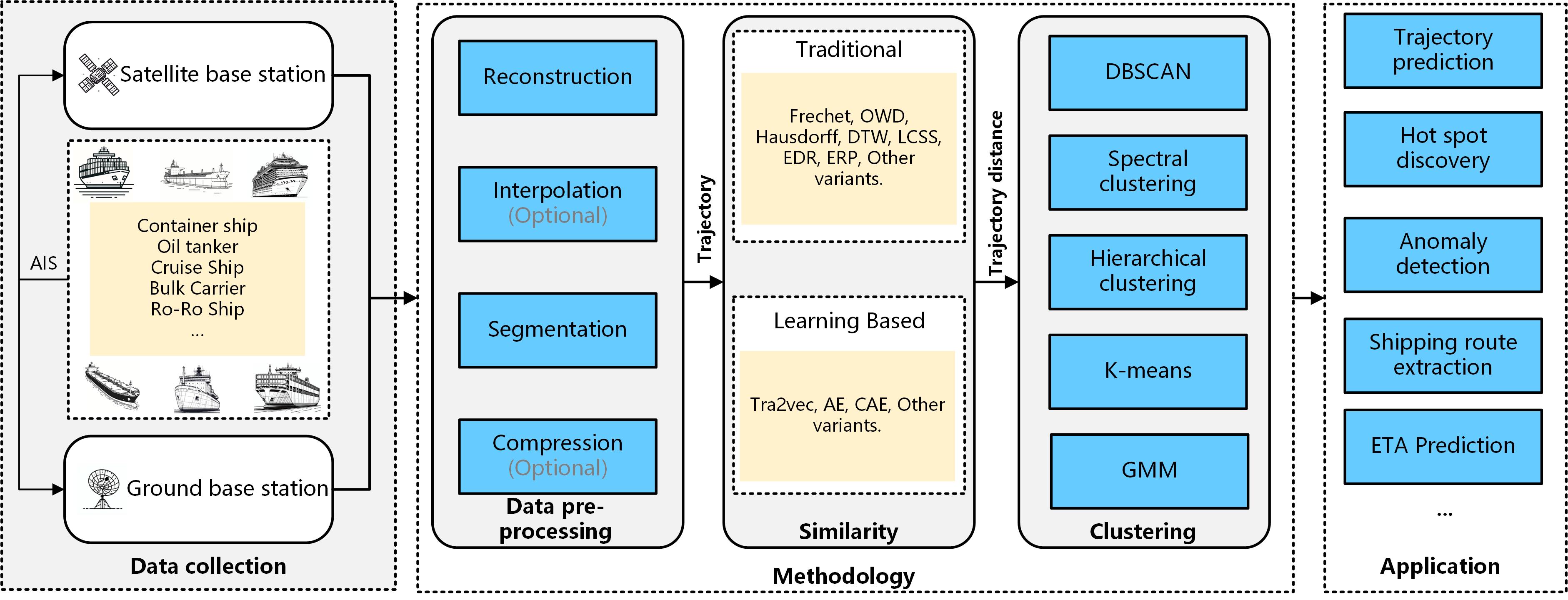
Vessel trajectory clustering, a crucial component of the maritime intelligent transportation systems, provides valuable insights for applications such as anomaly detection and trajectory prediction. This paper presents a comprehensive survey of the most prevalent distance-based vessel trajectory clustering methods, which encompass two main steps: trajectory similarity measurement and clustering. Initially, we conducted a thorough literature review using relevant keywords to gather and summarize pertinent research papers and datasets. Then, this paper discussed the principal methods of data pre-processing that prepare data for further analysis. The survey progresses to detail the leading algorithms for measuring vessel trajectory similarity and the main clustering techniques used in the field today. Furthermore, the various applications of trajectory clustering within the maritime context are explored. Finally, the paper evaluates the effectiveness of different algorithm combinations and pre-processing methods through experimental analysis, focusing on their impact on the performance of distance-based trajectory clustering algorithms. The experimental results demonstrate the effectiveness of various trajectory clustering algorithms and notably highlight the significant improvements that trajectory compression techniques contribute to the efficiency and accuracy of trajectory clustering. This comprehensive approach ensures a deep understanding of current capabilities and future directions in vessel trajectory clustering.
Motivation & Objective
- To address the lack of systematic reviews on distance-based vessel trajectory clustering, particularly focusing on pre-processing, similarity measurement, and clustering methodologies.
- To evaluate the impact of different pre-processing techniques—especially compression and interpolation—on clustering performance.
- To provide a benchmarked experimental evaluation of state-of-the-art distance-based clustering algorithms using real-world AIS data.
- To identify optimal algorithm combinations and pre-processing strategies for improved clustering accuracy and computational efficiency.
- To highlight the critical need for standardized datasets and benchmarks in vessel trajectory clustering research.
Proposed method
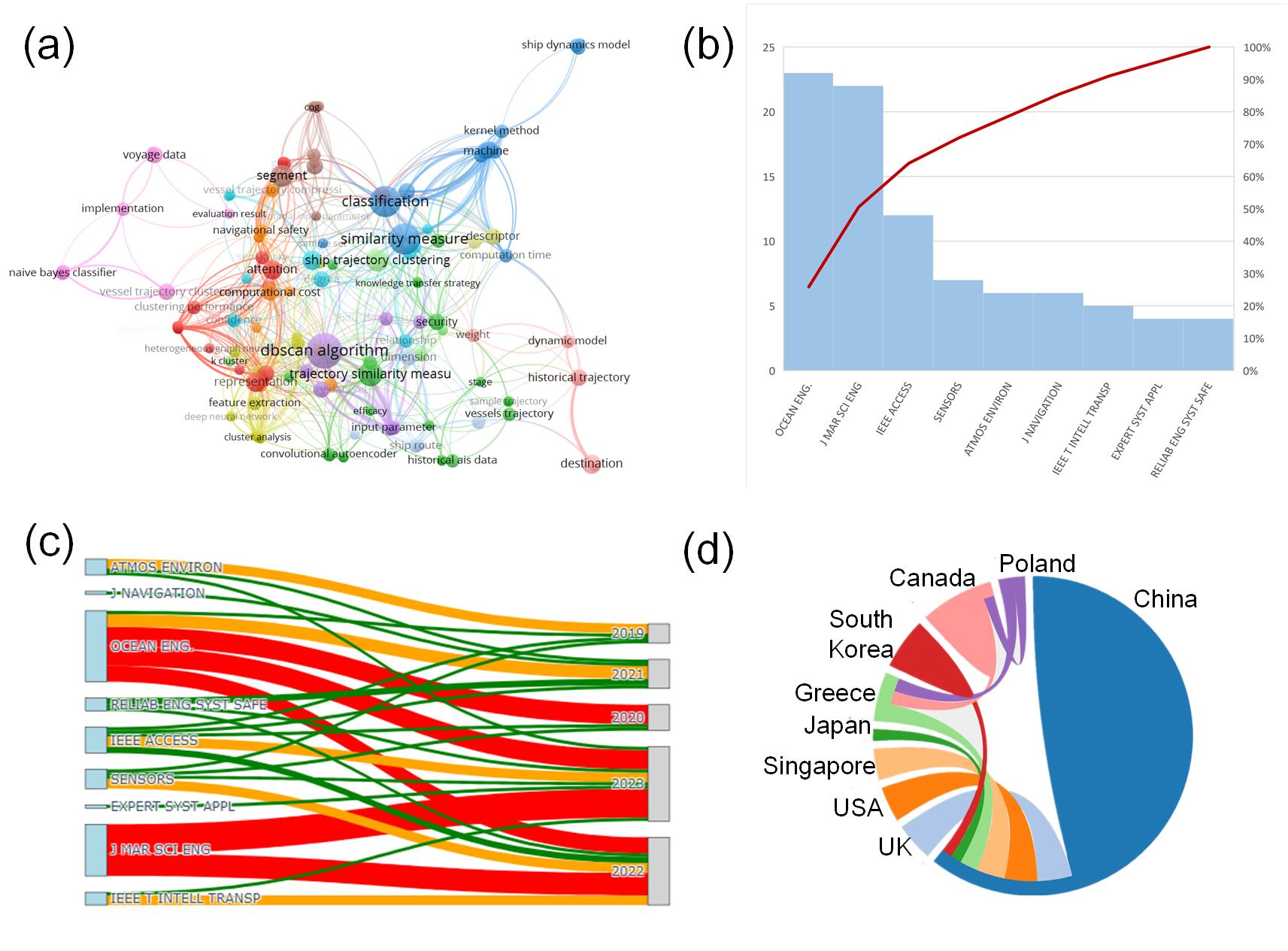
- Conducted a systematic literature review using keywords related to vessel trajectory clustering, similarity measurement, and clustering algorithms.
- Categorized and analyzed 100+ relevant studies to summarize pre-processing techniques, similarity metrics, and clustering methods.
- Evaluated trajectory similarity using Optimal Weighted Distance (OWD), Dynamic Time Warping (DTW), and Hausdorff Distance (HD) with varying parameter settings.
- Applied Douglas–Peucker compression and CSI interpolation for pre-processing, testing multiple compression ratios (20%, 50%, 80%) and interpolation intervals.
- Performed experimental evaluation using real AIS data, measuring clustering performance via adjusted Rand index (ARI), silhouette score, and computational time.
- Used HCA (Hierarchical Cluster Analysis) with average linkage as the clustering algorithm to assess stability and accuracy across different pre-processing and similarity combinations.
Experimental results
Research questions
- RQ1How do different pre-processing techniques—specifically trajectory compression and interpolation—affect the performance of distance-based vessel trajectory clustering?
- RQ2Which trajectory similarity measure (OWD, DTW, HD) delivers the most accurate and efficient clustering results in maritime contexts?
- RQ3What is the optimal compression ratio for balancing trajectory fidelity and computational efficiency in clustering?
- RQ4Does trajectory interpolation improve clustering accuracy, or does it degrade performance due to artifacts like the Runge phenomenon?
- RQ5How do combined algorithm pipelines (similarity measure + pre-processing + clustering) impact overall clustering effectiveness?
Key findings
- The Optimal Weighted Distance (OWD) method consistently outperformed DTW and HD in measuring trajectory similarity, delivering the highest clustering accuracy across all experiments.
- Trajectory compression with Douglas–Peucker at a 50% compression ratio yielded the best balance of accuracy and efficiency, improving clustering metrics without significant loss of trajectory shape.
- Compression reduced computational time significantly, demonstrating a strong positive impact on algorithm scalability.
- Interpolation using CSI did not improve clustering performance and sometimes worsened results due to the Runge phenomenon, particularly in curved or turning regions.
- The silhouette score and adjusted Rand index (ARI) were highest when using OWD with 50% compression, indicating superior cluster separation and internal cohesion.
- Despite widespread use, interpolation did not enhance clustering outcomes and was less efficient than compression, suggesting it is not a recommended pre-processing step for distance-based clustering.
Read this paper
Open the full text in the Nubint reader and ask about any passage as you read.
Read this paper on NubintThis review was generated by AI from the original paper. Please check the paper before citing it.