
[Paper Review] A Survey of Graph Retrieval-Augmented Generation for Customized Large Language Models
This survey analyzes graph retrieval-augmented generation (GraphRAG) for customizing LLMs, presenting a taxonomy, retrieval and integration techniques, domain applications, challenges, and future directions.
Large language models (LLMs) have demonstrated remarkable capabilities in a wide range of tasks, yet their application to specialized domains remains challenging due to the need for deep expertise. Retrieval-Augmented generation (RAG) has emerged as a promising solution to customize LLMs for professional fields by seamlessly integrating external knowledge bases, enabling real-time access to domain-specific expertise during inference. Despite its potential, traditional RAG systems, based on flat text retrieval, face three critical challenges: (i) complex query understanding in professional contexts, (ii) difficulties in knowledge integration across distributed sources, and (iii) system efficiency bottlenecks at scale. This survey presents a systematic analysis of Graph-based Retrieval-Augmented Generation (GraphRAG), a new paradigm that revolutionizes domain-specific LLM applications. GraphRAG addresses traditional RAG limitations through three key innovations: (i) graph-structured knowledge representation that explicitly captures entity relationships and domain hierarchies, (ii) efficient graph-based retrieval techniques that enable context-preserving knowledge retrieval with multihop reasoning ability, and (iii) structure-aware knowledge integration algorithms that leverage retrieved knowledge for accurate and logical coherent generation of LLMs. In this survey, we systematically analyze the technical foundations of GraphRAG and examine current implementations across various professional domains, identifying key technical challenges and promising research directions. All the related resources of GraphRAG, including research papers, open-source data, and projects, are collected for the community in https://github.com/DEEP-PolyU/Awesome-GraphRAG.
Motivation & Objective
- Explain why GraphRAG is needed to tailor LLMs to specialized domains.
- Present a structured taxonomy (Knowledge-based, Index-based, Hybrid GraphRAG) and compare it to traditional RAG.
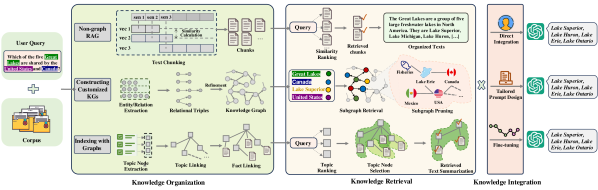
- Describe core components: knowledge organization, retrieval, and integration in GraphRAG.
- Survey practical implementations, datasets, benchmarks, and open-source resources across domains.
- Identify key challenges and propose promising research directions for GraphRAG systems.
Proposed method
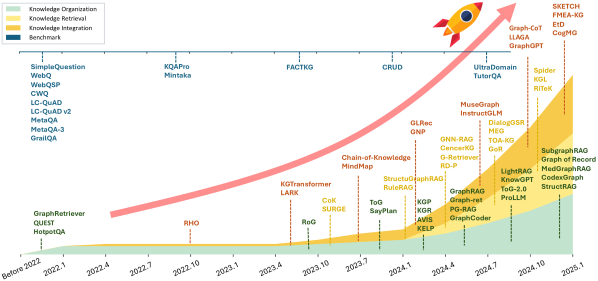
- Outline the evolution from traditional RAG to GraphRAG and formalize GraphRAG definitions.
- Classify GraphRAG approaches into three categories: Knowledge-based, Index-based, and Hybrid GraphRAG.
- Review retrieval techniques including graph-based planners and multi-hop reasoning for structured knowledge.
- Discuss knowledge integration strategies at node-, path-, and subgraph levels, plus in-context learning enhancements.
- Compile open-source projects, datasets, and domain-specific case studies supported by benchmarks.
- Highlight limitations and future directions in knowledge quality, retrieval efficiency, generalization, and security.
Experimental results
Research questions
- RQ1What is GraphRAG and how does it differ from traditional RAG in knowledge organization, retrieval, and integration?
- RQ2What are the main GraphRAG paradigms (Knowledge-based, Index-based, Hybrid) and their respective trade-offs?
- RQ3What retrieval techniques and planners are used for graph-structured knowledge, including multi-hop and reasoning capabilities?
- RQ4How can retrieved graph knowledge be integrated into LLM prompts effectively at different levels (node, path, subgraph)?
- RQ5What are current domain applications, datasets, benchmarks, and open-source resources for GraphRAG, and what challenges remain?
Key findings
- GraphRAG leverages graph-structured knowledge to capture complex relationships and enable context-preserving, multi-hop retrieval.
- There is a three-way taxonomy: Knowledge-based GraphRAG, Index-based GraphRAG, and Hybrid GraphRAG, each with distinct goals and mechanisms.
- GraphRAG improves retrieval efficiency and reasoning over distributed knowledge sources compared to flat-text RAG.
- The survey consolidates open-source projects, datasets, and domain-specific case studies to aid practical deployment.
- It identifies critical challenges such as knowledge quality, retrieval efficiency, system generalization, and security, and proposes directions for future research.
Read this paper
Open the full text in the Nubint reader and ask about any passage as you read.
Read this paper on NubintThis review was generated by AI from the original paper. Please check the paper before citing it.