
[Paper Review] A Survey of Hallucination in Large Foundation Models
A comprehensive survey of hallucination in large foundation models (LFMs) across text, image, video, and audio, detailing types, evaluation, detection, mitigation, datasets, and future directions.
Hallucination in a foundation model (FM) refers to the generation of content that strays from factual reality or includes fabricated information. This survey paper provides an extensive overview of recent efforts that aim to identify, elucidate, and tackle the problem of hallucination, with a particular focus on ``Large'' Foundation Models (LFMs). The paper classifies various types of hallucination phenomena that are specific to LFMs and establishes evaluation criteria for assessing the extent of hallucination. It also examines existing strategies for mitigating hallucination in LFMs and discusses potential directions for future research in this area. Essentially, the paper offers a comprehensive examination of the challenges and solutions related to hallucination in LFMs.
Motivation & Objective
- Categorize existing work on hallucination in LFMs.
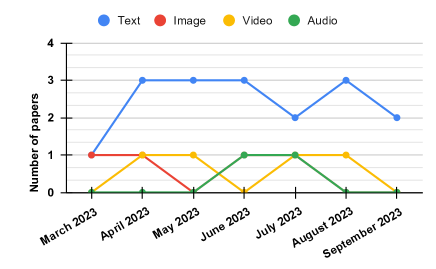
- Examine LFMs across text, image, video, and audio modalities.
- Summarize detection methods, mitigation strategies, tasks, datasets, and evaluation metrics.
- Propose future research directions and open-source resources.
Proposed method
- Classify LFMs into four modalities: text, image, video, and audio.
- Review detection, mitigation, tasks, datasets, and evaluation metrics for hallucination.
- Summarize modality-specific works and datasets (e.g., HaluEval, Med-HALT, M-HalDetect).
- Highlight prompting, external knowledge, grounding, and data-augmentation approaches for mitigation.
- Offer future directions including automated evaluation and curated knowledge sources.
Experimental results
Research questions
- RQ1What are the main types of hallucination observed in LFMs across different modalities?
- RQ2What detection and mitigation strategies are proposed for LFMs to reduce hallucinations?
- RQ3What datasets and evaluation metrics are used to assess hallucination across text, image, video, and audio?
- RQ4What future directions can advance reliable hallucination detection and mitigation in LFMs?
- RQ5How do domain-specific and multilingual LFMs differ in their hallucination profiles and remediation?
Key findings
- The survey provides a taxonomy of hallucination types and a cross-modal overview (text, image, video, audio) of LFMs.
- It catalogs detection methods, mitigation techniques, datasets, and evaluation metrics across modalities.
- It highlights notable benchmarks and datasets such as HaluEval, Med-HALT, HALO, M-HalDetect, and Lp-MusicCaps.
- It discusses prompting-based, knowledge-grounding, and external-knowledge integration as mitigation directions.
- It emphasizes future research directions in automated evaluation, knowledge-curation, and ethical considerations.
Better researchstarts right now
From reading papers to final review, dramatically reduce your research time.
No credit card · Free plan available
This review was created by AI and reviewed by human editors.