
[Paper Review] A Survey of Imitation Learning: Algorithms, Recent Developments, and Challenges
This survey provides a comprehensive, up-to-date overview of imitation learning (IL) in robotics and AI, covering core algorithms like behavioral cloning and inverse reinforcement learning, adversarial IL, and recent advances in cross-domain, cross-embodiment, and robust IL. It identifies key challenges such as imperfect demonstrations and domain shift, and outlines future research directions for scalable, generalizable IL systems.
In recent years, the development of robotics and artificial intelligence (AI) systems has been nothing short of remarkable. As these systems continue to evolve, they are being utilized in increasingly complex and unstructured environments, such as autonomous driving, aerial robotics, and natural language processing. As a consequence, programming their behaviors manually or defining their behavior through reward functions (as done in reinforcement learning (RL)) has become exceedingly difficult. This is because such environments require a high degree of flexibility and adaptability, making it challenging to specify an optimal set of rules or reward signals that can account for all possible situations. In such environments, learning from an expert's behavior through imitation is often more appealing. This is where imitation learning (IL) comes into play - a process where desired behavior is learned by imitating an expert's behavior, which is provided through demonstrations. This paper aims to provide an introduction to IL and an overview of its underlying assumptions and approaches. It also offers a detailed description of recent advances and emerging areas of research in the field. Additionally, the paper discusses how researchers have addressed common challenges associated with IL and provides potential directions for future research. Overall, the goal of the paper is to provide a comprehensive guide to the growing field of IL in robotics and AI.
Motivation & Objective
- To consolidate recent advances in imitation learning (IL) for researchers and practitioners in robotics and AI.
- To address the limitations of traditional reinforcement learning by offering IL as a scalable alternative that reduces reliance on reward engineering.
- To identify and analyze key challenges in IL, including imperfect demonstrations, domain shift, and embodiment differences.
- To provide a structured overview of IL approaches—behavioral cloning, inverse reinforcement learning, and adversarial imitation learning—along with their strengths and weaknesses.
- To guide future research by highlighting emerging trends and open problems in cross-domain, cross-embodiment, and robust IL.
Proposed method
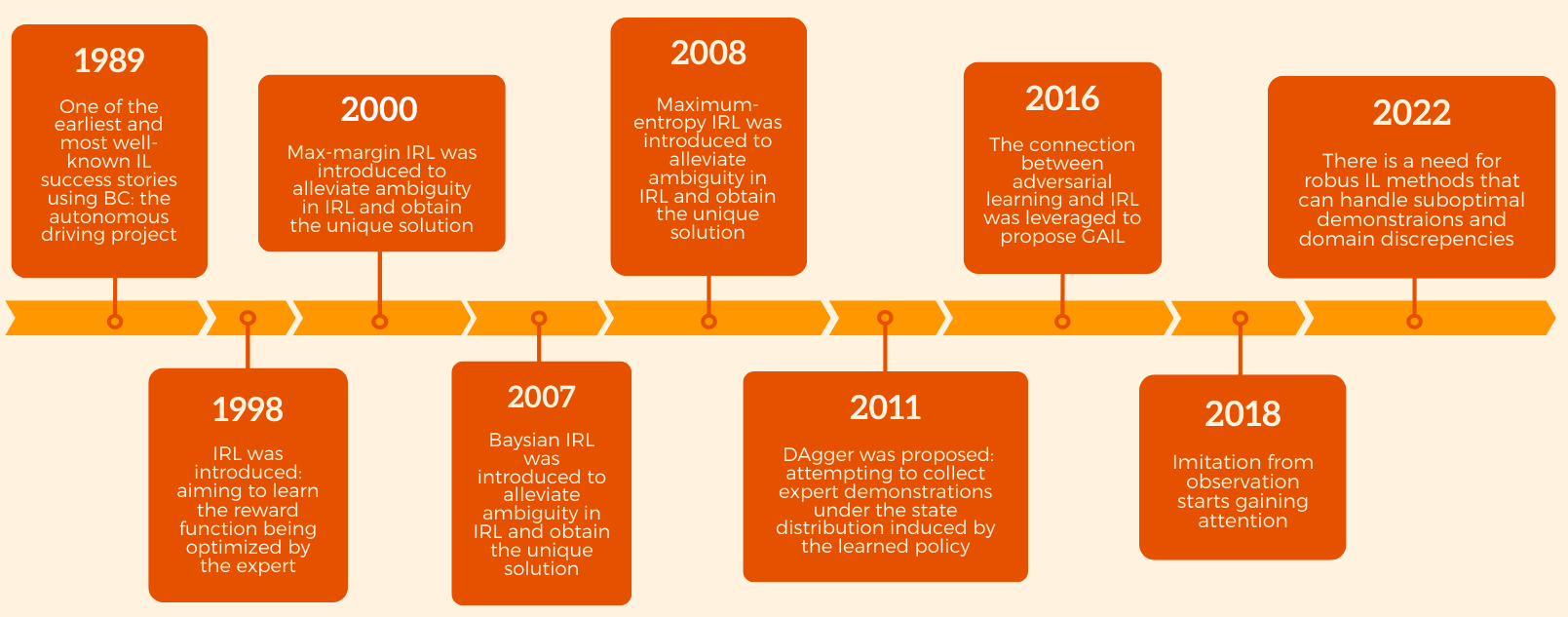
- Categorizes IL into three main paradigms: behavioral cloning (BC), inverse reinforcement learning (IRL), and adversarial imitation learning (AIL), based on learning objectives and formulations.
- Reviews recent methods that improve robustness to environment dynamics variation by minimizing Jensen-Shannon divergence between expert and agent policies across sampled dynamics.
- Examines cross-embodiment IL techniques such as XIRL, which uses temporal cycle consistency (TCC) to learn task-progress embeddings and distance-based rewards independent of agent embodiment.
- Introduces Gromov-Wasserstein-based methods that learn isometric transformations between expert and agent state-action occupancies to enable policy transfer without proxy tasks or explicit latent spaces.
- Proposes and analyzes the IfO (Imitation from Observations) framework for learning from state-only demonstrations, avoiding the need for action labels.
- Evaluates methods that use pseudo-rewards derived from structural preservation in state-action spaces to train policies via reinforcement learning in cross-domain settings.
Experimental results
Research questions
- RQ1How can imitation learning be made robust to variations in environment dynamics while using only a few demonstrations?
- RQ2What techniques enable effective policy transfer between agents with different embodiments, viewpoints, or dynamics?
- RQ3How can imitation learning be performed from imperfect or sparse demonstrations, including state-only observations?
- RQ4What role does structural preservation in state-action occupancy spaces play in enabling cross-domain imitation without explicit alignment?
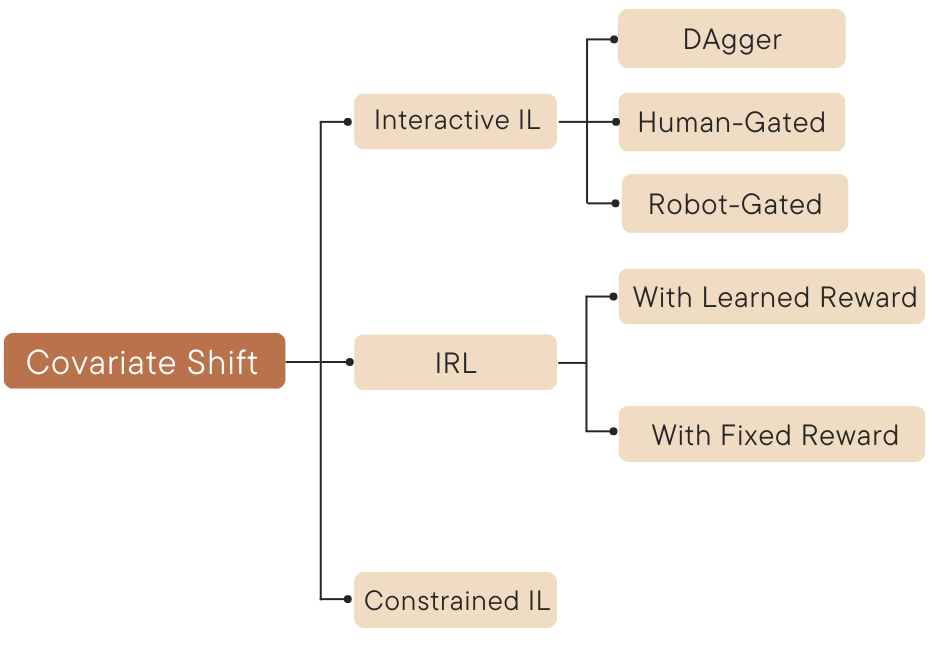
- RQ5How can the limitations of traditional IL—such as distribution shift and expert demonstration quality—be mitigated through novel algorithmic designs?
Key findings
- Adversarial imitation learning (AIL) and its variants have significantly improved policy generalization by leveraging generative adversarial networks to match expert behavior without explicit reward shaping.
- Cross-embodiment IRL (XIRL) successfully learns embodiment-invariant task representations using temporal cycle consistency (TCC) and goal-state distance in embedding space, enabling zero-shot transfer across diverse agents.
- Gromov-Wasserstein-based methods achieve effective policy transfer by preserving distance relationships between states and actions across domains, enabling imitation without proxy tasks or explicit latent space alignment.
- The framework of learning from observations (IfO) enables imitation from state-only demonstrations by modeling the policy as a conditional distribution over actions given states, reducing data requirements.
- Robust IL methods that minimize Jensen-Shannon divergence across multiple dynamics variations show improved generalization, with performance gains observed even under significant environmental perturbations.
- Despite progress, large-scale, diverse, and high-quality demonstrations remain a critical bottleneck, especially when dealing with real-world variability in expert behavior and video-based demonstrations.
Read this paper
Open the full text in the Nubint reader and ask about any passage as you read.
Read this paper on NubintThis review was generated by AI from the original paper. Please check the paper before citing it.