
[Paper Review] A Survey of Modern Deep Learning based Object Detection Models
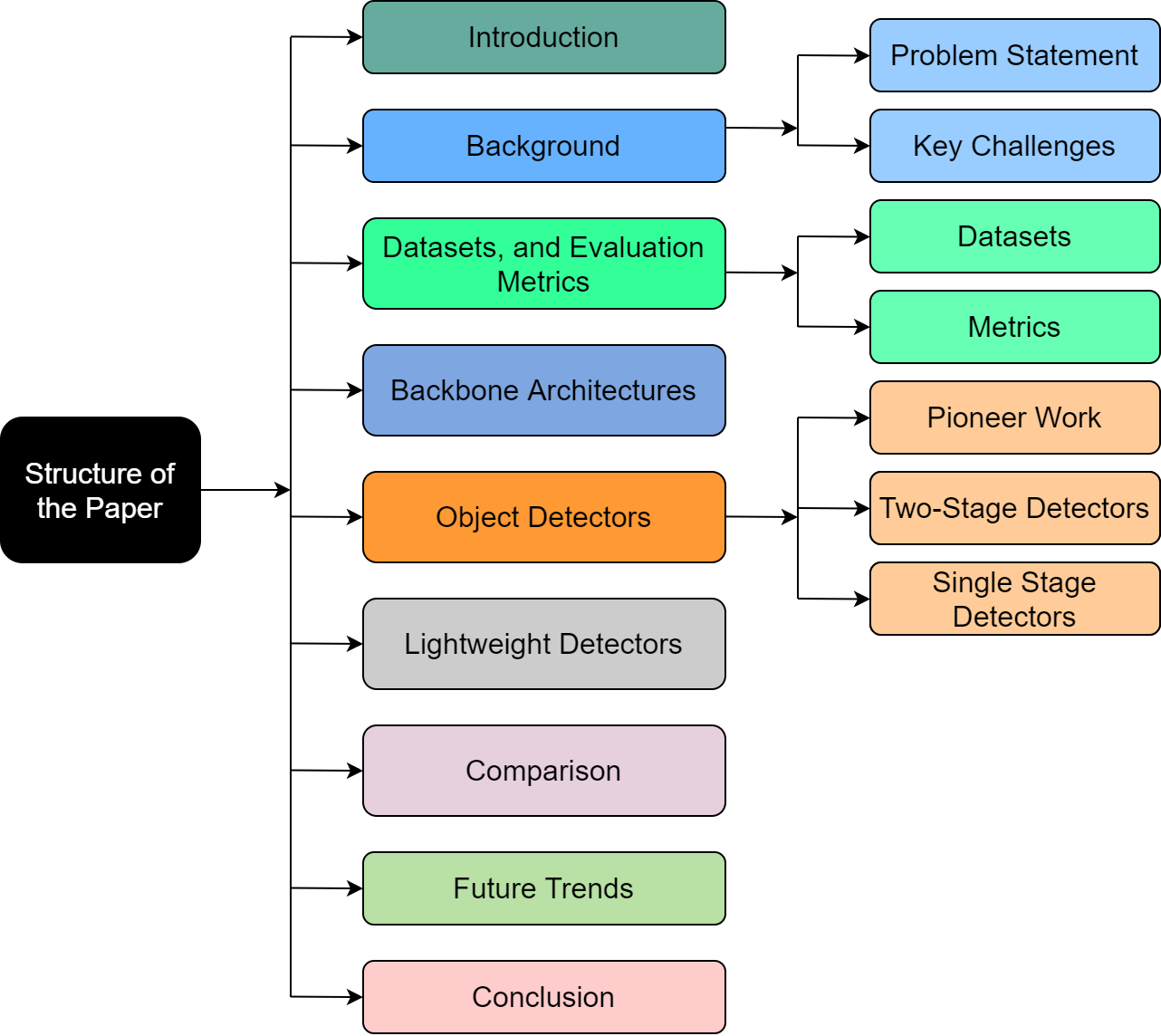
This survey provides a comprehensive analysis of modern deep learning-based object detection models, covering two-stage and single-stage detectors, backbone architectures, and lightweight models for edge deployment. It evaluates state-of-the-art models on PASCAL VOC and MS COCO benchmarks, highlighting performance trade-offs between accuracy (AP) and inference speed (FPS), with DetectoRS achieving 53.3% AP on COCO using ResNeXt-101.
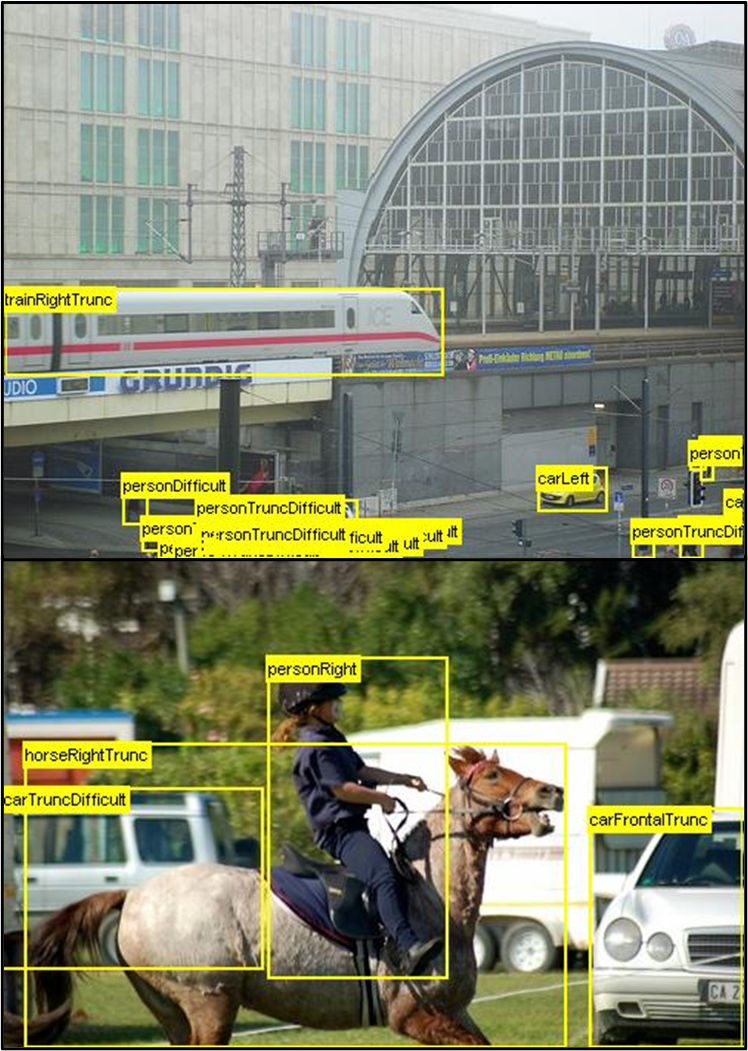
Object Detection is the task of classification and localization of objects in an image or video. It has gained prominence in recent years due to its widespread applications. This article surveys recent developments in deep learning based object detectors. Concise overview of benchmark datasets and evaluation metrics used in detection is also provided along with some of the prominent backbone architectures used in recognition tasks. It also covers contemporary lightweight classification models used on edge devices. Lastly, we compare the performances of these architectures on multiple metrics.
Motivation & Objective
- To provide a systematic review of recent advancements in deep learning-based object detection models, including both two-stage and single-stage detectors.
- To analyze and compare prominent backbone architectures used in modern object detectors, such as ResNet, ResNeXt, and Swin Transformers.
- To evaluate lightweight neural network models optimized for edge and mobile devices, focusing on efficiency and accuracy trade-offs.
- To present a comparative analysis of object detectors across multiple metrics, including mean average precision (AP), inference speed (FPS), and computational complexity.
- To identify current trends and future directions in object detection, particularly in efficiency, model compression, and hardware-aware design.
Proposed method
- The paper conducts a structured survey of object detection models, categorizing them into two-stage (e.g., Faster R-CNN, Mask R-CNN) and single-stage (e.g., YOLO, SSD, RetinaNet) detectors.
- It evaluates backbone networks such as ResNet, ResNeXt, EfficientNet, and Swin Transformers based on their performance in feature extraction for detection tasks.
- Lightweight models including MobileNet, ShuffleNet, SqueezeNet, and OFA are analyzed for their efficiency, with metrics like Top-1 accuracy, latency, parameters, and FLOPs.
- The study compares models on standard benchmarks—PASCAL VOC 2012 and MS COCO—using standard evaluation metrics: AP (IoU ≥ 0.5) and AP[0.5:0.95] for COCO.
- A comparative analysis is performed using reported results from original papers, focusing on accuracy (AP), inference speed (FPS), and model complexity (FLOPs).
- The Once-for-All (OFA) method is examined as a novel approach to efficient architecture design, enabling a single model to distill sub-networks with varying depth, width, and kernel size.
Experimental results
Research questions
- RQ1How do modern two-stage and single-stage object detection models compare in terms of accuracy and inference speed across standard benchmarks?
- RQ2Which backbone architectures deliver the best trade-off between accuracy and computational efficiency in object detection?
- RQ3How do lightweight models such as MobileNet, ShuffleNet, and OFA perform in terms of accuracy, latency, and FLOPs for edge deployment?
- RQ4What are the key performance differences between models trained on PASCAL VOC and MS COCO datasets, particularly regarding IoU thresholds and AP metrics?
- RQ5How does the Once-for-All (OFA) framework enable efficient model compression and hardware-aware architecture search without retraining?
Key findings
- DetectoRS achieved 53.3% AP on MS COCO using ResNeXt-101 and input size 1333, setting a new SOTA for two-stage detectors at the time of the survey.
- YOLOv4 achieved 43.0% AP and 64.9% AP on MS COCO with 31 FPS inference speed, demonstrating strong real-time performance.
- EfficientDet-D2 achieved 43.0% AP and 62.3% AP on COCO with 41.7 FLOPs, showing high efficiency and accuracy balance.
- OFA achieved 80.0% ImageNet Top-1 accuracy with 58ms latency and 595 MFLOPs, winning the 4th Low Power Computer Vision Challenge.
- Lightweight models like MobileNetV3 and OFA achieved over 75% Top-1 accuracy with under 600 MFLOPs, making them suitable for mobile and edge devices.
- CenterNet achieved 42.1% AP and 61.1% AP on COCO with 7.8 FPS, demonstrating strong performance in keypoint-based detection.
Read this paper
Open the full text in the Nubint reader and ask about any passage as you read.
Read this paper on NubintThis review was generated by AI from the original paper. Please check the paper before citing it.