
[Paper Review] A Survey of Progress on Cooperative Multi-agent Reinforcement Learning in Open Environment
This paper surveys recent advances in cooperative multi-agent reinforcement learning (MARL), emphasizing open-environment settings, key methods, test environments, and future research directions.
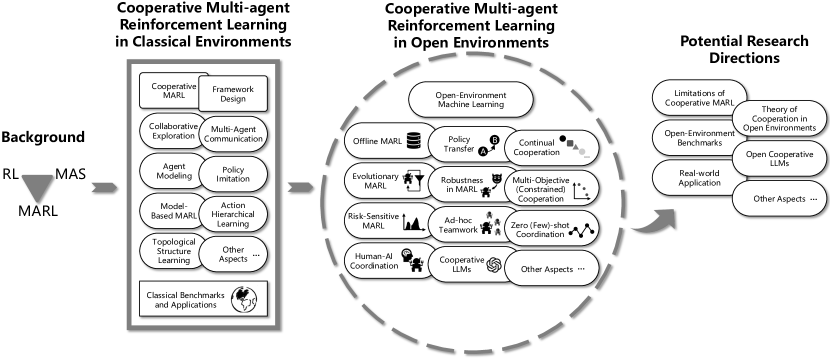
Multi-agent Reinforcement Learning (MARL) has gained wide attention in recent years and has made progress in various fields. Specifically, cooperative MARL focuses on training a team of agents to cooperatively achieve tasks that are difficult for a single agent to handle. It has shown great potential in applications such as path planning, autonomous driving, active voltage control, and dynamic algorithm configuration. One of the research focuses in the field of cooperative MARL is how to improve the coordination efficiency of the system, while research work has mainly been conducted in simple, static, and closed environment settings. To promote the application of artificial intelligence in real-world, some research has begun to explore multi-agent coordination in open environments. These works have made progress in exploring and researching the environments where important factors might change. However, the mainstream work still lacks a comprehensive review of the research direction. In this paper, starting from the concept of reinforcement learning, we subsequently introduce multi-agent systems (MAS), cooperative MARL, typical methods, and test environments. Then, we summarize the research work of cooperative MARL from closed to open environments, extract multiple research directions, and introduce typical works. Finally, we summarize the strengths and weaknesses of the current research, and look forward to the future development direction and research problems in cooperative MARL in open environments.
Motivation & Objective
- Introduce foundational concepts of reinforcement learning and multi-agent systems relevant to cooperative MARL.
- Review cooperative MARL methods and their performance in classical closed environments.
- Summarize emerging work on cooperative MARL in open environments and identify research directions and challenges.
Proposed method
- Review and categorize core MARL methods (policy gradient, value-based, and actor-critic) and their extensions.
- Explain open-environment challenges including non-stationarity, credit assignment, and scaling in MAS.
- Summarize testbeds, environments, and application domains used for cooperative MARL.
- Outline future directions and potential research problems in open environments.
Experimental results
Research questions
- RQ1What are the mainstream cooperative MARL methods and how do they address coordination and credit assignment?
- RQ2How do open-environment factors affect MARL, and what work exists to tackle these challenges?
- RQ3What are common test environments and application domains for cooperative MARL in open environments?
- RQ4What are the gaps and future directions for making cooperative MARL practical in real-world open settings?
Key findings
- The survey identifies common MARL approaches (e.g., MADDPG, MAPPO, VDN, QMIX) and their roles in cooperative settings.
- Open-environment MARL research is still limited and continuing to explore robustness, continual learning, generalization, and sim-to-real transfer.
- There is a focus on communication, offline policy deployment, world models, and training paradigms to enhance coordination.
- The paper discusses open-environment concepts like Ad-Hoc Teamwork, Zero-Shot Coordination, and Few-Shot Teamwork as settings of interest.
- It outlines standard backgrounds in RL, MAS, game theory, and stochastic games to ground MARL developments.
Read this paper
Open the full text in the Nubint reader and ask about any passage as you read.
Read this paper on NubintThis review was generated by AI from the original paper. Please check the paper before citing it.