
[Paper Review] A Survey of Resource-efficient LLM and Multimodal Foundation Models
A comprehensive survey on algorithmic and system-level approaches to making large language models, vision transformers, diffusion, and multimodal foundation models more resource-efficient across training, inference, and deployment, from cloud to edge.
Large foundation models, including large language models (LLMs), vision transformers (ViTs), diffusion, and LLM-based multimodal models, are revolutionizing the entire machine learning lifecycle, from training to deployment. However, the substantial advancements in versatility and performance these models offer come at a significant cost in terms of hardware resources. To support the growth of these large models in a scalable and environmentally sustainable way, there has been a considerable focus on developing resource-efficient strategies. This survey delves into the critical importance of such research, examining both algorithmic and systemic aspects. It offers a comprehensive analysis and valuable insights gleaned from existing literature, encompassing a broad array of topics from cutting-edge model architectures and training/serving algorithms to practical system designs and implementations. The goal of this survey is to provide an overarching understanding of how current approaches are tackling the resource challenges posed by large foundation models and to potentially inspire future breakthroughs in this field.
Motivation & Objective
- Assess the resource challenges posed by large foundation models and the need for efficiency.
- Survey algorithmic and systemic approaches to reduce compute, memory, energy, and bandwidth without sacrificing performance.
- Categorize advances in model architectures, training and inference methods, data management, and deployment systems.
- Bridge insights from language, vision, and multimodal foundation models to guide future research and practical implementations.
Proposed method
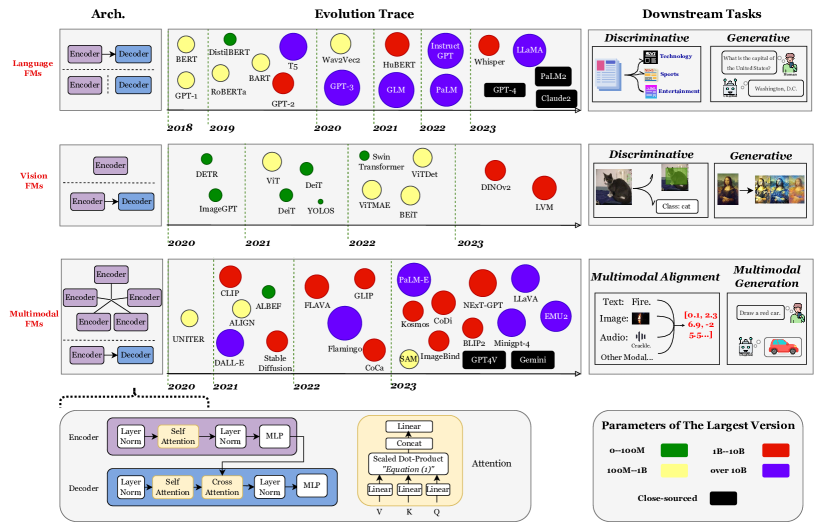
- Catalog architectures and representative models across language, vision, and multimodal foundations.
- Analyze cost factors and efficiency challenges, including attention, FFN, and KV caching implications.
- Summarize resource-efficient architectures (e.g., efficient attention variants, Mixture of Experts, diffusion optimizations) and data/training tricks.
- Outline resource-efficient algorithms for pre-training, fine-tuning, and inference (e.g., data reduction, mixed precision, progressive learning, pruning, quantization).
- Describe resource-efficient systems aspects from distributed training to edge deployment and serving.

Experimental results
Research questions
- RQ1What are the dominant resource bottlenecks in current language, vision, and multimodal foundation models?
- RQ2What architecture and system-level strategies exist to improve efficiency in training and deployment?
- RQ3How do design choices in pre-training, fine-tuning, and inference affect resource usage across modalities?
- RQ4What are practical guidelines for deploying resource-efficient foundation models from cloud to edge?
Key findings
- Foundational models achieve high versatility but incur substantial hardware and energy costs during training and serving.
- A variety of efficiency approaches target attention, data throughput, and model architecture (e.g., sparse/approximate attention, Mixture of Experts, diffusion in latent space).
- Resource-aware training and inference techniques (mixed precision, data reduction, progressive learning, efficient fine-tuning) can reduce compute and memory without uniformly sacrificing performance.
- System-level design choices (distributed training, federated learning, cloud vs edge deployment) critically impact practicality and energy use.
- The survey consolidates architectures, algorithms, and systems design to guide future work toward scalable and sustainable foundation models.
Read this paper
Open the full text in the Nubint reader and ask about any passage as you read.
Read this paper on NubintThis review was generated by AI from the original paper. Please check the paper before citing it.