
[Paper Review] A Survey on Automated Program Repair Techniques
This survey classifies Automated Program Repair (APR) techniques into four generations—search-based, constraint-based, template-based, and learning-based—and analyzes their development, evaluation criteria, and future directions, with emphasis on data-driven and deep-learning approaches.
With the rapid development and large-scale popularity of program software, modern society increasingly relies on software systems. However, the problems exposed by software have also come to the fore. Software defect has become an important factor troubling developers. In this context, Automated Program Repair (APR) techniques have emerged, aiming to automatically fix software defect problems and reduce manual debugging work. In particular, benefiting from the advances in deep learning, numerous learning-based APR techniques have emerged in recent years, which also bring new opportunities for APR research. To give researchers a quick overview of APR techniques' complete development and future opportunities, we revisit the evolution of APR techniques and discuss in depth the latest advances in APR research. In this paper, the development of APR techniques is introduced in terms of four different patch generation schemes: search-based, constraint-based, template-based, and learning-based. Moreover, we propose a uniform set of criteria to review and compare each APR tool, summarize the advantages and disadvantages of APR techniques, and discuss the current state of APR development. Furthermore, we introduce the research on the related technical areas of APR that have also provided a strong motivation to advance APR development. Finally, we analyze current challenges and future directions, especially highlighting the critical opportunities that large language models bring to APR research.
Motivation & Objective
- Provide a systematic taxonomy of APR techniques and trace their historical development.
- Propose a uniform evaluation framework to compare APR tools across dimensions of approach, repair ability, quality, and efficiency.
- Highlight recent data-driven and learning-based APR advances and their impact on repair quality and scalability.
- Discuss challenges in empirical evaluation, dataset quality, and the role of large language models in APR research.
Proposed method
- Classify APR techniques into four categories: search-based, constraint-based, template-based, and learning-based.
- Propose a uniform, multi-dimensional evaluation criteria covering Approach Design, Repair Ability, Repair Quality, and Repair Efficiency.
- Review APR techniques in time order and summarize strengths and limitations of each category.
- Highlight issues in empirical evaluation such as dataset overlap and fairness of comparisons.
- Discuss the impact and potential of large language models (LLMs) and data-driven approaches on APR research.
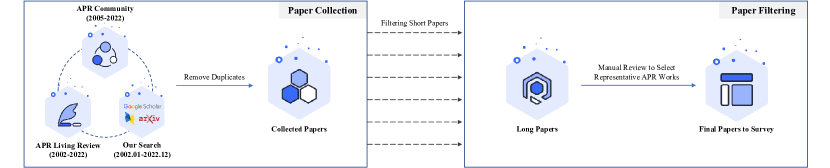
Experimental results
Research questions
- RQ1How have APR techniques evolved across the four patch-generation schemes in response to software defects?
- RQ2What evaluation criteria best compare APR tools across design, capability, quality, and efficiency?
- RQ3What are the key advantages and drawbacks of each APR category, especially in data-driven and learning-based methods?
- RQ4What are the major challenges and opportunities for future APR research, including industrial deployment and LLM integration.
Key findings
- APR techniques are organized into four generation families: search-based, constraint-based, template-based, and learning-based, with learning-based methods increasingly prominent.
- A uniform evaluation framework with 12 metrics across four dimensions is proposed to compare APR tools in a structured way.
- Learning-based APR approaches enable empirical knowledge acquisition from repair data, potentially improving repair scope and quality over time.
- The survey notes challenges in empirical studies, such as unfair comparisons and dataset quality, and emphasizes the need for standardized benchmarks.
- The authors discuss the critical role of large language models and data-driven methods as future directions for APR development.
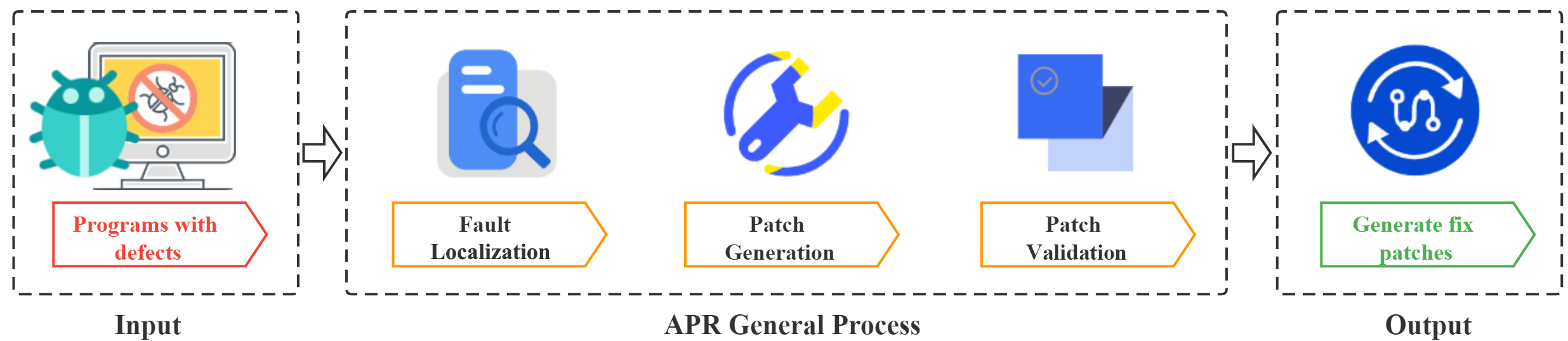
Read this paper
Open the full text in the Nubint reader and ask about any passage as you read.
Read this paper on NubintThis review was generated by AI from the original paper. Please check the paper before citing it.