
[Paper Review] A Survey on Causal Discovery Methods for I.I.D. and Time Series Data
This survey comprehensively reviews causal discovery methods for both I.I.D. and time series data, detailing algorithms, assumptions, benchmarks, tools, and applications, and discusses challenges and future directions.
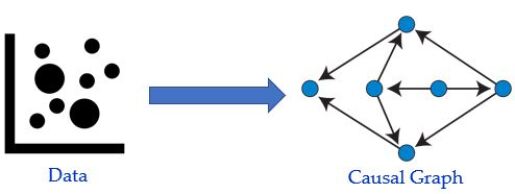
The ability to understand causality from data is one of the major milestones of human-level intelligence. Causal Discovery (CD) algorithms can identify the cause-effect relationships among the variables of a system from related observational data with certain assumptions. Over the years, several methods have been developed primarily based on the statistical properties of data to uncover the underlying causal mechanism. In this study, we present an extensive discussion on the methods designed to perform causal discovery from both independent and identically distributed (I.I.D.) data and time series data. For this purpose, we first introduce the common terminologies used in causal discovery literature and then provide a comprehensive discussion of the algorithms designed to identify causal relations in different settings. We further discuss some of the benchmark datasets available for evaluating the algorithmic performance, off-the-shelf tools or software packages to perform causal discovery readily, and the common metrics used to evaluate these methods. We also evaluate some widely used causal discovery algorithms on multiple benchmark datasets and compare their performances. Finally, we conclude by discussing the research challenges and the applications of causal discovery algorithms in multiple areas of interest.
Motivation & Objective
- Summarize the spectrum of causal discovery approaches for I.I.D. data and time series data.
- Clarify terminologies, models, and underlying assumptions used in causal discovery.
- Discuss benchmark datasets, evaluation metrics, and available software tools.
- Evaluate representative causal discovery algorithms on standard datasets to illustrate performance.
- Identify challenges and potential applications across domains with guidelines for future research.
Proposed method
- Classify causal discovery methods by core strategies: constraint-based, score-based, functional causal models (FCMs), gradient-based, and miscellaneous.
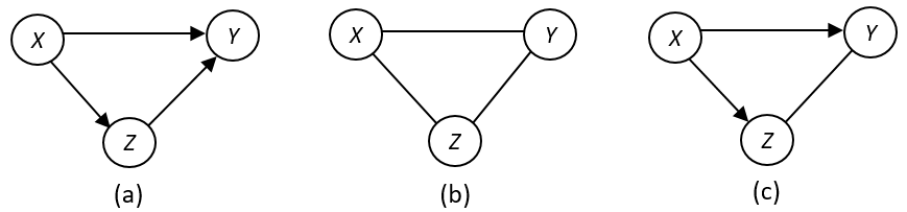
- Explain key graphical-model concepts (DAGs, PDAGs, CPDAGs, MAGs, PAGs) and Markov equivalence.
- Describe conditional independence testing (CI tests) and d-separation as foundational tools.
- Summarize how acyclicity and other causal assumptions (CMC, CFC, causal sufficiency) are enforced in different methods.
- Survey time-series specific approaches and the role of prior knowledge in structure recovery.
Experimental results
Research questions
- RQ1What are the main methodological families used for causal discovery in I.I.D. data and in time series data?
- RQ2How do these methods compare in terms of assumptions, output graphs, and computational properties?
- RQ3What datasets, benchmarks, metrics, and tools are commonly used to evaluate causal discovery methods?
- RQ4What are the current challenges and practical applications of causal discovery across fields?
- RQ5How can prior knowledge be integrated to improve causal discovery performance?
Key findings
- The paper provides an extensive taxonomy of causal discovery methods including constraint-based, score-based, FCM-based, gradient-based, hybrid, continuous-optimization, prior-knowledge-based, and miscellaneous approaches for both I.I.D. and time series data.
- It introduces and explains foundational concepts such as DAGs, PDAGs, CPDAGs, MAGs, PAGs, d-separation, and Markov equivalence, and discusses their relevance to CD outputs.
- Conditional independence testing and the d-separation framework are central to many constraint-based methods, with a wide range of CI tests surveyed.
- The survey covers common assumptions (CMC, CFC, causal sufficiency, acyclicity) and discusses how these influence method applicability and performance in practice.
- Benchmark datasets, metrics, and open-source tools are discussed to aid researchers in evaluating and applying causal discovery methods.
Read this paper
Open the full text in the Nubint reader and ask about any passage as you read.
Read this paper on NubintThis review was generated by AI from the original paper. Please check the paper before citing it.