
[Paper Review] A Survey on Data Selection for Language Models
This paper provides a comprehensive review of data selection methods for language models, offering a unified framework, a taxonomy, and guidance on future research across pretraining, instruction-tuning, alignment, and related areas.
A major factor in the recent success of large language models is the use of enormous and ever-growing text datasets for unsupervised pre-training. However, naively training a model on all available data may not be optimal (or feasible), as the quality of available text data can vary. Filtering out data can also decrease the carbon footprint and financial costs of training models by reducing the amount of training required. Data selection methods aim to determine which candidate data points to include in the training dataset and how to appropriately sample from the selected data points. The promise of improved data selection methods has caused the volume of research in the area to rapidly expand. However, because deep learning is mostly driven by empirical evidence and experimentation on large-scale data is expensive, few organizations have the resources for extensive data selection research. Consequently, knowledge of effective data selection practices has become concentrated within a few organizations, many of which do not openly share their findings and methodologies. To narrow this gap in knowledge, we present a comprehensive review of existing literature on data selection methods and related research areas, providing a taxonomy of existing approaches. By describing the current landscape of research, this work aims to accelerate progress in data selection by establishing an entry point for new and established researchers. Additionally, throughout this review we draw attention to noticeable holes in the literature and conclude the paper by proposing promising avenues for future research.
Motivation & Objective
- Provide a unified view of data selection methods across language model training stages.
- Introduce a taxonomy and a unified conceptual framework to compare data selection approaches.
- Identify key design dimensions and tradeoffs in data selection.
- Survey data selection techniques for pretraining and for other training regimes (instruction-tuning, alignment, etc.).
- Highlight gaps in the literature and propose promising directions for future work.
Proposed method
- Propose a formal data selection framework with a utility function and a selection mechanism.
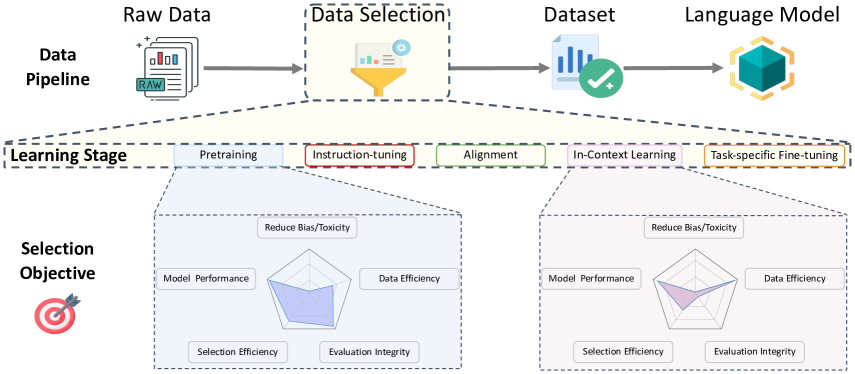
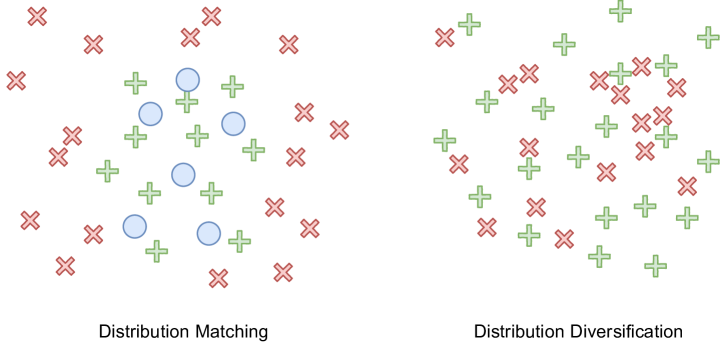
- Classify data selection methods along dimensions such as distribution matching vs diversification, data point vs dataset adjustments, and binary vs natural-number outputs.
- Organize the survey by training stage (pretraining, instruction-tuning, alignment, etc.) and discuss representative methods for each stage.
- Provide a taxonomy and a narrative review of language filtering, heuristic approaches, data quality, deduplication, toxicity filtering, multilingual filtering, and data mixing.
- Identify practical considerations, tradeoffs, and tools relevant to applying data selection in real-world settings.
Experimental results
Research questions
- RQ1What are the existing data selection methods for language models and how can they be categorized within a unified framework?
- RQ2How do data selection objectives differ across training stages (pretraining, instruction-tuning, alignment, in-context learning, task-specific fine-tuning) and what tradeoffs arise?
- RQ3What gaps and open questions exist in the literature, and what future directions appear most promising for data selection research?
Key findings
- The authors present a unified conceptual framework and taxonomy that contrasts distribution matching with diversification and distinguishes data-point versus dataset-level adjustments.
- They survey a wide range of methods for pretraining data selection, including language filtering, heuristic filtering, data quality, deduplication, and toxicity filtering, among others.
- The paper highlights the stage-specific goals of data selection (e.g., efficiency and performance in pretraining; targeted signals in fine-tuning) and discusses practical tradeoffs and challenges in applying filters at scale.
- They identify holes in the literature, such as the need for better multilingual code-data detection within mixed documents and the shifting landscape of data sources, and propose directions for accelerating research and improving understanding of target distributions.
- The review emphasizes the consideration of evaluation integrity, memorization vs generalization, and compute-time shifts from model training to data processing as important factors in data selection.
Read this paper
Open the full text in the Nubint reader and ask about any passage as you read.
Read this paper on NubintThis review was generated by AI from the original paper. Please check the paper before citing it.