
[Paper Review] A Survey on Deep Neural Network Pruning-Taxonomy, Comparison, Analysis, and Recommendations
A comprehensive survey of deep neural network pruning, proposing a taxonomy, conducting comparative analyses across pruning paradigms, and offering recommendations and future directions.
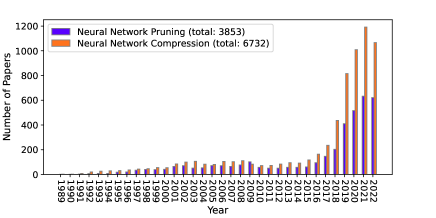
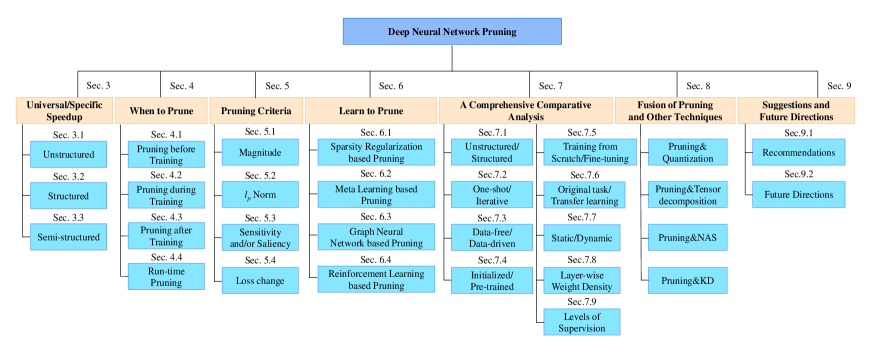
Modern deep neural networks, particularly recent large language models, come with massive model sizes that require significant computational and storage resources. To enable the deployment of modern models on resource-constrained environments and accelerate inference time, researchers have increasingly explored pruning techniques as a popular research direction in neural network compression. However, there is a dearth of up-to-date comprehensive review papers on pruning. To address this issue, in this survey, we provide a comprehensive review of existing research works on deep neural network pruning in a taxonomy of 1) universal/specific speedup, 2) when to prune, 3) how to prune, and 4) fusion of pruning and other compression techniques. We then provide a thorough comparative analysis of eight pairs of contrast settings for pruning and explore emerging topics, including pruning for large language models, large multimodal models, post-training pruning, and different supervision levels for pruning to shed light on the commonalities and differences of existing methods and lay the foundation for further method development. To facilitate future research, we build a curated collection of datasets, networks, and evaluations on different applications. Finally, we provide valuable recommendations on selecting pruning methods and prospect several promising research directions. We build a repository at https://github.com/hrcheng1066/awesome-pruning.
Motivation & Objective
- Provide a unified taxonomy of deep neural network pruning covering speedup universality, timing, and criteria or learning-based pruning.
- Compare seven pairs of pruning settings (unstructured vs structured, one-shot vs iterative, data-free vs data-driven, initialized vs pretrained) and analyze their implications.
- Review pruning-before-training, pruning-during-training, pruning-after-training, and dynamic run-time pruning to clarify practical pipelines.
- Summarize pruning applications, datasets, networks, and evaluation benchmarks to guide practitioners.
- Offer recommendations on method selection and highlight promising directions for neural network pruning research.
Proposed method
- Develop a taxonomy organized around three questions: universal vs specific speedup, when to prune (before/during/after training, static vs dynamic), and prune criteria vs learning-driven approaches.
- Provide formal definitions and classifications for unstructured, semi-structured, and structured pruning, including the notions of pruning masks, layer-wise vs global pruning, and dynamic versus static pruning.
- Analyze representative pruning methods and experimental setups across prior work, including data-free and data-driven criteria, sparsity regularization, and dynamic sparse training paradigms.
- Synthesize a comparative analysis across multiple pruning paradigms and discuss the effects on training, inference, and hardware compatibility.
- Curate applications, datasets, networks, and evaluation resources, and maintain an online repository for open-source pruning papers and codes.
Experimental results
Research questions
- RQ1What are the core dimensions (speedup universality, timing, and pruning criteria) that effectively categorize deep neural network pruning methods?
- RQ2How do unstructured, semi-structured, and structured pruning compare in terms of performance, hardware compatibility, and accuracy under various training pipelines?
- RQ3What are the practical implications of pruning before, during, or after training, including static versus dynamic pruning?
- RQ4What insights emerge when comparing data-free versus data-driven pruning and initialization versus pretrained weight pruning?
- RQ5What recommendations emerge for selecting pruning methods and directions for future research across applications?
Key findings
- Pruning can be categorized into unstructured (weight-wise), semi-structured (pattern-based), and structured (coarse-grained) pruning, with universal speedup achievable only by fully structured pruning.
- Static pruning pipelines (before/during/after training) are contrasted with dynamic run-time pruning, each with distinct trade-offs in efficiency and accuracy.
- Pruning criteria (e.g., magnitude, gradient, regularization-based scores) and learning-based pruning methods offer different advantages, including data-free and data-driven approaches.
- A wide range of pruning applications and benchmarks are summarized, and a repository of pruning papers and codes is provided for ongoing research.
- The survey includes comparative experiments across seven pairs of contrast settings to illuminate practical performance and robustness differences.
Read this paper
Open the full text in the Nubint reader and ask about any passage as you read.
Read this paper on NubintThis review was generated by AI from the original paper. Please check the paper before citing it.