
[Paper Review] A Survey on Explainability of Graph Neural Networks
This survey provides a comprehensive taxonomy of explainability methods for Graph Neural Networks (GNNs), covering both factual and counterfactual approaches, and discusses evaluation metrics and datasets.
Graph neural networks (GNNs) are powerful graph-based deep-learning models that have gained significant attention and demonstrated remarkable performance in various domains, including natural language processing, drug discovery, and recommendation systems. However, combining feature information and combinatorial graph structures has led to complex non-linear GNN models. Consequently, this has increased the challenges of understanding the workings of GNNs and the underlying reasons behind their predictions. To address this, numerous explainability methods have been proposed to shed light on the inner mechanism of the GNNs. Explainable GNNs improve their security and enhance trust in their recommendations. This survey aims to provide a comprehensive overview of the existing explainability techniques for GNNs. We create a novel taxonomy and hierarchy to categorize these methods based on their objective and methodology. We also discuss the strengths, limitations, and application scenarios of each category. Furthermore, we highlight the key evaluation metrics and datasets commonly used to assess the explainability of GNNs. This survey aims to assist researchers and practitioners in understanding the existing landscape of explainability methods, identifying gaps, and fostering further advancements in interpretable graph-based machine learning.
Motivation & Objective
- Motivate the need for explainability in GNNs due to their complex non-linear structure.
- Provide a novel taxonomy categorizing explainability methods by objective and methodology.
- Summarize strengths, limitations, and application scenarios of each category.
- Highlight evaluation metrics and commonly used datasets for assessing GNN explainability.
- Bridge gaps left by prior surveys that focus on only factual or counterfactual methods.
Proposed method
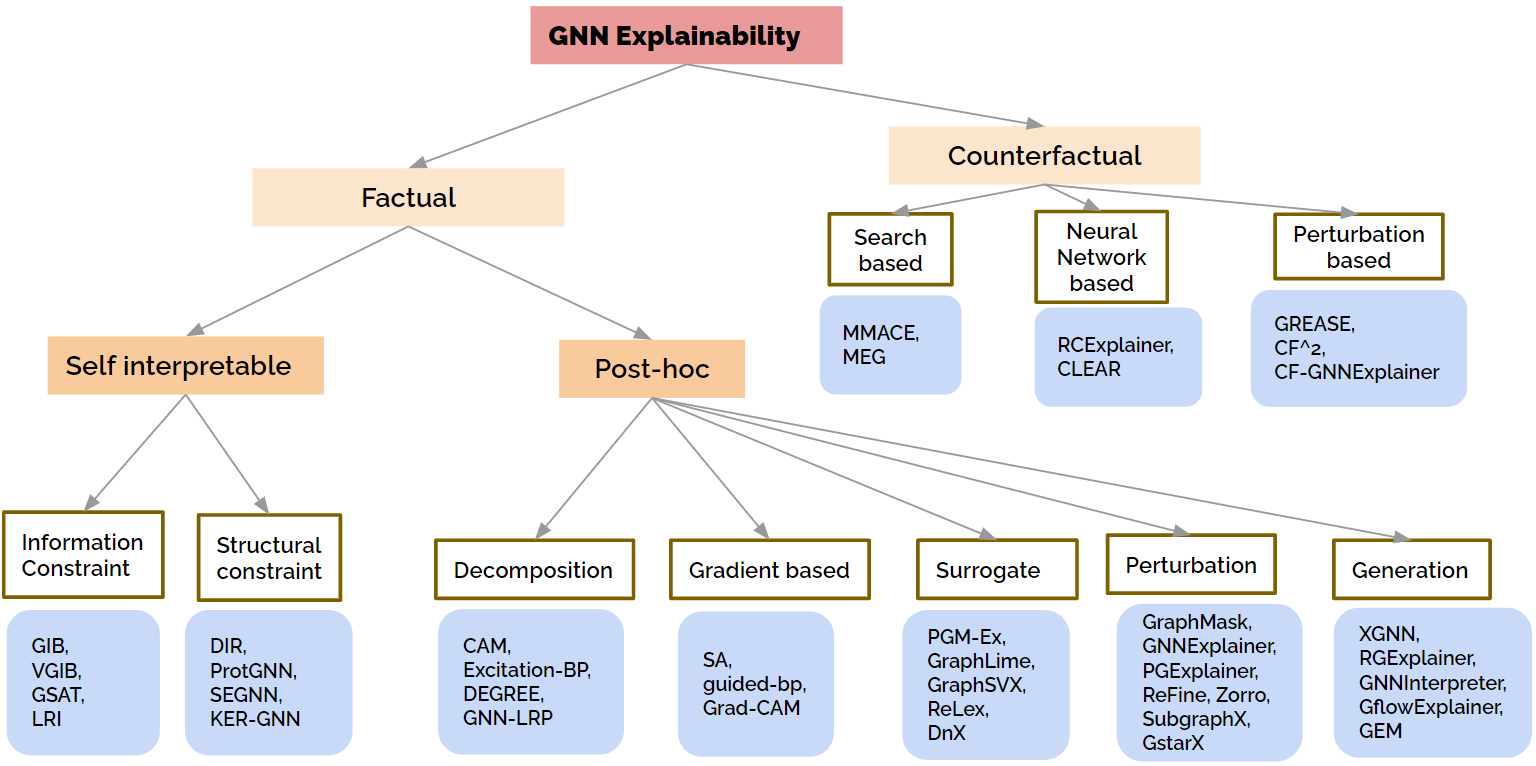
- Proposes a novel taxonomy for GNN explainability split into factual and counterfactual methods.
- Classifies factual methods into self-interpretable and post-hoc, further dividing post-hoc into decomposition, gradient-based, surrogate, perturbation-based, and generation-based categories.
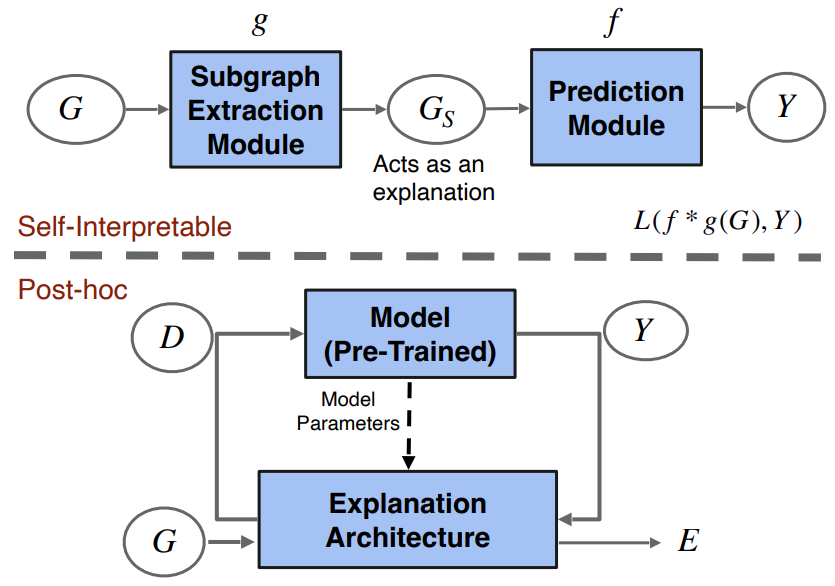
- Reviews self-interpretable methods based on information or structural constraints and explains subgraph extraction with an objective to predict Y.
- Discusses evaluation strategies and datasets used to assess explainability in GNNs.
- Discusses challenges unique to graph explanations, such as combinatorial substructure search and the need to consider both node features and graph topology.
Experimental results
Research questions
- RQ1What are the existing explainability methods for GNNs and how can they be systematically categorized?
- RQ2What are the strengths, limitations, and suitable application scenarios for each category of GNN explainability methods?
- RQ3What datasets and evaluation metrics are commonly used to assess GNN explainability?
- RQ4How do factual and counterfactual approaches compare in the context of GNN explanations?
Key findings
- Introduces a comprehensive taxonomy organizing explainability methods into factual and counterfactual, with detailed subcategories.
- Identifies that post-hoc methods can be white-box or black-box, and that self-interpretable methods integrate explanations into model architecture.
- Summarizes decomposition-based, gradient-based, surrogate, perturbation-based, and generation-based post-hoc methods, along with their typical inputs, outputs, and constraints.
- Highlights that self-interpretable methods may trade interpretability for predictive accuracy, due to integrated constraints.
- Emphasizes the need to consider both node attributes and graph structure when explaining GNN predictions.
- Reviews datasets and evaluation metrics commonly used for GNN explainability (Section 7 and 8 in the paper).
Read this paper
Open the full text in the Nubint reader and ask about any passage as you read.
Read this paper on NubintThis review was generated by AI from the original paper. Please check the paper before citing it.