
[Paper Review] A Survey on Fairness-aware Recommender Systems
This survey provides a comprehensive overview of fairness-aware recommender systems, categorizing fairness methods into pre-processing, in-processing, and post-processing stages. It identifies key biases in recommendation pipelines, evaluates fairness metrics and datasets, and highlights the trade-offs between fairness and accuracy, while emphasizing the integration of fairness with other trustworthy AI properties like explainability and robustness.
As information filtering services, recommender systems have extremely enriched our daily life by providing personalized suggestions and facilitating people in decision-making, which makes them vital and indispensable to human society in the information era. However, as people become more dependent on them, recent studies show that recommender systems potentially own unintentional impacts on society and individuals because of their unfairness (e.g., gender discrimination in job recommendations). To develop trustworthy services, it is crucial to devise fairness-aware recommender systems that can mitigate these bias issues. In this survey, we summarise existing methodologies and practices of fairness in recommender systems. Firstly, we present concepts of fairness in different recommendation scenarios, comprehensively categorize current advances, and introduce typical methods to promote fairness in different stages of recommender systems. Next, after introducing datasets and evaluation metrics applied to assess the fairness of recommender systems, we will delve into the significant influence that fairness-aware recommender systems exert on real-world industrial applications. Subsequently, we highlight the connection between fairness and other principles of trustworthy recommender systems, aiming to consider trustworthiness principles holistically while advocating for fairness. Finally, we summarize this review, spotlighting promising opportunities in comprehending concepts, frameworks, the balance between accuracy and fairness, and the ties with trustworthiness, with the ultimate goal of fostering the development of fairness-aware recommender systems.
Motivation & Objective
- To systematically categorize fairness issues in recommender systems across different recommendation scenarios.
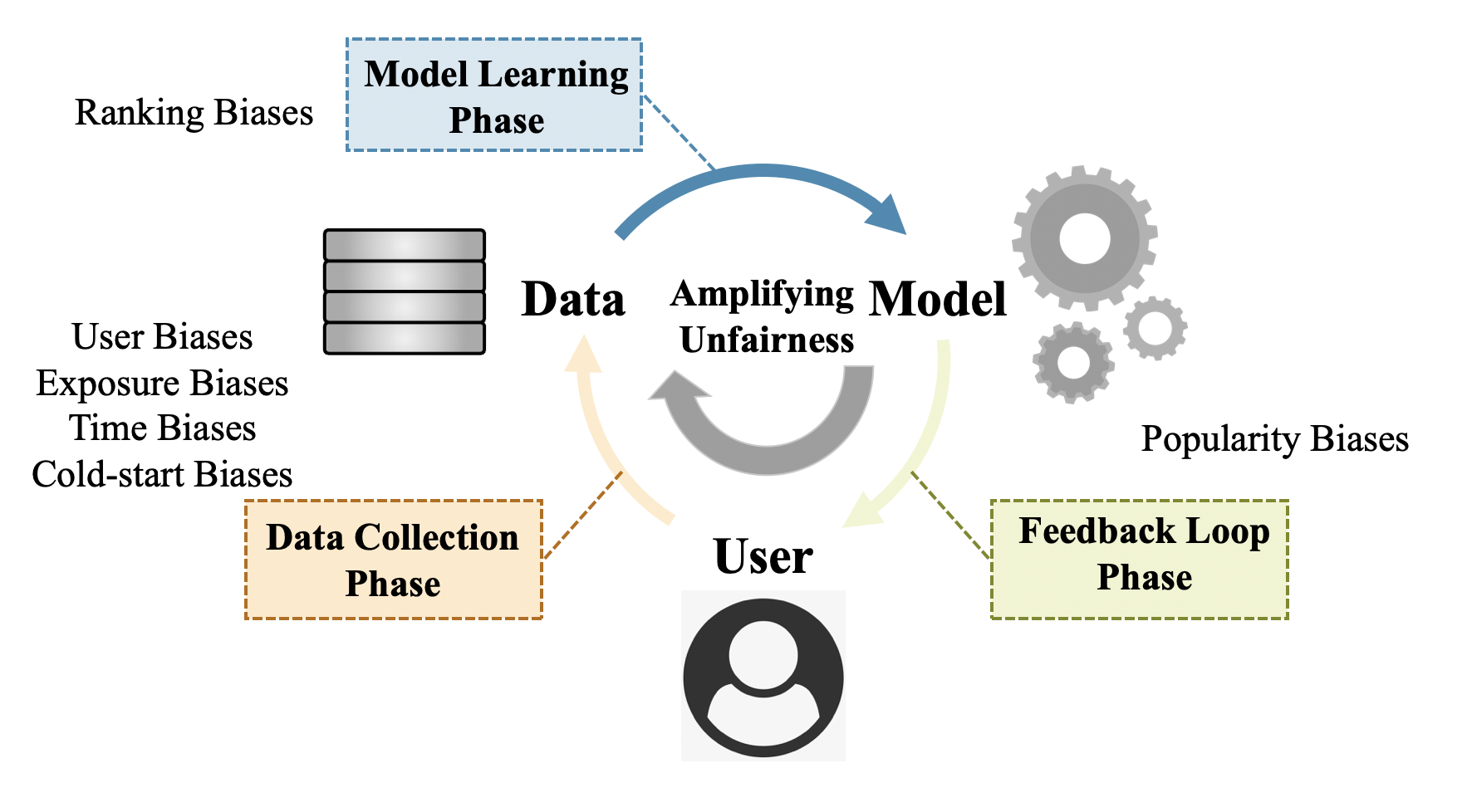
- To analyze the root causes of unfairness in the recommendation lifecycle, including data bias and model bias.
- To summarize fairness-aware methods across pre-processing, in-processing, and post-processing stages.
- To evaluate fairness using standardized datasets and metrics, enabling reproducible research.
- To explore the interplay between fairness and other trustworthy AI properties such as explainability, robustness, and privacy.
Proposed method
- Classifies fairness methods into three stages: pre-processing (bias mitigation in data), in-processing (fairness constraints in model training), and post-processing (fairness adjustment in outputs).
- Introduces fairness metrics such as demographic parity, equal opportunity, and treatment fairness to quantify bias in recommendations.
- Reviews benchmark datasets like Amazon, MovieLens, and MOOC for evaluating fairness in e-commerce, content, and education domains.
- Analyzes trade-offs between accuracy and fairness using empirical evaluation across diverse recommendation scenarios.
- Examines the integration of fairness with other trustworthiness properties, such as explainability and robustness, through case studies and literature synthesis.
- Proposes a framework for future research that emphasizes holistic trustworthiness by unifying fairness with multiple AI ethics principles.
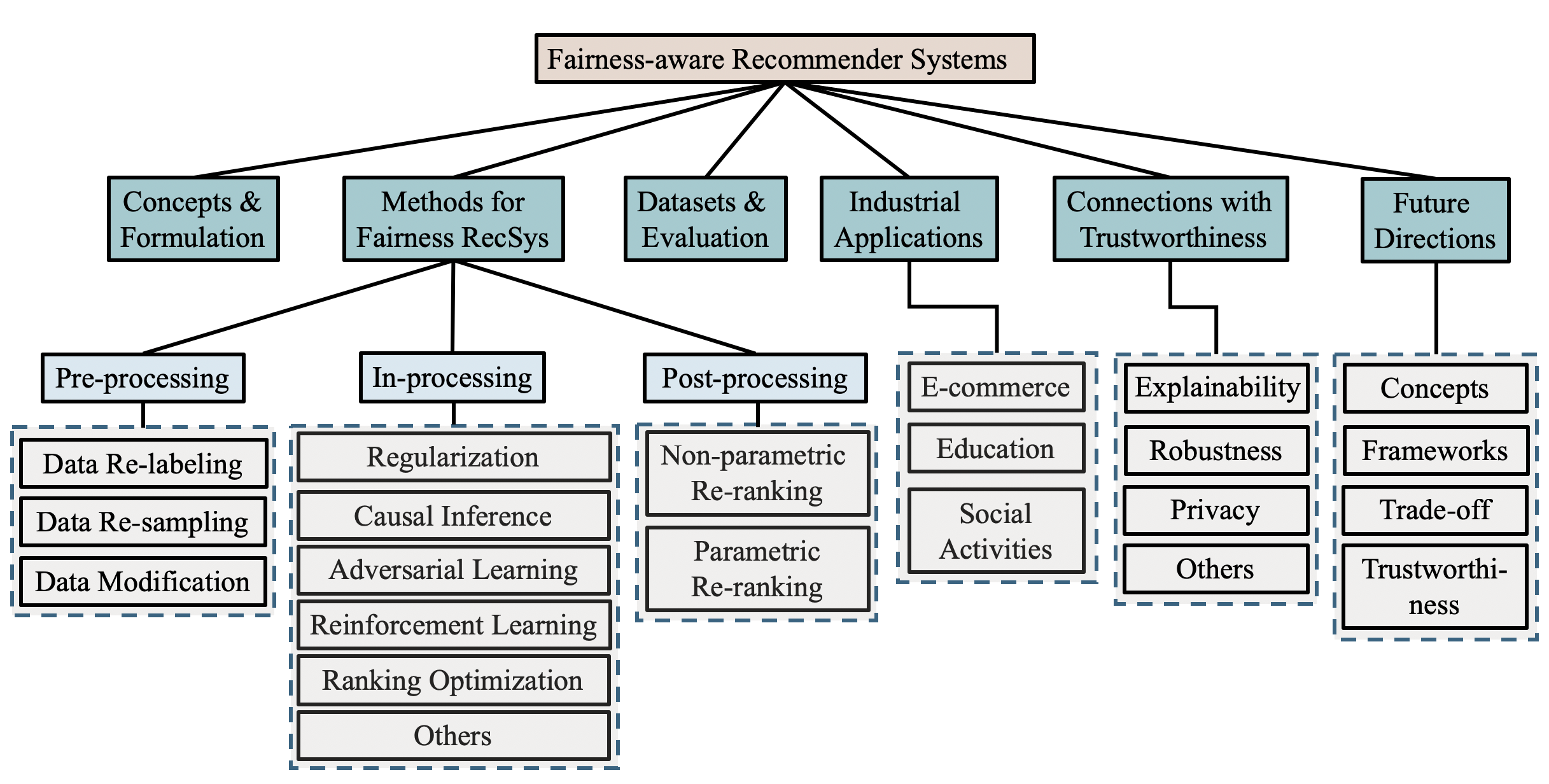
Experimental results
Research questions
- RQ1How do different types of bias emerge at various stages of the recommender system lifecycle?
- RQ2What are the most effective fairness-aware methods in pre-processing, in-processing, and post-processing, and how do they compare in performance and fairness?
- RQ3What are the key datasets and evaluation metrics used to measure fairness in recommender systems?
- RQ4How does fairness interact with other trustworthy AI properties such as explainability and robustness in real-world applications?
- RQ5What are the major challenges in balancing fairness and recommendation accuracy, and how can they be mitigated?
Key findings
- Fairness-aware recommender systems significantly reduce discriminatory outcomes, such as gender or racial bias in job or loan recommendations.
- Pre-processing methods like re-weighting and data augmentation help mitigate historical data bias, while in-processing methods such as adversarial training enforce fairness during model learning.
- Post-processing techniques, including re-ranking and calibration, effectively adjust recommendation outputs to meet fairness criteria without retraining.
- A trade-off between fairness and accuracy is consistently observed, with fairness improvements often leading to slight reductions in recommendation accuracy.
- There is growing evidence that integrating fairness with explainability and robustness enhances overall system trustworthiness and user acceptance.
- Current research lacks comprehensive frameworks that simultaneously optimize fairness with multiple trustworthy properties, indicating a significant research gap.
Read this paper
Open the full text in the Nubint reader and ask about any passage as you read.
Read this paper on NubintThis review was generated by AI from the original paper. Please check the paper before citing it.