
[Paper Review] A Survey on Graph Neural Networks for Time Series: Forecasting, Classification, Imputation, and Anomaly Detection
Comprehensive survey of graph neural networks applied to time series across forecasting, classification, anomaly detection, and imputation, with a unified task- and methodology-oriented framework and future directions.
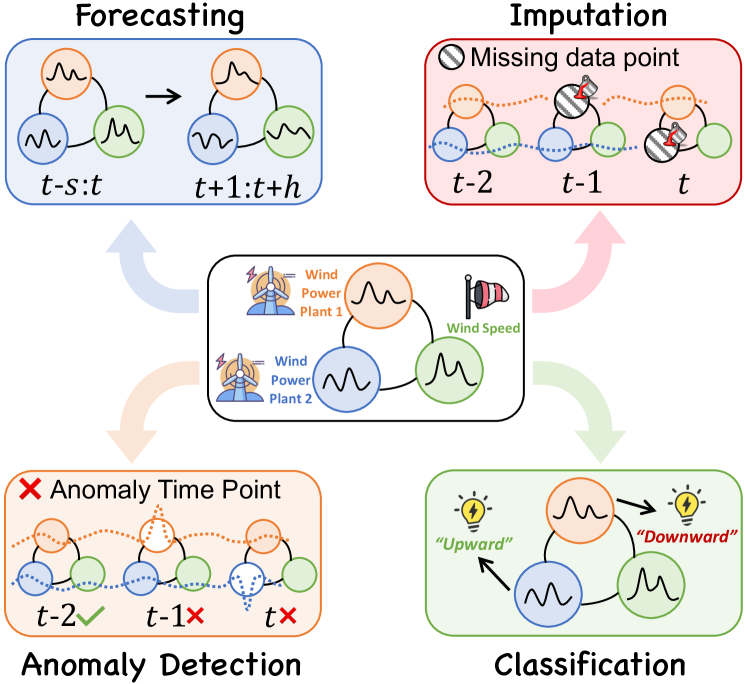
Time series are the primary data type used to record dynamic system measurements and generated in great volume by both physical sensors and online processes (virtual sensors). Time series analytics is therefore crucial to unlocking the wealth of information implicit in available data. With the recent advancements in graph neural networks (GNNs), there has been a surge in GNN-based approaches for time series analysis. These approaches can explicitly model inter-temporal and inter-variable relationships, which traditional and other deep neural network-based methods struggle to do. In this survey, we provide a comprehensive review of graph neural networks for time series analysis (GNN4TS), encompassing four fundamental dimensions: forecasting, classification, anomaly detection, and imputation. Our aim is to guide designers and practitioners to understand, build applications, and advance research of GNN4TS. At first, we provide a comprehensive task-oriented taxonomy of GNN4TS. Then, we present and discuss representative research works and introduce mainstream applications of GNN4TS. A comprehensive discussion of potential future research directions completes the survey. This survey, for the first time, brings together a vast array of knowledge on GNN-based time series research, highlighting foundations, practical applications, and opportunities of graph neural networks for time series analysis.
Motivation & Objective
- Provide a task-oriented taxonomy for GNNs in time series analysis (forecasting, anomaly detection, imputation, classification).
- Present a unified methodological framework (spatial-temporal GNNs) for encoding time series data into graphs and learning representations.
- Survey representative works and applications across domains to guide design and implementation of GNN4TS systems.
- Discuss open challenges and future directions to advance GNN-based time series research.
Proposed method
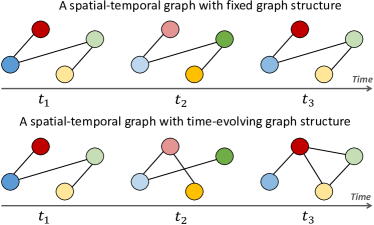
- Define spatial-temporal graphs to represent multivariate time series as sequences of attributed graphs.
- Categorize approaches by task (forecasting, anomaly detection, imputation, classification) and by spatial/temporal modeling choices (spectral vs spatial GNNs, time vs frequency domain, discrete vs continuous architectures).
- Propose a unified pipeline: data processing and graph construction, STGNN-based representation learning, and downstream task predictors.
- Review heuristic-based and learning-based graph construction methods (proximity, connectivity, similarity, functional dependence, and learned graphs).
- Describe architectural patterns (factorized vs coupled STGNNs) and temporal modules (RNNs, TCNs, Transformers, and hybrids).
- Summarize representative models and their task-specific formulations (e.g., forecasting loss, imputation loss, classification loss).
Experimental results
Research questions
- RQ1What are the main task categories in GNN-based time series analysis and how are they modeled?
- RQ2How can spatial-temporal graphs and STGNN architectures be unified to handle diverse time series tasks?
- RQ3What are the core graph construction strategies (heuristic and learned) for time series, and how do they affect performance?
- RQ4What are common architectural patterns (discrete vs continuous, factorized vs coupled) in STGNNs for time series forecasting, anomaly detection, imputation, and classification?
- RQ5What are the key directions and open challenges for GNNs in time series research?
Key findings
- The survey provides the first comprehensive, up-to-date review of GNN-based time series analytics across forecasting, classification, anomaly detection, and imputation.
- It offers a unified, structured taxonomy from task- and methodology-oriented perspectives and introduces a three-part framework (spatial module, temporal module, overall architecture).
- It highlights the breadth of application domains and the versatility of GNN4TS in modeling inter-variable and inter-temporal dependencies.
- It discusses heuristic and learning-based graph construction strategies, detailing when each approach is appropriate.
- It outlines future research directions and open questions to guide subsequent work in GNN4TS.
Read this paper
Open the full text in the Nubint reader and ask about any passage as you read.
Read this paper on NubintThis review was generated by AI from the original paper. Please check the paper before citing it.