
[Paper Review] A Survey on Graph Representation Learning Methods
This survey provides a comprehensive review of graph representation learning methods, covering traditional graph embedding and GNN-based approaches for both static and dynamic graphs. It uniquely summarizes nine key limitations of GNNs—such as over-smoothing, over-squashing, and expressive power—along with proposed solutions, and outlines future research directions, making it a timely and detailed reference for researchers in the field.
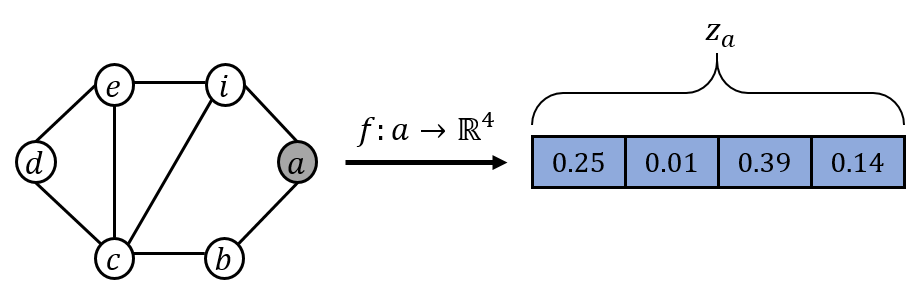
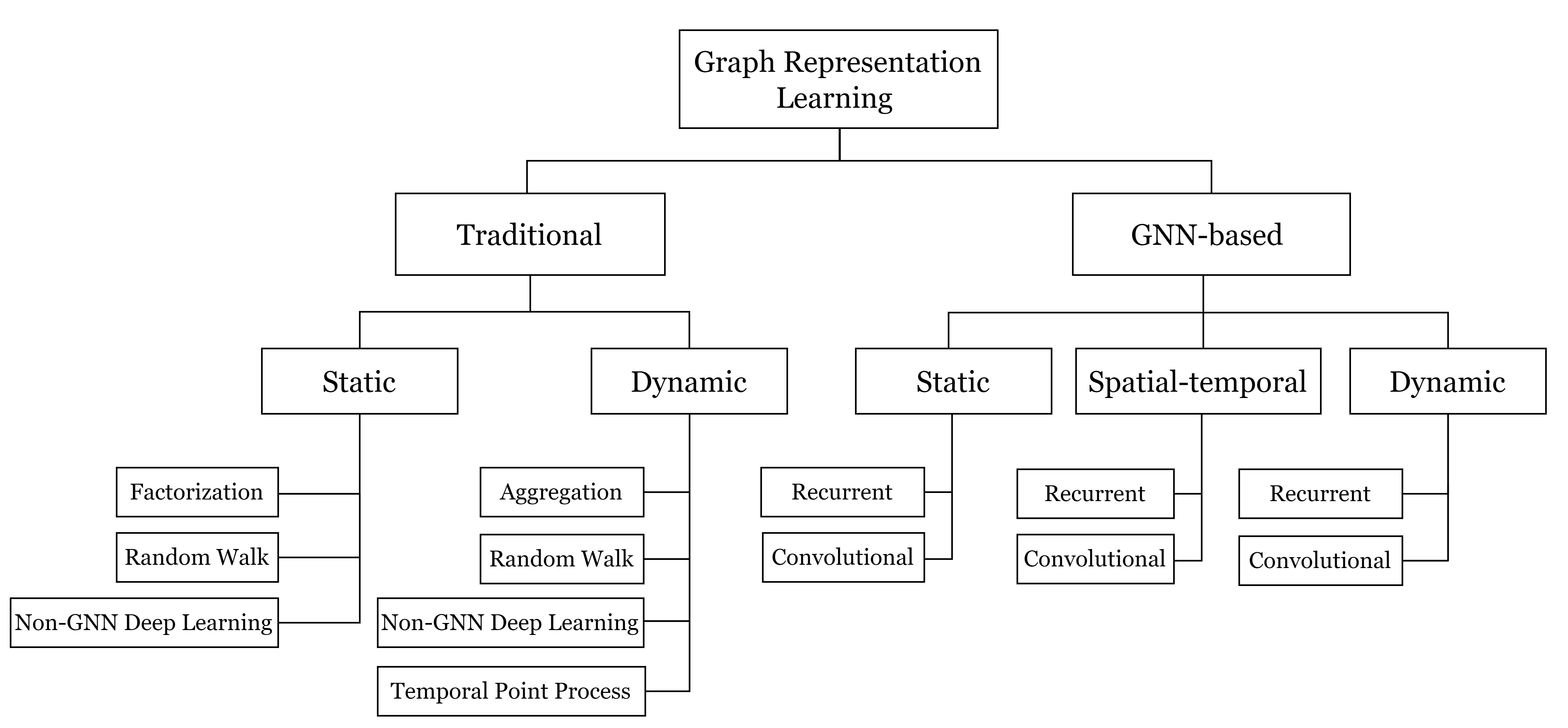
Graphs representation learning has been a very active research area in recent years. The goal of graph representation learning is to generate graph representation vectors that capture the structure and features of large graphs accurately. This is especially important because the quality of the graph representation vectors will affect the performance of these vectors in downstream tasks such as node classification, link prediction and anomaly detection. Many techniques are proposed for generating effective graph representation vectors. Two of the most prevalent categories of graph representation learning are graph embedding methods without using graph neural nets (GNN), which we denote as non-GNN based graph embedding methods, and graph neural nets (GNN) based methods. Non-GNN graph embedding methods are based on techniques such as random walks, temporal point processes and neural network learning methods. GNN-based methods, on the other hand, are the application of deep learning on graph data. In this survey, we provide an overview of these two categories and cover the current state-of-the-art methods for both static and dynamic graphs. Finally, we explore some open and ongoing research directions for future work.
Motivation & Objective
- To provide a unified, up-to-date review of graph representation learning methods, including both traditional and GNN-based approaches for static and dynamic graphs.
- To identify and summarize nine major limitations of GNN-based methods and the corresponding solutions proposed in recent literature.
- To highlight real-world applications of GNNs in production systems, which are often overlooked in prior surveys.
- To identify and discuss emerging research directions in graph representation learning, particularly those not covered in previous surveys.
- To bridge the gap between static and dynamic graph representation learning by integrating both in a single, comprehensive survey.
Proposed method
- Categorizing graph representation learning into traditional graph embedding (factorization-based, random walk-based, non-GNN deep learning) and GNN-based methods.
- Surveying static, spatial-temporal, and dynamic GNN architectures, including their design principles and learning mechanisms.
- Systematically analyzing limitations of GNNs such as over-smoothing, over-squashing, and expressive power, and summarizing proposed solutions.
- Incorporating recent advancements from reputable venues (e.g., NeurIPS, ICML, KDD) published from 2017 to 2022, including high-impact pre-2017 works.
- Integrating domain-specific knowledge into GNNs through architectural, input, and loss function modifications.
- Exploring the transferability of deep learning advances from NLP and computer vision to graph learning, especially for dynamic graphs.
Experimental results
Research questions
- RQ1What are the key differences and trade-offs between traditional graph embedding and GNN-based graph representation learning methods?
- RQ2How do GNNs handle dynamic graphs, and what are the main challenges in modeling evolving graph structures?
- RQ3What are the major theoretical and practical limitations of GNNs, and how have recent works addressed them?
- RQ4In what real-world production systems have GNN-based methods been successfully deployed?
- RQ5What are the most promising future research directions in graph representation learning that extend beyond current survey coverage?
Key findings
- The survey identifies nine major limitations of GNNs: expressive power, over-smoothing, scalability, over-squashing, long-range dependency capture, design space complexity, substructure neglect, homophily assumption dependency, and catastrophic forgetting.
- Recent GNN variants based on partial differential equations (PDEs) show promise in mitigating over-smoothing, suggesting a new direction for model design.
- Incorporating domain knowledge into GNNs through input, loss, or architecture modifications improves performance on specific tasks, though this area remains underexplored.
- Self-supervised learning, contrastive learning, and data augmentation are effective strategies for training GNNs with limited labeled data, especially in low-data regimes.
- Transfer of techniques from computer vision and NLP—such as video representation learning concepts—can inspire new models for dynamic graph learning.
- GNNs have been successfully deployed in production for applications including power grid monitoring, drug overprescription prediction, and academic publication forecasting.
Read this paper
Open the full text in the Nubint reader and ask about any passage as you read.
Read this paper on NubintThis review was generated by AI from the original paper. Please check the paper before citing it.