
[Paper Review] A Survey on Large Language Model based Autonomous Agents
This survey aggregates and analyzes LLM-based autonomous agents, proposing a unified architecture (profiling, memory, planning, action), and reviews their construction, applications, and evaluation, with taxonomy and future directions.
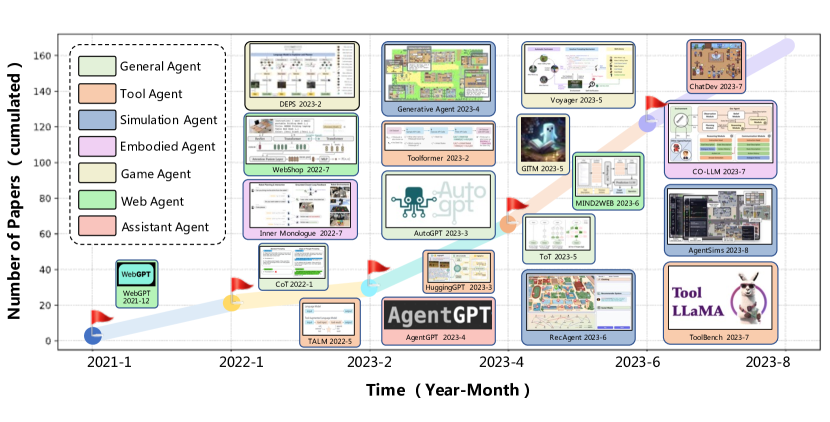
Autonomous agents have long been a prominent research focus in both academic and industry communities. Previous research in this field often focuses on training agents with limited knowledge within isolated environments, which diverges significantly from human learning processes, and thus makes the agents hard to achieve human-like decisions. Recently, through the acquisition of vast amounts of web knowledge, large language models (LLMs) have demonstrated remarkable potential in achieving human-level intelligence. This has sparked an upsurge in studies investigating LLM-based autonomous agents. In this paper, we present a comprehensive survey of these studies, delivering a systematic review of the field of LLM-based autonomous agents from a holistic perspective. More specifically, we first discuss the construction of LLM-based autonomous agents, for which we propose a unified framework that encompasses a majority of the previous work. Then, we present a comprehensive overview of the diverse applications of LLM-based autonomous agents in the fields of social science, natural science, and engineering. Finally, we delve into the evaluation strategies commonly used for LLM-based autonomous agents. Based on the previous studies, we also present several challenges and future directions in this field. To keep track of this field and continuously update our survey, we maintain a repository of relevant references at https://github.com/Paitesanshi/LLM-Agent-Survey.
Motivation & Objective
- Explain why LLMs are enabling autonomous agents and the gaps in prior work.
- Present a unified architecture framework that can encompass most existing LLM-based agent designs.
- Survey memory, planning, and profiling modules to understand agent capabilities and limitations.
- Summarize applications across social science, natural science, and engineering and discuss evaluation approaches.
- Identify challenges and future directions to guide research in LLM-based autonomous agents.
Proposed method
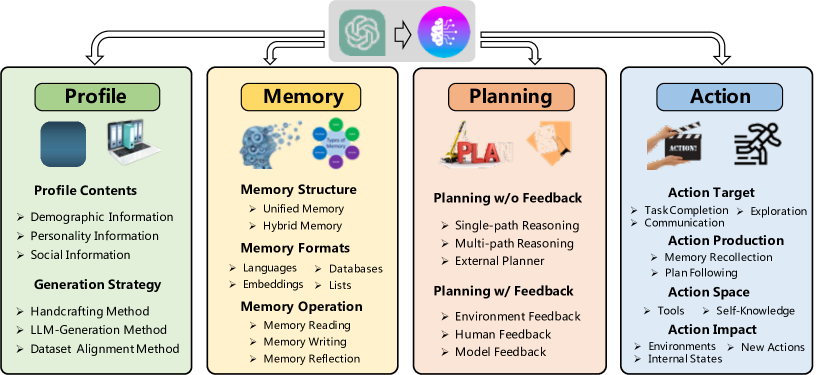
- Propose a unified agent architecture comprising profiling, memory, planning, and action modules.
- Classify memory structures into short-term (unified) and hybrid memory with long-term storage and retrieval.
- Survey planning strategies with and without feedback, including single-path, multi-path, and external planner integrations.
- Review profiling strategies (handcrafted, LLM-generated, dataset-aligned) and their impact on agent behavior.
- Summarize external sources and prior works to construct a taxonomy and guide future development.
Experimental results
Research questions
- RQ1What architectures and modules are most effective for leveraging LLMs as autonomous agents?
- RQ2How do memory and planning strategies contribute to agent performance and reliability in open environments?
- RQ3What are the best practices for profiling agents to align behavior with intended roles?
- RQ4How are LLM-based agents evaluated, and what challenges remain in benchmarking them?
Key findings
- A unified four-module framework (profiling, memory, planning, action) can encompass most prior LLM-based agent designs.
- Hybrid memory, combining short-term and long-term memories, is commonly used to improve long-range reasoning and consistency.
- planning with feedback (environmental, human, model) enhances plan robustness over planning without feedback.
- Memory can be stored in natural language, embeddings, databases, or structured lists, with formats often combined for benefits.
- Researchers employ single-path and multi-path planning, external planners, and feedback-driven loops to handle complex tasks.
Better researchstarts right now
From reading papers to final review, dramatically reduce your research time.
No credit card · Free plan available
This review was created by AI and reviewed by human editors.