
[Paper Review] A Survey on Large Language Models with some Insights on their Capabilities and Limitations
This survey reviews LLM foundations, scaling laws, architectures, and emergent abilities, and discusses CoT/PoT, RAG, and domain applications, highlighting capabilities and limits.
The rapid advancement of artificial intelligence, particularly with the development of Large Language Models (LLMs) built on the transformer architecture, has redefined the capabilities of natural language processing. These models now exhibit remarkable performance across various language-related tasks, such as text generation, question answering, translation, and summarization, often rivaling human-like comprehension. More intriguingly, LLMs have demonstrated emergent abilities extending beyond their core functions, showing proficiency in tasks like commonsense reasoning, code generation, and arithmetic. This survey paper explores the foundational components, scaling mechanisms, and architectural strategies that drive these capabilities. Emphasizing models like GPT and LLaMA, we analyze the impact of exponential data and computational growth on LLM performance, while also addressing the trade-offs associated with scaling. We also examine LLM applications across sectors, such as healthcare, finance, education, and law, highlighting their adaptability and potential to solve domain-specific challenges. Central to this work are the questions of how LLMs generalize across diverse tasks, exhibit planning, and reasoning abilities, and whether these emergent abilities can be systematically elicited or enhanced. In particular, we provide some insights into the CoT (Chain of Thought) and PoT (Plan of Thought) abilities within LLMs, focusing on how pre-training data influences their emergence. Additionally, we investigate LLM-modulo frameworks that integrate external systems, allowing LLMs to handle complex, dynamic tasks. By analyzing these factors, this paper aims to foster the ongoing discussion on the capabilities and limits of LLMs, promoting their responsible development and application in novel and increasingly complex environments.
Motivation & Objective
- Assess the development and key components of large language models (LLMs) and their transformative impact across domains.
- Analyze scaling laws (KM and Chinchilla) and how model size, data, and compute affect performance.
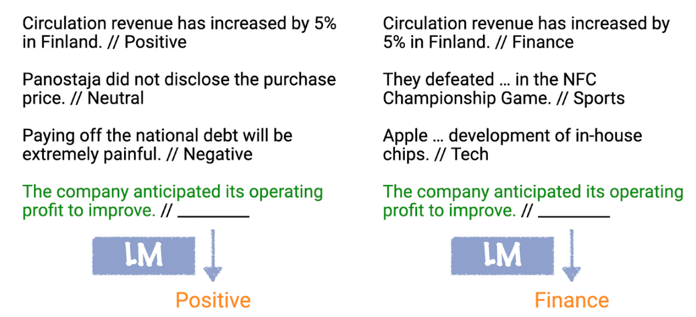
- Examine emergent abilities (in-context learning, chain-of-thought, plan-based reasoning) and how they arise.
- Discuss practical applications, adaptation strategies, and ethical/operational limitations of LLMs across sectors.
Proposed method
- Survey foundational LLM concepts and transformer-based architectures (BERT, GPT, LLaMA, T5, etc.).
- Describe scaling laws and their implications for model size, data, and compute.
- Analyze pre-training, data sources, and adaptation techniques (instruction tuning, alignment).
- Explore in-context learning, chain-of-thought prompting, program-of-thoughts, and LLM-modulo frameworks.
- Present empirical insights on CoT origins using experiments with Llama-family models on GSM8k datasets.
- Discuss domain applications in healthcare, finance, education, and law, and consider ethical and environmental challenges.
Experimental results
Research questions
- RQ1How do LLMs generalize across diverse tasks and domains and exhibit planning and reasoning abilities?
- RQ2What factors (size, data, architecture) drive emergent abilities, and can they be systematically elicited or enhanced?
- RQ3What are the trade-offs and limitations of scaling LLMs, and how can they be mitigated in practice?
- RQ4How can external systems (retrieval, plugins) be integrated to handle complex tasks (LLM-modulo frameworks)?
Key findings
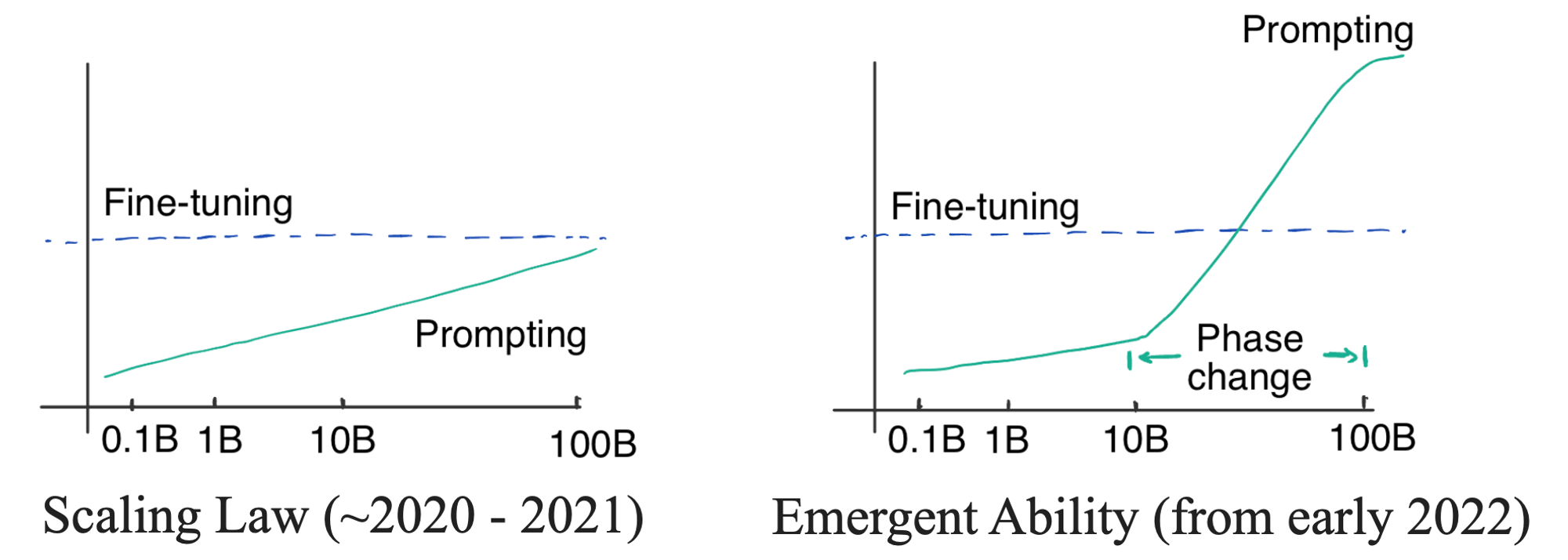
- Emergent abilities such as in-context learning and chain-of-thought prompting appear with increased model scale and vary by task and model size.
- Instruction tuning and alignment strategies improve task following for larger models, with performance gains beginning around tens of billions of parameters.
- Scaling laws (KM and Chinchilla) provide guidance on allocating compute between model size and data to optimize performance.
- Retrieval-Augmented Generation (RAG) and external knowledge integrations enhance factual accuracy and task capability.
- LLMs show versatile applicability across healthcare, finance, education, law, and scientific research, while raising ethical, environmental, and bias-related concerns.
Read this paper
Open the full text in the Nubint reader and ask about any passage as you read.
Read this paper on NubintThis review was generated by AI from the original paper. Please check the paper before citing it.