
[Paper Review] A Survey on LLM-Generated Text Detection: Necessity, Methods, and Future Directions
This survey synthesizes advances in detecting text generated by large language models, covering detectors, datasets, evaluation, challenges, and future directions.
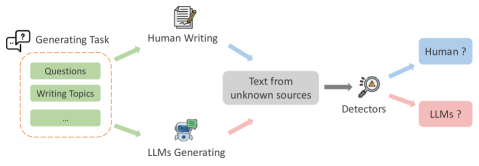
The powerful ability to understand, follow, and generate complex language emerging from large language models (LLMs) makes LLM-generated text flood many areas of our daily lives at an incredible speed and is widely accepted by humans. As LLMs continue to expand, there is an imperative need to develop detectors that can detect LLM-generated text. This is crucial to mitigate potential misuse of LLMs and safeguard realms like artistic expression and social networks from harmful influence of LLM-generated content. The LLM-generated text detection aims to discern if a piece of text was produced by an LLM, which is essentially a binary classification task. The detector techniques have witnessed notable advancements recently, propelled by innovations in watermarking techniques, statistics-based detectors, neural-base detectors, and human-assisted methods. In this survey, we collate recent research breakthroughs in this area and underscore the pressing need to bolster detector research. We also delve into prevalent datasets, elucidating their limitations and developmental requirements. Furthermore, we analyze various LLM-generated text detection paradigms, shedding light on challenges like out-of-distribution problems, potential attacks, real-world data issues and the lack of effective evaluation framework. Conclusively, we highlight interesting directions for future research in LLM-generated text detection to advance the implementation of responsible artificial intelligence (AI). Our aim with this survey is to provide a clear and comprehensive introduction for newcomers while also offering seasoned researchers a valuable update in the field of LLM-generated text detection. The useful resources are publicly available at: https://github.com/NLP2CT/LLM-generated-Text-Detection.
Motivation & Objective
- Motivate the need for LLM-generated text detectors to mitigate misuse and preserve integrity in AI-enabled text.
- Aggregate and analyze recent detector approaches, datasets, and evaluation practices.
- Identify current limitations and chart future research directions to strengthen detection.
- Provide a clear, up-to-date introduction for newcomers and a concise update for researchers.
Proposed method
- Conducted a systematic literature review (SLR) following Kitchenham guidelines to review LLM-generated text detection literature.
- Used targeted search terms: “LLM-generated text detection” OR “machine-generated text detection” OR “AI-written text detection” OR “deepfake text detection”.
- Sourced from Google Scholar, ArXiv, Scopus, Web of Science, IEEE Xplore, Springer Link, ACL Anthology, ACM DL, etc.
- Applied inclusion criteria: (i) review focused on detection methods, (ii) proposes a detection methodology, (iii) discusses challenges and future directions, (iv) articulates necessity and applications.
- Screened 82 relevant papers and analyzed data, detectors, metrics, issues, and future directions.
Experimental results
Research questions
- RQ1What are the prevailing methods for detecting LLM-generated text and their associated challenges?
- RQ2What datasets and benchmarks exist for LLM-generated text detection, and what limitations do they exhibit?
- RQ3What evaluation metrics are used, and how well do detectors perform under various conditions?
- RQ4What are the key challenges (e.g., out-of-distribution, attacks, data ambiguity) and future directions for robust detectors?
Key findings
- There has been a surge of work in 2023 on LLM-generated text detection.
- The survey catalogs detectors spanning watermarking, zero-shot, fine-tuning LM methods, adversarial learning, LLMs as detectors, and human-assisted approaches.
- A wide range of datasets and benchmarks exist (e.g., HC3, CHEAT, GROVER-based datasets, TweepFake, GPT-2 Output Dataset), with noted limitations and need for improvements.
- Evaluation metrics include accuracy, AUROC, recall, and F1-score, with discussion of out-of-distribution and data ambiguity challenges.
- The paper discusses issues such as attacks on detectors and the need for robust detectors in low-resource settings and under data ambiguity.
- Future directions highlight building detectors robust to attacks, enhancing zero-shot detectors, and multi-agent systems, among others.

Read this paper
Open the full text in the Nubint reader and ask about any passage as you read.
Read this paper on NubintThis review was generated by AI from the original paper. Please check the paper before citing it.