
[Paper Review] A Survey on Mamba Architecture for Vision Applications
This survey reviews Vision Mamba (ViM) and VideoMamba, detailing bidirectional/spatiotemporal scanning with state-space models to achieve near-linear scalability for vision tasks, and compares their performance across image, video, and 3D tasks.
Transformers have become foundational for visual tasks such as object detection, semantic segmentation, and video understanding, but their quadratic complexity in attention mechanisms presents scalability challenges. To address these limitations, the Mamba architecture utilizes state-space models (SSMs) for linear scalability, efficient processing, and improved contextual awareness. This paper investigates Mamba architecture for visual domain applications and its recent advancements, including Vision Mamba (ViM) and VideoMamba, which introduce bidirectional scanning, selective scanning mechanisms, and spatiotemporal processing to enhance image and video understanding. Architectural innovations like position embeddings, cross-scan modules, and hierarchical designs further optimize the Mamba framework for global and local feature extraction. These advancements position Mamba as a promising architecture in computer vision research and applications.
Motivation & Objective
- Assess how Mamba architectures adapt state-space models for visual data.
- Discuss ViM and VideoMamba design choices to handle spatial and temporal dependencies.
- Evaluate architectural innovations (position embeddings, cross-scan modules, hierarchical designs) and their impact on performance.
- Provide comparative guidance on selecting Mamba-based architectures for image, video, and multi-task vision applications.
Proposed method
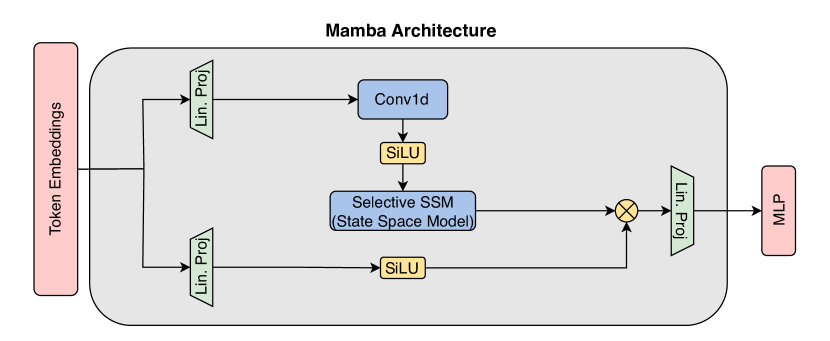
- Describe the Mamba block and selective scanning (S6) mechanism.
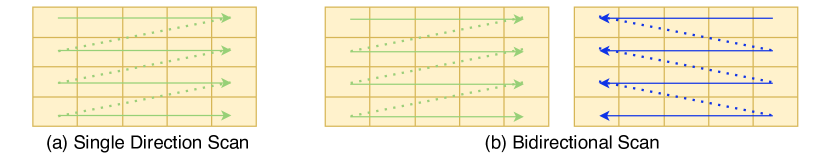
- Explain Vision Mamba (ViM) with bidirectional scanning and position embeddings.
- Explain VideoMamba with 3D bidirectional scanning and spatiotemporal processing.
- Summarize architectural variants (Cross-Scan Module, LocalMamba, Spatial-Mamba, VSSD, Hi-Mamba, Famba-V, etc.) and their purposes.
- Compare ViM and VideoMamba on standard vision benchmarks and tasks.
Experimental results
Research questions
- RQ1How do bidirectional and spatiotemporal scanning in ViM/VideoMamba affect performance on image and video tasks compared to Transformers?
- RQ2Which architectural innovations (e.g., position embeddings, SASF, register tokens, masked backward computation) yield the best accuracy-efficiency trade-offs across tasks?
- RQ3What are the trade-offs in complexity (params, FLOPS) versus accuracy for ViM/VideoMamba variants on Imagenet-1k, ADE20K, MS-COCO, Kinetics-400, and SSv2?
- RQ4What challenges remain for achieving parity with Transformer-based models in vision and video?
- RQ5What future directions can extend Mamba's applicability to 2D/3D vision and multi-modal fusion?
Key findings
- ViM variants achieve strong image classification results, with Vmamba-S achieving 83.6% Top-1 accuracy on ImageNet-1k and Spatial-Mamba-S reaching 84.6%.
- Vmamba-S and Spatial-Mamba-S also deliver leading semantic segmentation performance on ADE20K (around 50.6 mIoU for Vmamba-S).
- For object detection on MS-COCO, Spatial Mamba-S achieves 54.2 AP bbox@75, and VSSD-S achieves 53.1 AP bbox@75, indicating strong performance with structure-aware or non-causal mechanisms.
- VideoMamba variants excel in long-range video understanding, with VideoMamba-S achieving 81.5% Top-1 on Kinetics-400 and VideoMambaPro-S reaching 88.5%.
- EfficientViM-M4 demonstrates excellent accuracy-efficiency balance (81.9% Top-1 with 21.3M params and 4.1 GFLOPS) for image classification.
- VideoMambaPro-S shows improvements over VideoMamba-S via residual/masked backward strategies, achieving higher accuracy with similar or lower FLOPS.
Read this paper
Open the full text in the Nubint reader and ask about any passage as you read.
Read this paper on NubintThis review was generated by AI from the original paper. Please check the paper before citing it.