
[Paper Review] A Survey on Safety-Critical Driving Scenario Generation -- A Methodological Perspective
This survey presents a comprehensive methodological taxonomy of safety-critical driving scenario generation for autonomous vehicles, categorizing approaches into data-driven, adversarial, and knowledge-based methods. It identifies key challenges—fidelity, efficiency, diversity, transferability, and controllability—and proposes future directions, including integrating physical laws and using generated scenarios to improve robustness and generalization through curriculum learning and adversarial training.
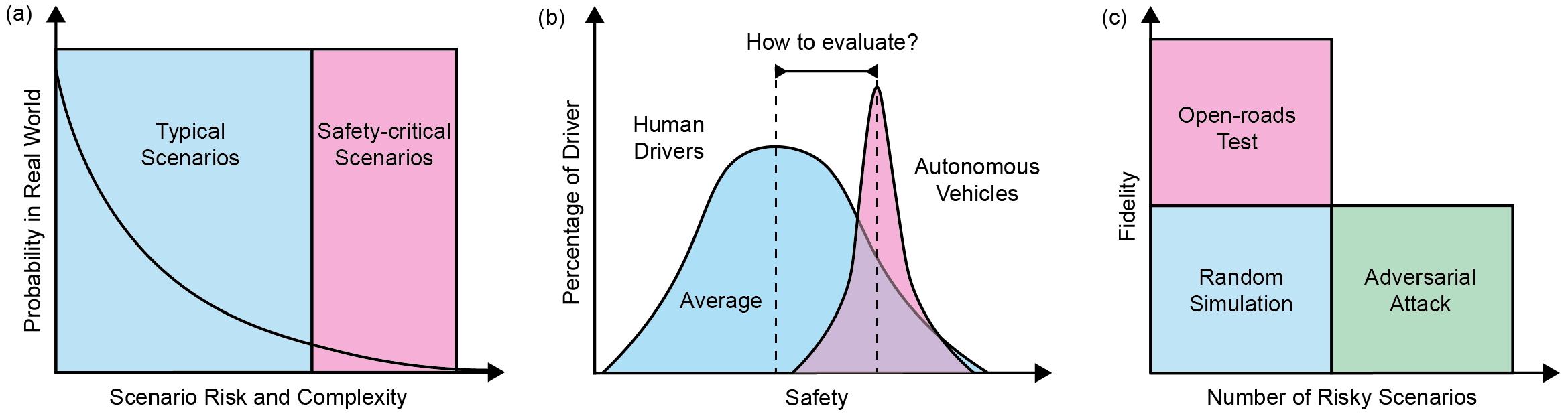
Autonomous driving systems have witnessed a significant development during the past years thanks to the advance in machine learning-enabled sensing and decision-making algorithms. One critical challenge for their massive deployment in the real world is their safety evaluation. Most existing driving systems are still trained and evaluated on naturalistic scenarios collected from daily life or heuristically-generated adversarial ones. However, the large population of cars, in general, leads to an extremely low collision rate, indicating that the safety-critical scenarios are rare in the collected real-world data. Thus, methods to artificially generate scenarios become crucial to measure the risk and reduce the cost. In this survey, we focus on the algorithms of safety-critical scenario generation in autonomous driving. We first provide a comprehensive taxonomy of existing algorithms by dividing them into three categories: data-driven generation, adversarial generation, and knowledge-based generation. Then, we discuss useful tools for scenario generation, including simulation platforms and packages. Finally, we extend our discussion to five main challenges of current works -- fidelity, efficiency, diversity, transferability, controllability -- and research opportunities lighted up by these challenges.
Motivation & Objective
- To address the critical challenge of evaluating autonomous vehicle safety in rare, high-risk scenarios that are underrepresented in real-world data.
- To provide a systematic taxonomy of existing scenario generation methods based on their underlying information sources and frameworks.
- To identify key challenges—fidelity, efficiency, diversity, transferability, and controllability—in current scenario generation approaches.
- To guide researchers and practitioners in selecting appropriate generation algorithms based on specific evaluation needs.
- To outline future research directions, including integrating physical laws, leveraging offline reinforcement learning, and using generated scenarios to enhance system robustness and generalization.
Proposed method
- Categorizes scenario generation into three main methodological families: data-driven (using deep generative models on real-world data), adversarial (applying optimization or reinforcement learning to find failure cases), and knowledge-based (using rule-based or symbolic constraints to define safety-critical conditions).
- Proposes a hierarchical representation of scenarios that embeds physical laws and object interactions to improve realism and interpretability.
- Reviews widely used simulation platforms (e.g., CARLA, LGSVL) and open-source tools (e.g., AirSim, ScenarioGen) for scenario design and evaluation.
- Integrates offline reinforcement learning and imitation learning to better align generated scenarios with real-world data distributions.
- Recommends combining methods—e.g., data-driven + adversarial or knowledge-based + adversarial—to balance diversity, realism, and controllability.
- Proposes curriculum learning and distributional robust optimization as strategies to use generated scenarios for improving AV generalization and robustness.
Experimental results
Research questions
- RQ1How can safety-critical driving scenarios be systematically categorized based on their underlying methodology and information source?
- RQ2What are the key limitations in current scenario generation methods, and how do they affect the evaluation of autonomous vehicle safety?
- RQ3How can generated scenarios be made both realistic (high fidelity) and effective at uncovering system vulnerabilities (high criticality)?
- RQ4What role can external knowledge, such as physical laws and traffic rules, play in improving the interpretability and validity of generated scenarios?
- RQ5How can generated scenarios be leveraged not only for evaluation but also for improving the robustness and generalization of autonomous driving systems?
Key findings
- Data-driven methods, particularly deep generative models, can capture complex traffic patterns but often fail to generate high-risk scenarios due to data sparsity.
- Adversarial generation methods are effective at discovering failure cases but may produce unrealistic or physically implausible scenarios.
- Knowledge-based methods provide high interpretability and control but often lack diversity and may miss rare, complex interactions.
- Combining data-driven and adversarial methods offers a promising path to discover diverse, realistic, and safety-critical scenarios.
- Integrating physical laws and real-world data distributions into scenario generation improves fidelity and ensures generated scenarios are both meaningful and testable.
- Using generated scenarios in curriculum learning and adversarial training frameworks can significantly improve the robustness and generalization of autonomous driving systems.

Read this paper
Open the full text in the Nubint reader and ask about any passage as you read.
Read this paper on NubintThis review was generated by AI from the original paper. Please check the paper before citing it.