
[Paper Review] A Survey on Spectral Graph Neural Networks
This paper systematically reviews spectral GNNs, categorizing methods by eigenvalues or eigenvectors, analyzing theory and applications, and benchmarking performance across datasets.
Graph neural networks (GNNs) have attracted considerable attention from the research community. It is well established that GNNs are usually roughly divided into spatial and spectral methods. Despite that spectral GNNs play an important role in both graph signal processing and graph representation learning, existing studies are biased toward spatial approaches, and there is no comprehensive review on spectral GNNs so far. In this paper, we summarize the recent development of spectral GNNs, including model, theory, and application. Specifically, we first discuss the connection between spatial GNNs and spectral GNNs, which shows that spectral GNNs can capture global information and have better expressiveness and interpretability. Next, we categorize existing spectral GNNs according to the spectrum information they use, \ie, eigenvalues or eigenvectors. In addition, we review major theoretical results and applications of spectral GNNs, followed by a quantitative experiment to benchmark some popular spectral GNNs. Finally, we conclude the paper with some future directions.
Motivation & Objective
- Differentiate spatial and spectral GNNs and highlight the unique challenges of spectral methods.
- Classify spectral GNNs into eigenvalue-based and eigenvector-based categories with subcategories.
- Summarize major theoretical results (expressive power, robustness, transferability) and key applications.
- Provide a quantitative benchmark of popular spectral GNNs on standard datasets and discuss future directions.
Proposed method
- Define spectral graph convolution via graph Fourier transform and eigenspaces.
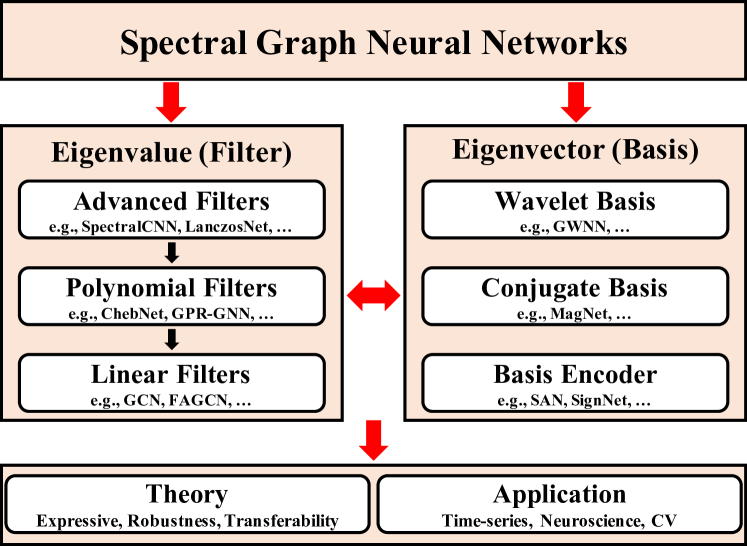
- Categorize spectral GNNs into eigenvalue-based (advanced, polynomial, linear filters) and eigenvector-based (wavelet, conjugate/basis encoders) approaches.
- Discuss theoretical results on expressiveness, robustness, and transferability.
- Review major applications in multivariate time-series forecasting, neuroscience, and computer vision.
- Conduct a benchmark on six datasets to compare spectral GNNs using a unified framework.
Experimental results
Research questions
- RQ1What are the main spectral information sources (eigenvalues vs eigenvectors) used by spectral GNNs and what are their trade-offs?
- RQ2How do spectral GNNs differ in expressiveness, scalability, and interpretability compared to spatial GNNs?
- RQ3What theoretical guarantees exist for spectral GNNs in terms of expressiveness, robustness, and transferability?
- RQ4How do spectral GNNs perform empirically across homophilic and heterophilic graphs and real-world tasks?
Key findings
- Spectral GNNs capture global information and offer interpretability through learned frequency components.
- Two main spectral categories exist: eigenvalue-based filters (advanced, polynomial, linear) and eigenvector-based bases (wavelets, conjugate bases, basis encoders).
- Polynomial and linear filters enable scalable learning on large graphs, with trade-offs in expressiveness; advanced filters can be powerful but computationally intensive.
- Eigenvector-based methods (e.g., graph wavelets, Hermitian Laplacian) provide localization and directional information but are less explored.
- The paper discusses theory on expressiveness, robustness to perturbations, and transferability, and presents benchmark results indicating performance differences across datasets.
Read this paper
Open the full text in the Nubint reader and ask about any passage as you read.
Read this paper on NubintThis review was generated by AI from the original paper. Please check the paper before citing it.