
[Paper Review] A Survey on the Applications of Zero-Knowledge Proofs
A comprehensive survey covering practical applications of zero-knowledge proofs (ZKPs), with emphasis on zkSNARKs, infrastructure, and both blockchain and non-blockchain use cases, plus future directions.
Zero-knowledge proofs (ZKPs) represent a revolutionary advance in computational integrity and privacy technology, enabling the secure and private exchange of information without revealing underlying private data. ZKPs have unique advantages in terms of universality and minimal security assumptions when compared to other privacy-sensitive computational methods for distributed systems, such as homomorphic encryption and secure multiparty computation. Their application spans multiple domains, from enhancing privacy in blockchain to facilitating confidential verification of computational tasks. This survey starts with a high-level overview of the technical workings of ZKPs with a focus on an increasingly relevant subset of ZKPs called zk-SNARKS. While there have been prior surveys on the algorithmic and theoretical aspects of ZKPs, our work is distinguished by providing a broader view of practical aspects and describing many recently-developed use cases of ZKPs across various domains. These application domains span blockchain privacy, scaling, storage, and interoperability, as well as non-blockchain applications like voting, authentication, timelocks, and machine learning. Aimed at both practitioners and researchers, the survey also covers foundational components and infrastructure such as zero-knowledge virtual machines (zkVM), domain-specific languages (DSLs), supporting libraries, frameworks, and protocols. We conclude with a discussion on future directions, positioning ZKPs as pivotal in the advancement of cryptographic practices and digital privacy across many applications.
Motivation & Objective
- Provide a broad, practice-oriented overview of ZKPs and zkSNARKs beyond theory.
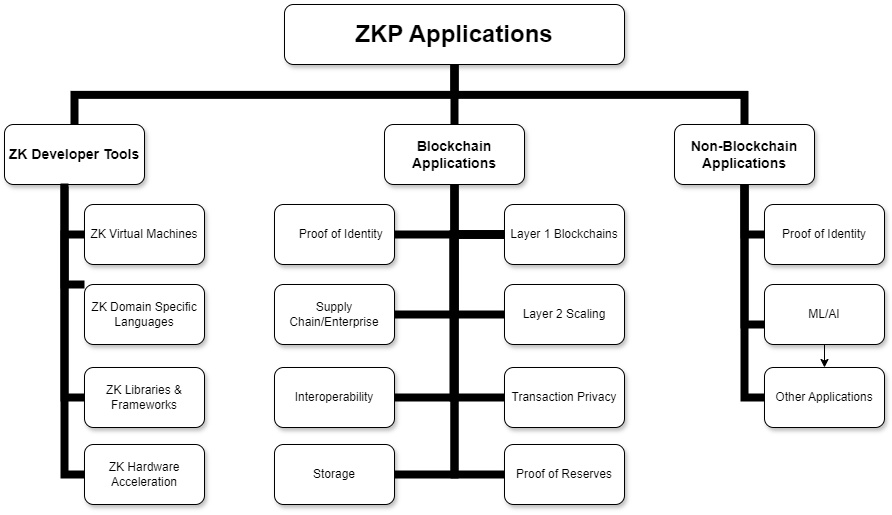
- Highlight practical applications of ZKPs in blockchain (privacy, scaling, storage, interoperability) and non-blockchain domains (voting, authentication, timelocks, ML).
- Describe foundational components, infrastructure, and tooling (zkVMs, DSLs, libraries, frameworks) enabling ZKP deployment.
- Compare ZKPs to other privacy-preserving methods (FHE, MPC) and discuss trade-offs and setup considerations.
- Identify future directions and the role of ZKPs in advancing cryptographic privacy in diverse applications.
Proposed method
- Explain SNARK definitions and properties (succinctness, non-interactivity, knowledge).
- Describe the ZKP lifecycle from frontend (high-level code to circuits) to backend (proof generation, verification).
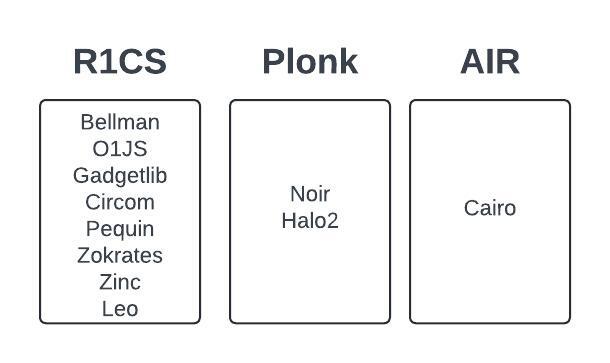
- Present arithmetization via Rank-1 Constraint Systems (R1CS) and backends as Quadratic Arithmetic Programs (QAP).
- Discuss integration with cryptographic gadgets like polynomial commitment schemes and Fiat-Shamir for non-interactive proofs.
- Examine zkVM architectures, domain-specific languages, and supporting libraries/frameworks used to build ZKP-enabled applications.
Experimental results
Research questions
- RQ1What are the foundational components and properties of zkSNARKs that enable practical zero-knowledge proofs?
- RQ2What infrastructure (zkVMs, DSLs, libraries) supports the development and deployment of ZKP-enabled applications?
- RQ3How are ZKPs applied across blockchain and non-blockchain domains, and what are the key use cases and challenges?
- RQ4What are the future directions and open research directions in ZKP deployment and privacy-preserving computation?
Key findings
- ZKPs offer succinct, private proofs of computation, enabling verification without revealing inputs or processes.
- zkSNARKs, with non-interactivity via Fiat-Shamir, are central to practical, publicly verifiable proofs in modern systems.
- The survey contrasts ZKPs with FHE and MPC, highlighting universality and minimal security assumptions as advantages.
- A broad infrastructure ecosystem (zkVMs, zkDSLs, libraries, protocols) supports building ZKP-enabled applications.
- ZKPs are applicable to both blockchain-specific needs (privacy, scaling, interoperability) and broader domains (voting, authentication, ML, timelocks).
- Future directions emphasize the expanding role of ZKPs in cryptographic practice and digital privacy across diverse applications.
Read this paper
Open the full text in the Nubint reader and ask about any passage as you read.
Read this paper on NubintThis review was generated by AI from the original paper. Please check the paper before citing it.