
[Paper Review] A Survey on the Memory Mechanism of Large Language Model based Agents
This survey analyzes the memory module in LLM-based agents, defining memory, detailing design strategies (sources, forms, operations), evaluation, and applications, and outlining future directions.
Large language model (LLM) based agents have recently attracted much attention from the research and industry communities. Compared with original LLMs, LLM-based agents are featured in their self-evolving capability, which is the basis for solving real-world problems that need long-term and complex agent-environment interactions. The key component to support agent-environment interactions is the memory of the agents. While previous studies have proposed many promising memory mechanisms, they are scattered in different papers, and there lacks a systematical review to summarize and compare these works from a holistic perspective, failing to abstract common and effective designing patterns for inspiring future studies. To bridge this gap, in this paper, we propose a comprehensive survey on the memory mechanism of LLM-based agents. In specific, we first discuss ''what is'' and ''why do we need'' the memory in LLM-based agents. Then, we systematically review previous studies on how to design and evaluate the memory module. In addition, we also present many agent applications, where the memory module plays an important role. At last, we analyze the limitations of existing work and show important future directions. To keep up with the latest advances in this field, we create a repository at \url{https://github.com/nuster1128/LLM_Agent_Memory_Survey}.
Motivation & Objective
- Define memory in LLM-based agents and justify its necessity.
- Systematically categorize memory design across sources, forms, and operations.
- Review evaluation methodologies for agent memory and identify best practices.
- Survey agent applications where memory is critical and analyze limitations.
- Highlight open challenges and future research directions in memory-enabled agents.
Proposed method
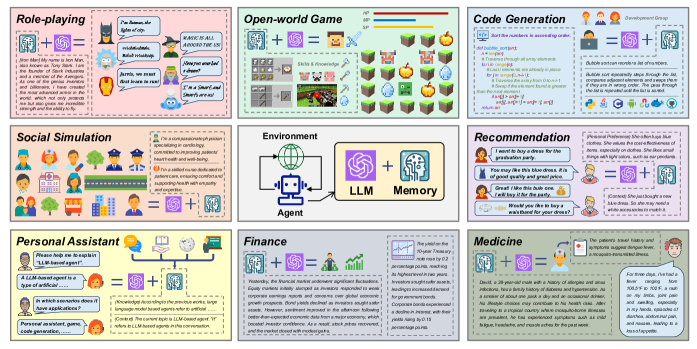
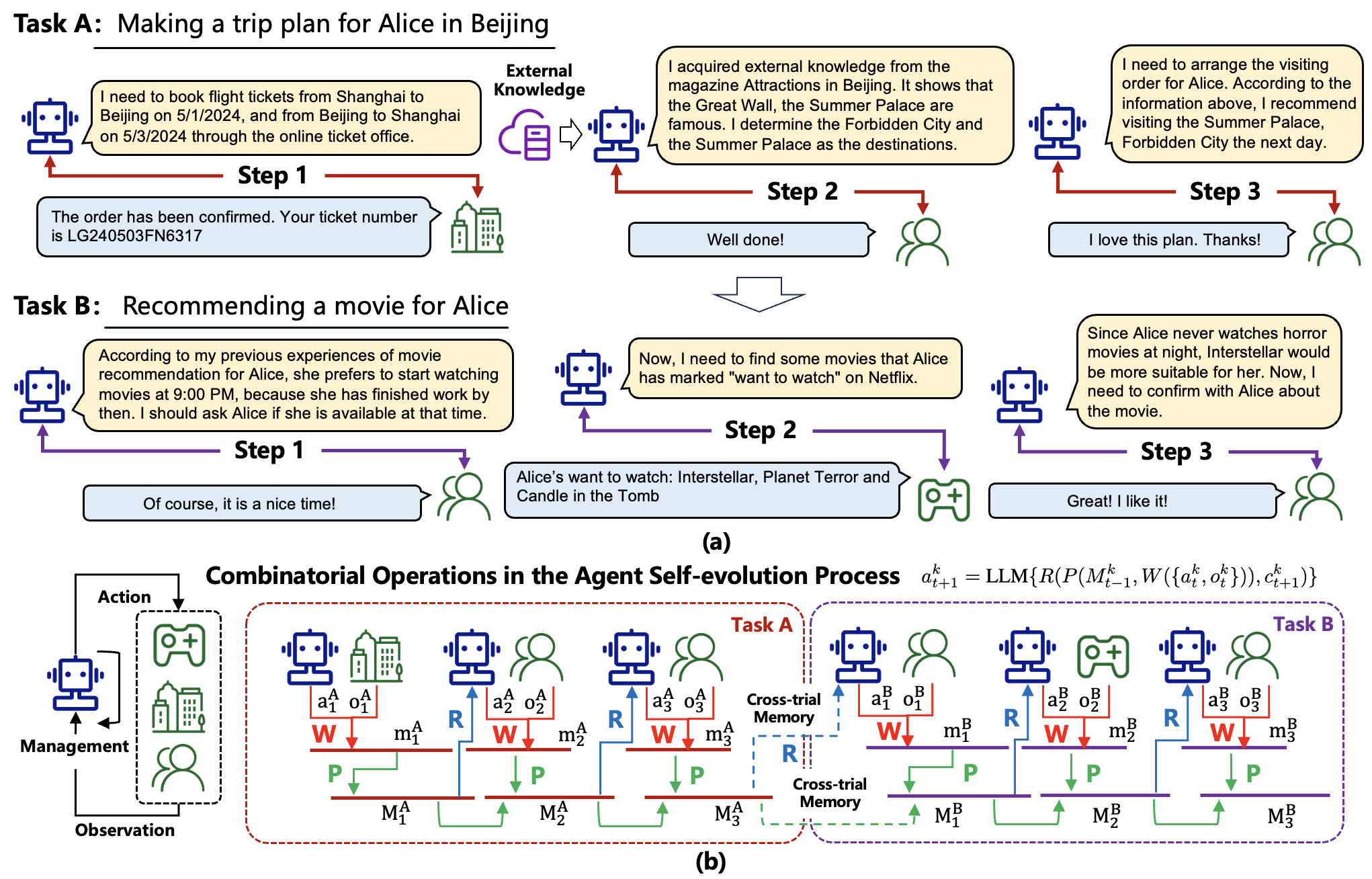
- Define narrow and broad notions of agent memory and model the three-phase interaction process (writing, management, reading).
- Classify memory sources into inside-trial, cross-trial, and external knowledge, with examples from existing systems.
- Describe memory forms as textual or parametric representations and compare their pros/cons.
- Explain memory operations: writing (W), management (P), reading (R) and the unified evolving function with LLMs.
- Survey evaluation approaches including direct and indirect tasks, and various application scenarios.
Experimental results
Research questions
- RQ1What constitutes memory in LLM-based agents, and why is it needed for agent autonomy and self-evolution?
- RQ2How can memory be effectively implemented (sources, forms, operations) and evaluated across tasks?
- RQ3What are the main applications that demonstrate the importance of memory in LLM-based agents?
- RQ4What are the limitations of current memory modules and future directions for improvement.
Key findings
- Memory is essential for agent-environment interaction, enabling perception, processing, and action in a loop.
- Memory can be narrow (within a trial) or broad (across trials and tasks), incorporating external knowledge.
- Memory sources include inside-trial information, cross-trial information, and external knowledge, with many systems using all three to varying extents.
- Memory forms include textual and parametric representations, each with trade-offs in explainability and efficiency.
- Memory operations comprise writing, management, and reading, with a unified formulation guiding agent actions via LLMs.
- The survey identifies limitations and highlights future directions such as parametric memory, multi-agent memory, and lifelong learning.
Read this paper
Open the full text in the Nubint reader and ask about any passage as you read.
Read this paper on NubintThis review was generated by AI from the original paper. Please check the paper before citing it.