
[Paper Review] A Survey on Transformers in Reinforcement Learning
A comprehensive survey of how Transformer architectures are used in reinforcement learning, including representations, world models, sequential decision-making, and generalist agents, with taxonomy and future directions.
Transformer has been considered the dominating neural architecture in NLP and CV, mostly under supervised settings. Recently, a similar surge of using Transformers has appeared in the domain of reinforcement learning (RL), but it is faced with unique design choices and challenges brought by the nature of RL. However, the evolution of Transformers in RL has not yet been well unraveled. In this paper, we seek to systematically review motivations and progress on using Transformers in RL, provide a taxonomy on existing works, discuss each sub-field, and summarize future prospects.
Motivation & Objective
- Motivate the study of Transformer architectures in RL and identify unique challenges compared to supervised learning.
- Provide a taxonomy of Transformer-based RL methods and summarize representative works across sub-fields.
- Analyze how Transformers are used for state representation, world modeling, and direct sequential decision-making in RL.
- Discuss practical challenges such as non-stationarity, sample efficiency, and computational demands, and outline future directions.
Proposed method
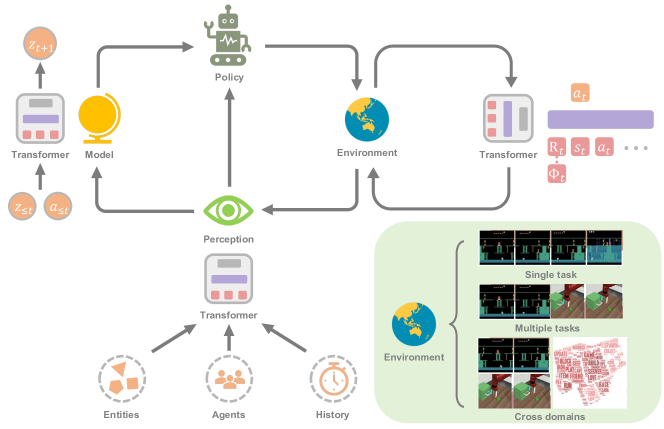
- Survey existing literature on Transformers in RL and organize it into a structured taxonomy (representation learning, model learning, sequential decision-making, generalist agents).
- Describe how Transformers are used as encoders for local per-timestep and temporal sequences, including multi-entity observations and memory-based policies.
- Explain Transformer-based world models that condition on history and enable planning in model-based RL.
- Summarize offline RL formulations where RL is treated as conditional sequence modeling (Decision Transformer and variants).
- Highlight architectural improvements and conditioning strategies (return-to-go, hindsight information) and robustness strategies (separate world/policy models).
- Discuss challenges (non-stationarity, data efficiency, compute/memory costs) and propose future directions.
Experimental results
Research questions
- RQ1What are the motivations and benefits of applying Transformer architectures to reinforcement learning?
- RQ2How are Transformer-based methods categorized in RL (representation, model learning, sequential decision-making, generalist agents) and what are representative approaches in each category?
- RQ3What conditioning signals and architectural modifications improve Transformer-based RL performance and robustness?
- RQ4What are the main challenges hindering Transformer usage in RL and how are offline RL and related paradigms addressing them?
- RQ5What future directions could consolidate Transformers as foundational models for RL?
Key findings
- Transformers have been applied as both representation learners and as full sequential decision-makers in RL, with notable success in memory, relational reasoning, and long-horizon tasks.
- World models conditioned on history using Transformer architectures can improve data efficiency and long-term prediction in model-based RL.
- Decision Transformer and related works recast RL as conditional sequence modeling, enabling planning and imitation within an offline data framework.
- A wide variety of conditioning signals (return-to-go, hindsight information, task-specific cues) and architectural variants (inner/outer Transformers, separate world/policy models) enhance robustness and performance in different RL settings.
- Offline RL and offline-to-online strategies leveraging Transformers address non-stationarity and sample efficiency challenges inherent to RL.
- Despite improvements, Transformers in RL face high computational/memory costs and data-hungry requirements, motivating efficiency-focused research and offline-oriented approaches.

Read this paper
Open the full text in the Nubint reader and ask about any passage as you read.
Read this paper on NubintThis review was generated by AI from the original paper. Please check the paper before citing it.