
[Paper Review] A Theoretical Understanding of Self-Correction through In-context Alignment
This paper provides the first theoretical analysis showing that large language models (LLMs) can perform in-context alignment through self-correction, leveraging realistic transformer components like softmax attention, multi-head attention, and MLP blocks to refine responses using self-generated rewards. It proves that transformers can optimize ranking-based alignment objectives (e.g., Bradley-Terry, Plackett-Luce) via in-context gradient descent, validating the mechanism with synthetic and real-world experiments, including jailbreak defense and bias mitigation.
Going beyond mimicking limited human experiences, recent studies show initial evidence that, like humans, large language models (LLMs) are capable of improving their abilities purely by self-correction, i.e., correcting previous responses through self-examination, in certain circumstances. Nevertheless, little is known about how such capabilities arise. In this work, based on a simplified setup akin to an alignment task, we theoretically analyze self-correction from an in-context learning perspective, showing that when LLMs give relatively accurate self-examinations as rewards, they are capable of refining responses in an in-context way. Notably, going beyond previous theories on over-simplified linear transformers, our theoretical construction underpins the roles of several key designs of realistic transformers for self-correction: softmax attention, multi-head attention, and the MLP block. We validate these findings extensively on synthetic datasets. Inspired by these findings, we also illustrate novel applications of self-correction, such as defending against LLM jailbreaks, where a simple self-correction step does make a large difference. We believe that these findings will inspire further research on understanding, exploiting, and enhancing self-correction for building better foundation models.
Motivation & Objective
- To establish a principled theoretical understanding of how self-correction emerges in large language models (LLMs) without fine-tuning.
- To formalize self-correction as in-context alignment (ICA), where LLMs use (query, response, reward) triplets to refine outputs.
- To analyze the role of realistic transformer components—softmax attention, multi-head attention, and MLP blocks—in enabling in-context alignment.
- To validate the theory through synthetic and real-world experiments, including jailbreak defense and bias reduction.
- To demonstrate that high-quality self-critics are essential for effective self-correction, aligning with empirical findings.
Proposed method
- Formulate self-correction as in-context alignment (ICA) using triplet examples (query, response, reward), analogous to RLHF and DPO.
- Construct a theoretical setup where a multi-layer transformer learns to optimize ranking-based alignment objectives (e.g., Bradley-Terry, Plackett-Luce) via in-context gradient descent.
- Design a modified attention mechanism that tracks the maximum reward among previous tokens using masked positional encodings and residual updates.
- Introduce a key-query-value matrix construction that enables the model to attend to the highest-reward response so far, using large-scale attention scaling and masking.
- Use a residual connection to propagate the positional encoding of the highest-reward token to the output, enabling selection of the best response.
- Validate the mechanism on synthetic datasets with noisy responses and accurate critics, and test on real LLMs (e.g., Vicuna-7b, Llama2-7b) for bias and jailbreak mitigation.
Experimental results
Research questions
- RQ1Can LLMs perform effective in-context alignment using self-generated rewards from self-examination?
- RQ2What is the theoretical mechanism by which realistic transformer components (e.g., softmax attention, multi-head attention, MLP) enable self-correction?
- RQ3How does the quality of self-critics affect the performance of self-correction in LLMs?
- RQ4Can self-correction via in-context alignment reduce social bias and defend against jailbreak attacks without external feedback?
- RQ5To what extent do real transformer components matter for in-context alignment compared to simplified linear models?
Key findings
- Theoretical analysis proves that a standard multi-layer transformer can optimize ranking-based alignment objectives (e.g., Bradley-Terry, Plackett-Luce) via in-context gradient descent using self-generated rewards.
- The mechanism relies on a modified attention mechanism that tracks the highest-reward response through masked positional encodings and residual updates.
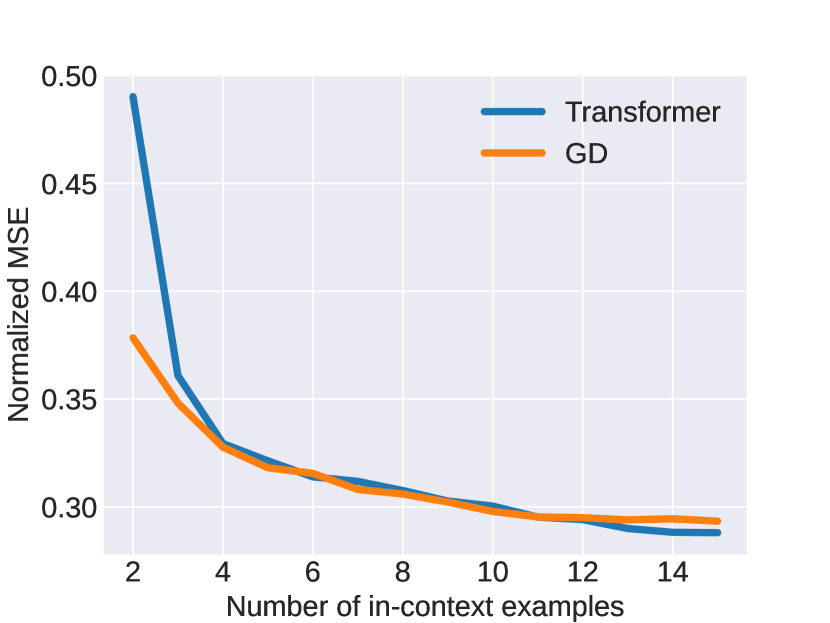
- Synthetic experiments confirm that transformers can refine responses using noisy outputs when provided with relatively accurate self-critics.
- Real-world experiments show that self-correction reduces jailbreak success rates from 95% to 2% on Llama2-7b-chat, demonstrating strong defense capability.
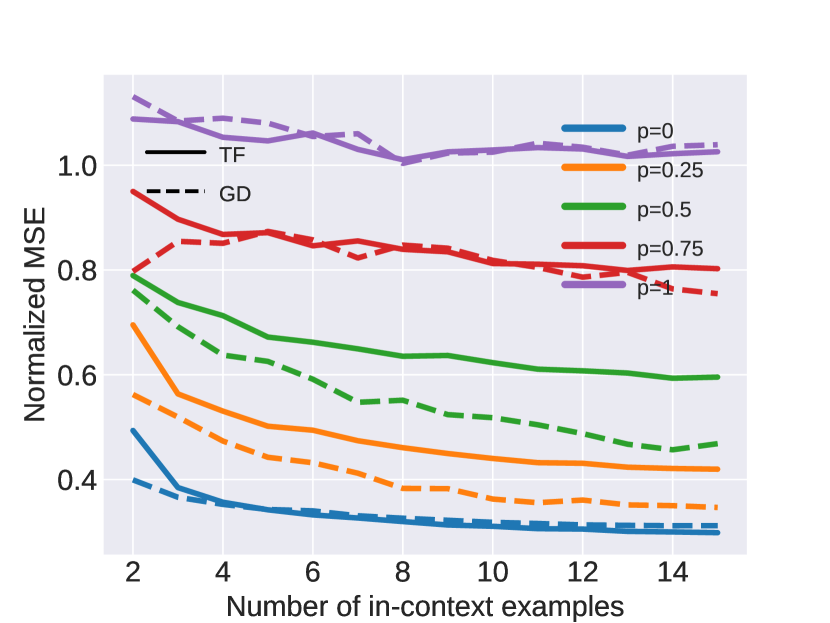
- A strong correlation is observed between self-checking accuracy and final model performance, validating the role of high-quality self-critics.
- Theoretical insights reveal that multi-head attention, softmax attention, and MLP blocks are essential for effective in-context alignment, moving beyond simplified linear models.
Read this paper
Open the full text in the Nubint reader and ask about any passage as you read.
Read this paper on NubintThis review was generated by AI from the original paper. Please check the paper before citing it.