
[Paper Review] A Touch, Vision, and Language Dataset for Multimodal Alignment
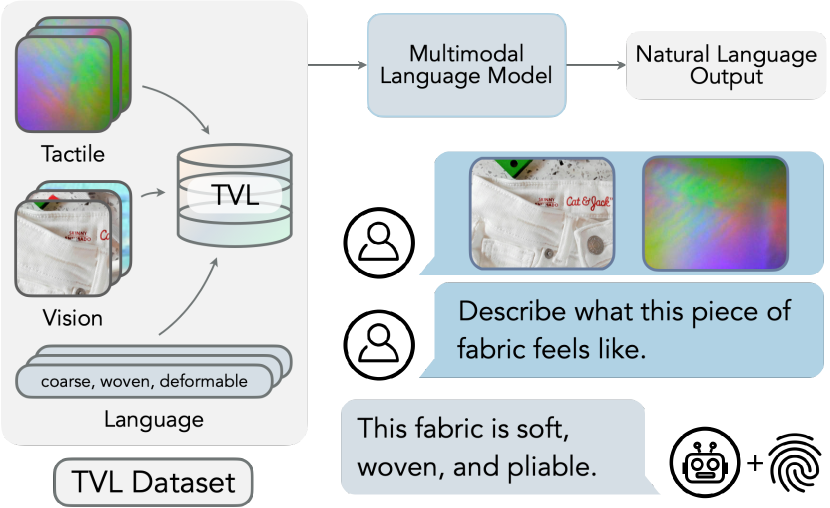
This paper introduces the TVL dataset (44K vision-tactile pairs with human and GPT-4V labels) and trains a tactile encoder aligned to vision and language, enabling a tactile-vision-language model (TVLM) that generates tactile descriptions from visual and tactile inputs and improves multimodal alignment.
Touch is an important sensing modality for humans, but it has not yet been incorporated into a multimodal generative language model. This is partially due to the difficulty of obtaining natural language labels for tactile data and the complexity of aligning tactile readings with both visual observations and language descriptions. As a step towards bridging that gap, this work introduces a new dataset of 44K in-the-wild vision-touch pairs, with English language labels annotated by humans (10%) and textual pseudo-labels from GPT-4V (90%). We use this dataset to train a vision-language-aligned tactile encoder for open-vocabulary classification and a touch-vision-language (TVL) model for text generation using the trained encoder. Results suggest that by incorporating touch, the TVL model improves (+29% classification accuracy) touch-vision-language alignment over existing models trained on any pair of those modalities. Although only a small fraction of the dataset is human-labeled, the TVL model demonstrates improved visual-tactile understanding over GPT-4V (+12%) and open-source vision-language models (+32%) on a new touch-vision understanding benchmark. Code and data: https://tactile-vlm.github.io.
Motivation & Objective
- Motivate integrating tactile sensing into multimodal language models for open-vocabulary tasks.
- Create a large in-the-wild vision-tactile dataset with human and GPT-4V annotations.
- Train a vision-language-aligned tactile encoder and a tactile-vision-language model (TVLM).
- Demonstrate improved touch-vision-language alignment and generation compared to baselines.
- Show that pseudo-labeling with GPT-4V can complement limited human labels.
Proposed method
- Collect a 44K vision-tactile dataset (TVL) with in-the-wild data using a hand-held device and synchronized vision and tactile readings.
- Annotate 10% of data with human tactile language descriptions and use GPT-4V to pseudo-label the remaining 90%.
- Train a tactile encoder using pairwise contrastive learning across tactile-language, tactile-vision, and vision-language pairs, aligned to OpenCLIP embeddings.
- Fine-tune a language-capable model (TVL-LLaMA) to generate tactile descriptions from combined visual and tactile inputs.
- Evaluate using a TVL Benchmark with a cross-modal classification task and a tactile-semantic generation task, scoring against ground-truth annotations.
Experimental results
Research questions
- RQ1How can tactile data be aligned with vision and language in an open-vocabulary setting?
- RQ2Does a mixed-supervision regime (human + GPT-4V labels) improve tactile-vision-language alignment and generation?
- RQ3Can a tactile encoder aligned to visual and textual modalities support open-vocabulary tactile description generation?
- RQ4How does TVLM compare to existing vision-language models and GPT-4V on touch-vision-language benchmarks?
Key findings
- TVL encoder achieves improved tactile-language alignment, showing +29% classification accuracy over models trained on any single modality pairing.
- TVL-LLaMA models outperform GPT-4V and open-source vision-language models on the TVL Benchmark, with at least +12% and +32% improvements respectively.
- Using both human and pseudo labels enables better multimodal understanding than using only one source of labels.
- Open-vocabulary tactile classification on the TVL benchmark is feasible with a tactile encoder trained on the TVL dataset.
- Pseudo-labels from GPT-4V effectively scale data utility when combined with a smaller fraction of human annotations.

Read this paper
Open the full text in the Nubint reader and ask about any passage as you read.
Read this paper on NubintThis review was generated by AI from the original paper. Please check the paper before citing it.