
[Paper Review] A Trust-Centric Privacy-Preserving Blockchain for Dynamic Spectrum Management in IoT Networks
This paper proposes a trust-centric, privacy-preserving blockchain for dynamic spectrum access in IoT networks, using a Proof-of-Trust (PoT) consensus mechanism and a hybrid ring signature/commit-and-reveal scheme to ensure low computational overhead, high transaction throughput, and protection of node location privacy. The system improves cooperative sensing accuracy while resisting Sybil, free-riding, and on-off attacks through a trust model that resists malicious behavior when parameters satisfy ρ > η/(1−e^−η) − η.
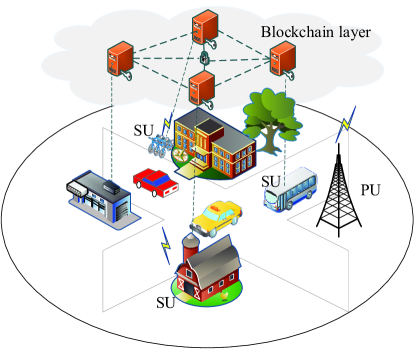
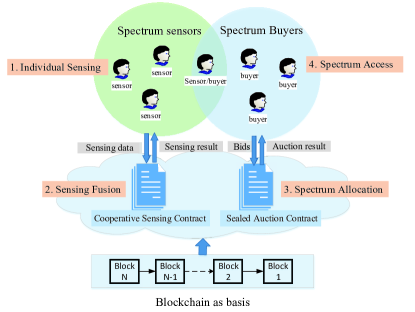
In this paper, we propose a trust-centric privacy-preserving blockchain for dynamic spectrum access in IoT networks. To be specific, we propose a trust evaluation mechanism to evaluate the trustworthiness of sensing nodes and design a Proof-of-Trust (PoT) consensus mechanism to build a scalable blockchain with high transaction-per-second (TPS). Moreover, a privacy protection scheme is proposed to protect sensors' real-time geolocatioin information when they upload sensing data to the blockchain. Two smart contracts are designed to make the whole procedure (spectrum sensing, spectrum auction, and spectrum allocation) run automatically. Simulation results demonstrate the expected computation cost of the PoT consensus algorithm for reliable sensing nodes is low, and the cooperative sensing performance is improved with the help of trust value evaluation mechanism.In addition, incentivization and security are also analyzed, which show that our design not only can encourage nodes' participation, but also resist to many kinds of attacks which are frequently encountered in trust-based blockchain systems.
Motivation & Objective
- To address the lack of trust and privacy in blockchain-based dynamic spectrum access (DSA) for IoT networks.
- To reduce the high computational cost of traditional consensus mechanisms like Proof-of-Work (PoW) in resource-constrained IoT environments.
- To protect the real-time geolocation and identity of sensing nodes during data upload to the blockchain.
- To incentivize honest participation and resist common attacks such as Sybil, free-riding, and on-off attacks in trust-based blockchain systems.
- To enable fully automated spectrum sensing, auction, and allocation using smart contracts on a decentralized platform.
Proposed method
- Proposes a trust evaluation mechanism that assigns and updates trust values based on sensing accuracy and behavior history, using a function f(N_r, N_w) = e^(-ρ·N_w)·(1 - e^(-η·N_r)) to model trust decay and growth.
- Introduces a Proof-of-Trust (PoT) consensus algorithm where mining difficulty is proportional to a node’s trust value, reducing computation cost for honest nodes and increasing it for malicious ones.
- Employs a hybrid privacy protection scheme combining ring signatures (to hide node identities during data upload) and a commit-and-reveal protocol (to bind data to originators post-fusion for trust and reward assignment).
- Designs two smart contracts to automate the entire DSA pipeline: one for spectrum sensing and data submission, and another for spectrum auction and allocation.
- Implements the system using Solidity on Ethereum, with a deposit mechanism to deter Sybil attacks by requiring token collateral for participation.
- Uses secure ECDSA signatures to prevent spoofing attacks, ensuring transaction authenticity when private keys are protected.
Experimental results
Research questions
- RQ1How can a trust evaluation mechanism be designed to improve the reliability of sensing data in a decentralized DSA system?
- RQ2Can a consensus mechanism be developed that reduces computational overhead for honest nodes while increasing it for malicious ones?
- RQ3How can the real-time geolocation and identity of IoT sensing nodes be protected during data submission to a public blockchain?
- RQ4To what extent can the proposed system resist common attacks such as Sybil, free-riding, and on-off attacks in trust-based blockchain systems?
- RQ5What is the impact of the proposed PoT consensus and trust model on cooperative sensing performance and system scalability?
Key findings
- The PoT consensus algorithm significantly reduces the expected computation cost for reliable sensing nodes, enabling high transaction-per-second (TPS) performance suitable for IoT-scale DSA.
- The trust evaluation mechanism improves cooperative sensing performance by incentivizing honest behavior and filtering out low-quality or malicious data.
- The hybrid ring signature and commit-and-reveal scheme effectively protects node privacy—hiding identities during upload while enabling post-fusion trust and reward assignment.
- Security analysis confirms resistance to Sybil attacks due to the deposit mechanism, which requires attackers to stake large token amounts.
- The system resists free-riding attacks because ring signatures obscure data ownership, and early submission is discouraged by timing constraints and lack of incentive.
- The trust model is proven resistant to on-off attacks when ρ > η/(1−e^−η) − η, ensuring that trust values drop faster under misbehavior than they rise under honest behavior.
Read this paper
Open the full text in the Nubint reader and ask about any passage as you read.
Read this paper on NubintThis review was generated by AI from the original paper. Please check the paper before citing it.