
[Paper Review] A tutorial on networks in social systems: A mathematical modeling perspective
This tutorial provides a foundational mathematical framework for modeling social networks, introducing key concepts like graph representations, network properties (e.g., clustering, degree distribution), and generative models (e.g., Erdős–Rényi, preferential attachment, Watts–Strogatz). It demonstrates how these models explain common structural patterns in real-world social networks, such as small-world properties and community structure.
This article serves as an introduction to the study of networks of social systems. First, we introduce the reader to key mathematical tools to study social networks, including mathematical representations of networks and essential terminology. We describe several network properties of interest and techniques for measuring these properties. We also discuss some popular generative models of networks and see how the study of these models provides insight into the mechanisms for the emergence of structural patterns. Throughout, we will highlight the patterns that commonly emerge in social networks. The goal is to provide an accessible, broad, and solid foundation for a reader who is new to the field so that they may confidently engage more deeply with the mathematical study of social networks.
Motivation & Objective
- To introduce researchers new to social network analysis with a mathematically grounded foundation in network representation and terminology.
- To explain core network properties—such as degree distribution, clustering, and path length—that commonly emerge in social systems.
- To demonstrate how generative network models (e.g., G(n,p), preferential attachment, stochastic block models) help explain the emergence of observed structural patterns.
- To guide researchers toward deeper study by highlighting key tools, resources, and open problems in the mathematical study of social networks.
Proposed method
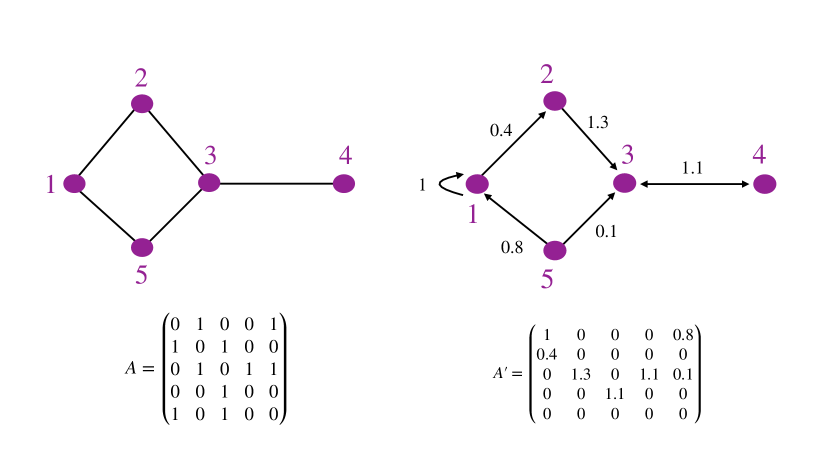
- Represent social networks using undirected or directed graphs G = (V, E), where V is the set of nodes and E the set of edges.
- Use adjacency matrices to encode network structure, with binary entries for unweighted graphs and weighted entries for weighted edges.
- Apply mathematical tools to measure network properties: degree distribution, clustering coefficient, shortest path length, and modularity.
- Utilize generative models such as G(n,p) and G(n,m) for random networks, and preferential attachment models to produce scale-free networks with power-law degree distributions.
- Employ the Watts–Strogatz model to generate networks with high clustering and short average path lengths, mimicking small-world phenomena.
- Use stochastic block models to generate networks with community structure by assigning different connection probabilities between node groups.
Experimental results
Research questions
- RQ1What mathematical tools are essential for modeling and analyzing social networks?
- RQ2Which structural properties—such as clustering, degree distribution, and small-world characteristics—are commonly observed in real social networks?
- RQ3How do generative network models explain the emergence of observed structural patterns like power-law degree distributions or community structure?
- RQ4What mechanisms underlie the formation of network features such as high clustering and short path lengths in social systems?
- RQ5How can mathematical modeling of networks inform the study of dynamics, such as information spread or decision-making, in social systems?
Key findings
- Real-world social networks frequently exhibit high clustering and short average path lengths, a combination known as the small-world property.
- Many social networks display a power-law degree distribution, which can be explained by preferential attachment mechanisms in generative models.
- The Watts–Strogatz model successfully generates networks with both high clustering and short path lengths by rewiring edges with a low probability.
- Stochastic block models can effectively reproduce community structure in networks by assigning different connection probabilities between node groups.
- Configuration models allow for the generation of networks with a specified degree sequence, enabling comparison with empirical data.
- Generative models such as preferential attachment and the configuration model provide theoretical insight into the mechanisms driving structural patterns in social networks.
Read this paper
Open the full text in the Nubint reader and ask about any passage as you read.
Read this paper on NubintThis review was generated by AI from the original paper. Please check the paper before citing it.