
[Paper Review] A Two-stage Complex Network using Cycle-consistent Generative Adversarial Networks for Speech Enhancement
This paper proposes a two-stage complex network using Cycle-GAN and a deep complex denoising network for single-channel speech enhancement. First, a Cycle-GAN estimates clean speech magnitude while preserving cycle-consistency; then, a complex-valued denoising network refines the phase and suppresses residual noise, achieving state-of-the-art performance in speech quality and noise suppression across multiple datasets.
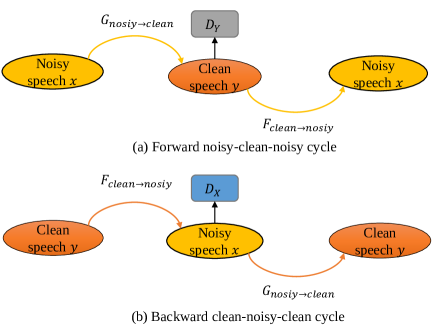
Cycle-consistent generative adversarial networks (CycleGAN) have shown their promising performance for speech enhancement (SE), while one intractable shortcoming of these CycleGAN-based SE systems is that the noise components propagate throughout the cycle and cannot be completely eliminated. Additionally, conventional CycleGAN-based SE systems only estimate the spectral magnitude, while the phase is unaltered. Motivated by the multi-stage learning concept, we propose a novel two-stage denoising system that combines a CycleGAN-based magnitude enhancing network and a subsequent complex spectral refining network in this paper. Specifically, in the first stage, a CycleGAN-based model is responsible for only estimating magnitude, which is subsequently coupled with the original noisy phase to obtain a coarsely enhanced complex spectrum. After that, the second stage is applied to further suppress the residual noise components and estimate the clean phase by a complex spectral mapping network, which is a pure complex-valued network composed of complex 2D convolution/deconvolution and complex temporal-frequency attention blocks. Experimental results on two public datasets demonstrate that the proposed approach consistently surpasses previous one-stage CycleGANs and other state-of-the-art SE systems in terms of various evaluation metrics, especially in background noise suppression.
Motivation & Objective
- To address the limitation of CycleGAN-based speech enhancement models that retain residual noise due to cycle-consistency constraints.
- To overcome phase distortion in low SNR conditions by jointly estimating clean phase and suppressing residual noise.
- To improve speech quality and intelligibility by decoupling magnitude and phase estimation into a two-stage learning framework.
- To introduce a novel complex-valued neural network with temporal-frequency attention for end-to-end complex spectral mapping.
- To validate the superiority of the two-stage approach over one-stage CycleGAN and other state-of-the-art methods on public datasets.
Proposed method
- A two-stage framework is designed: first, a Cycle-GAN-based magnitude mapping network (CycleGAN-MM) estimates clean spectral magnitude using relativistic average loss and cycle-consistency loss.
- The estimated magnitude is combined with the original noisy phase to form a coarsely enhanced complex spectrum as input to the second stage.
- A deep complex-valued denoising network (DCD-Net) is introduced in the second stage to refine the complex spectrum by estimating both real and imaginary components of the clean spectrum.
- DCD-Net employs complex 2D convolutional and deconvolutional layers, along with complex-valued temporal-frequency attention (T-FA) blocks to model long-range dependencies in time and frequency domains.
- The entire system is trained in a cascaded manner, with the first stage pre-trained before fine-tuning the second stage.
- The method uses a complex ratio mask for loss computation in the second stage to improve phase estimation accuracy.
Experimental results
Research questions
- RQ1Can a two-stage learning framework improve speech enhancement performance by decoupling magnitude and phase estimation?
- RQ2Does incorporating a complex-valued denoising network after a Cycle-GAN magnitude estimator reduce residual noise and phase distortion?
- RQ3Can temporal-frequency attention mechanisms in both stages enhance global dependency modeling and improve performance in low SNR conditions?
- RQ4How does the proposed two-stage complex network compare to one-stage CycleGAN and other SOTA methods in terms of objective and subjective metrics?
- RQ5Is the proposed method robust across different noise types and SNR levels?
Key findings
- The proposed two-stage model, CycleGAN-DCD, achieves an average 0.32 and 0.30 PESQ improvement over CycleGAN-MM on Babble and Factory1 noise types, respectively.
- It provides 0.99 dB and 1.03 dB gains in segmental SNR (SSNR) on Babble and Factory1 noise, indicating superior noise suppression.
- On the WSJ0-SI84 + DNS dataset, CycleGAN-DCD achieves 0.27 and 0.30 DNSMOS score improvements over CycleGAN-MM for Factory1 and Babble noise, respectively.
- Compared to the best non-GAN baseline (Noncausal-GCRN), CycleGAN-DCD improves PESQ by 0.06, STOI by 0.33%, and SSNR by 0.21 dB on average.
- The model shows significant improvements in CBAK (residual noise) and COVL (overall quality), confirming reduced distortion and enhanced speech quality.
- The ablation study confirms that the second-stage complex denoising network is essential for phase recovery and residual noise suppression, as it outperforms one-stage models significantly.

Read this paper
Open the full text in the Nubint reader and ask about any passage as you read.
Read this paper on NubintThis review was generated by AI from the original paper. Please check the paper before citing it.