
[Paper Review] A Unified Framework for Light Spanners
This paper presents a unified framework that transforms sparse spanners into light spanners across multiple graph classes, achieving optimal trade-offs in runtime, lightness, and degree. It resolves a 30-year open problem in geometric spanners by providing an O(n log n)-time construction of (1+ε)-spanners with constant lightness and degree in low-dimensional Euclidean spaces, while also establishing tight, refined lightness bounds for minor-free graphs that improve upon prior work and are matched by new lower bounds.
Seminal works on light spanners over the years have provided spanners with optimal lightness in various graph classes, such as general graphs, Euclidean spanners, and minor-free graphs. Three shortcomings of previous works on light spanners are: (i) The runtimes of these constructions are almost always sub-optimal and usually far from optimal. (ii) These constructions are optimal in the standard and crude sense but not in a refined sense that takes into account a wider range of involved parameters. (iii) The techniques are ad hoc per graph class and thus can't be applied broadly. This work aims at addressing these shortcomings by presenting a unified framework of light spanners in a variety of graph classes. Informally, the framework boils down to a transformation from sparse spanners to light spanners; since the state-of-the-art for sparse spanners is much more advanced than that for light spanners, such a transformation is powerful. First, we apply our framework to design fast constructions with optimal lightness for several graph classes. Second, we apply our framework to achieve more refined optimality bounds for several graph classes, i.e., the bounds remain optimal when taking into account a wider range of involved parameters, most notably $ε$. Our new constructions are significantly better than the state-of-the-art for every examined graph class.
Motivation & Objective
- Address the long-standing challenge of constructing light spanners with optimal runtime and refined lightness bounds across diverse graph classes.
- Overcome the limitations of prior ad hoc constructions that were suboptimal in runtime, lacked fine-grained optimality, and did not generalize across graph families.
- Unify disparate techniques for light spanners into a single, reusable framework based on transforming sparse spanners into light ones.
- Achieve tight, parameterized lightness bounds that account for ε, r (for minor-free graphs), and other structural parameters, improving upon previous results.
Proposed method
- Develop a general transformation from sparse spanners to light spanners, leveraging a potential function to guide edge selection and clustering.
- Use a hierarchical clustering process that partitions vertices and edges at multiple levels, with careful control over edge weights and degrees.
- Introduce a novel orientation scheme for edges in the spanner to bound the total weight of outgoing edges from clusters, ensuring lightness.
- Apply the framework to multiple graph classes, including Euclidean, general, and minor-free graphs, by adapting the clustering and edge selection rules accordingly.
- Establish tight lightness bounds via a combination of upper bounds using the framework and lower bounds via explicit constructions, including a geometric lower bound in R².
- Utilize the algebraic computation tree (ACT) model to achieve optimal O(n log n) runtime for Euclidean spanners with constant degree and lightness.
Experimental results
Research questions
- RQ1Can a single framework unify the construction of light spanners across diverse graph classes while achieving optimal runtime and lightness?
- RQ2What is the tightest possible lightness bound for (1+ε)-spanners in K_r-minor-free graphs, and how does it depend on ε and r?
- RQ3Is it possible to achieve O(n log n) time complexity for (1+ε)-spanners in low-dimensional Euclidean spaces with constant degree and constant lightness?
- RQ4What is the true dependency of lightness on ε in minor-free graphs, and does it exceed the previously conjectured 1/ε scaling?
- RQ5Can a lower bound construction be devised that matches the upper bound in lightness for minor-free graphs, particularly in geometric settings?
Key findings
- An O(n log n)-time construction of (1+ε)-spanners with constant lightness and constant degree is achieved in low-dimensional Euclidean spaces, resolving a 30-year open problem.
- For K_r-minor-free graphs, the framework yields a (1+ε)-spanner with lightness Õ_r,ε(r/ε + 1/ε²), improving over the prior bound of Õ_r,ε(r/ε³).
- A matching lower bound of Ω(r/ε + 1/ε²) is proven for (1+ε)-spanners in K_r-minor-free graphs, showing the bound is tight and surprising due to the 1/ε² dependency.
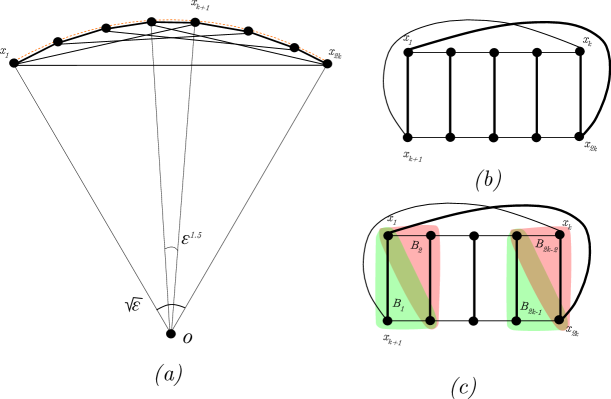
- The lower bound is realized by a geometric graph in R², demonstrating that the 1/ε² dependence is inherent and not an artifact of the construction.
- The framework enables fine-grained optimality by simultaneously optimizing over multiple parameters, including ε, r, and the graph’s structural properties.
- The transformation from sparse to light spanners is shown to be powerful and generalizable, subsuming and improving upon prior ad hoc constructions in multiple settings.

Better researchstarts right now
From reading papers to final review, dramatically reduce your research time.
No credit card · Free plan available
This review was created by AI and reviewed by human editors.