
[Paper Review] A Unified Industrial Large Knowledge Model Framework in Industry 4.0 and Smart Manufacturing
The paper introduces an Industrial Large Knowledge Model (ILKM) framework that leverages domain-specific data to create domain knowledge LLMs for smart manufacturing, and contrasts ILKMs with general LLMs using a 6S principle.
The recent emergence of large language models (LLMs) demonstrates the potential for artificial general intelligence, revealing new opportunities in Industry 4.0 and smart manufacturing. However, a notable gap exists in applying these LLMs in industry, primarily due to their training on general knowledge rather than domain-specific knowledge. Such specialized domain knowledge is vital for effectively addressing the complex needs of industrial applications. To bridge this gap, this paper proposes a unified industrial large knowledge model (ILKM) framework, emphasizing its potential to revolutionize future industries. In addition, ILKMs and LLMs are compared from eight perspectives. Finally, the "6S Principle" is proposed as the guideline for ILKM development, and several potential opportunities are highlighted for ILKM deployment in Industry 4.0 and smart manufacturing.
Motivation & Objective
- Motivate the need for domain-specific large knowledge models in Industry 4.0 and smart manufacturing due to gaps in general LLM training.
- Propose an ILKM framework that integrates industrial data, domain instructions, and expert systems to address industrial challenges.
- Introduce the 6S Principle to guide development of ILKMs for safety, scalability, and standardization.
Proposed method
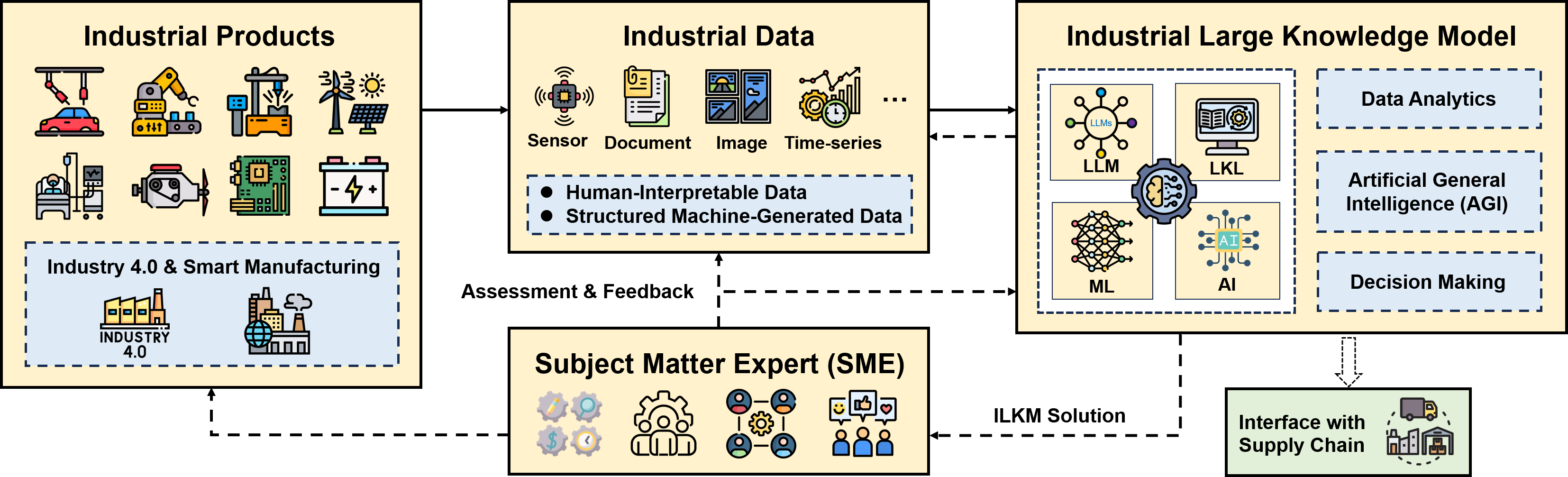
- Construct a Large Knowledge Library (LKL) separating human-interpretable and structured machine-generated data.
- Prepare domain-specific instruction data by organizing problems, inputs, and outputs for domain tuning.
- Pre-train and fine-tune a Domain Knowledge LLM using LKL-derived data and domain instructions.
- Deploy an intelligent multi-expert ML system where the Domain Knowledge LLM guides domain-specific modeling and SMEs refine outputs.
Experimental results
Research questions
- RQ1What are the key differences between Industrial Large Knowledge Models and Large Language Models across data, domain knowledge, privacy, and real-time decision-making?
- RQ2How can ILKMs be systematically developed and deployed in smart manufacturing to address industrial challenges?
- RQ3What guidelines (6S Principle) should govern the development of ILKMs in Industry 4.0 contexts?
Key findings
- ILKMs are designed for specialized industrial tasks with domain-specific data and better data privacy control compared to general LLMs.
- ILKMs leverage a large knowledge library and domain instructions to enable domain-specific problem solving and analytics.
- A four-step ILKM framework enables data collection, instruction data preparation, domain LLM development, and an intelligent multi-expert ML system.
- The framework emphasizes collaboration between domain knowledge LLMs and human SMEs to generate actionable industrial solutions.

Better researchstarts right now
From reading papers to final review, dramatically reduce your research time.
No credit card · Free plan available
This review was created by AI and reviewed by human editors.