
[Paper Review] A User-Centered, Interactive, Human-in-the-Loop Topic Modelling System
This paper presents a novel, user-centered, interactive human-in-the-loop topic modelling system that supports iterative refinement, model comparison, version tracking, and rollback through a visual interface. It uses query-driven topic modelling (QD-TM) and a novel topic words suggestion feature, significantly improving topic coherence and precision—achieving 0.96 average precision after refinement compared to 0.3 initially—while enabling targeted and full corpus analysis with user-friendly, traceable interactions.
Human-in-the-loop topic modelling incorporates users' knowledge into the modelling process, enabling them to refine the model iteratively. Recent research has demonstrated the value of user feedback, but there are still issues to consider, such as the difficulty in tracking changes, comparing different models and the lack of evaluation based on real-world examples of use. We developed a novel, interactive human-in-the-loop topic modeling system with a user-friendly interface that enables users compare and record every step they take, and a novel topic words suggestion feature to help users provide feedback that is faithful to the ground truth. Our system also supports not only what traditional topic models can do, i.e., learning the topics from the whole corpus, but also targeted topic modelling, i.e., learning topics for specific aspects of the corpus. In this article, we provide an overview of the system and present the results of a series of user studies designed to assess the value of the system in progressively more realistic applications of topic modelling.
Motivation & Objective
- To address limitations in existing human-in-the-loop topic modelling systems, such as lack of model comparison, inability to revert changes, and poor handling of targeted topic analysis.
- To support both full-analysis and targeted-topic modelling by leveraging query-driven topic modelling (QD-TM) as the underlying algorithm.
- To improve topic quality through a novel topic words suggestion feature that enhances user feedback fidelity to ground truth.
- To enable users to explore multiple refinement paths, compare models, and track changes through a complete history panel.
- To evaluate the system’s effectiveness in realistic, complex research scenarios through user studies and detailed use cases.
Proposed method
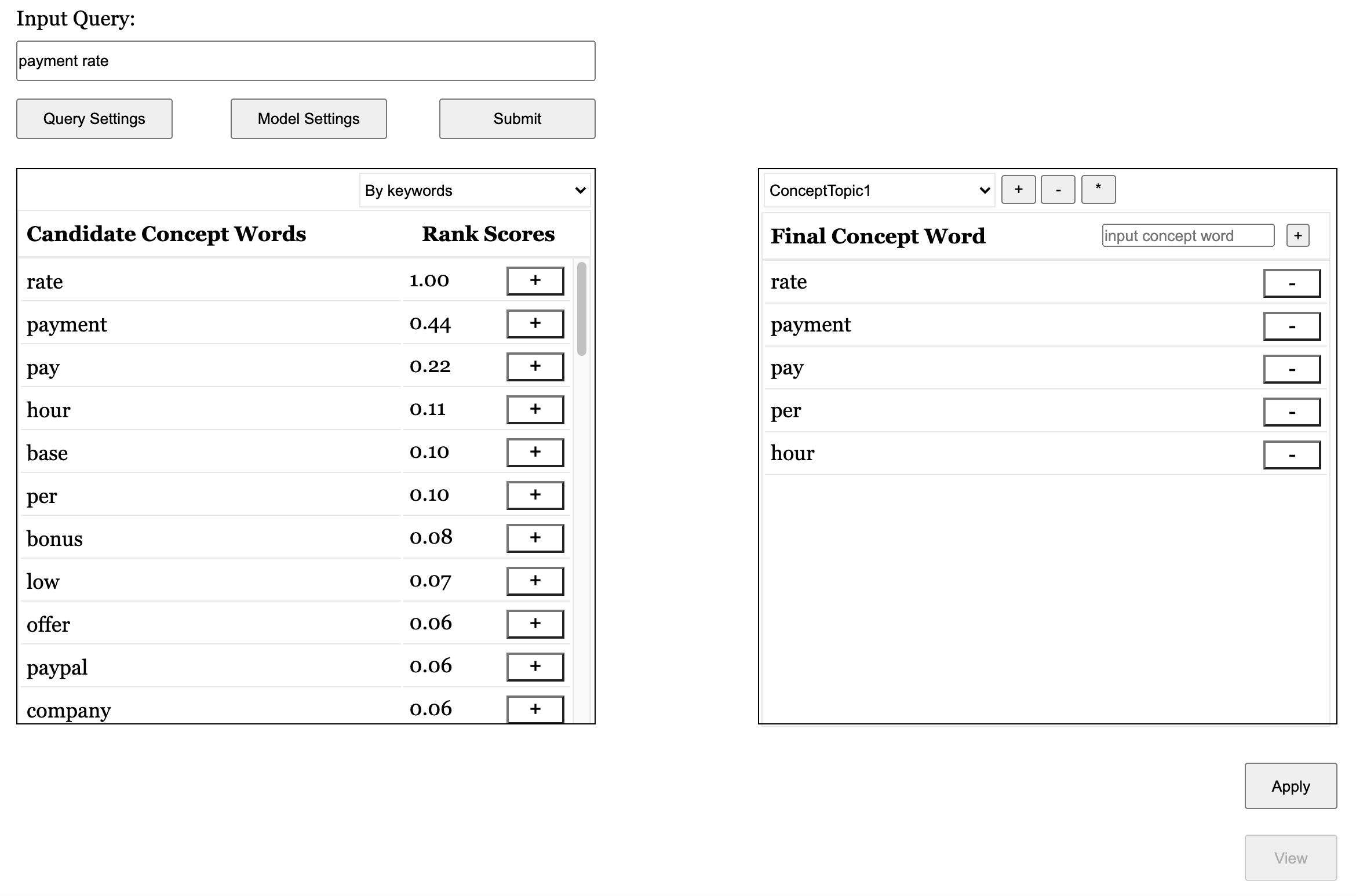
- The system implements six refinement operations: add words, remove words, swap word order, remove documents, merge topics, and split topics, all applied interactively.
- It uses query-driven topic modelling (QD-TM) as the underlying model, enabling both full-corpus and targeted topic learning by incorporating user-defined queries.
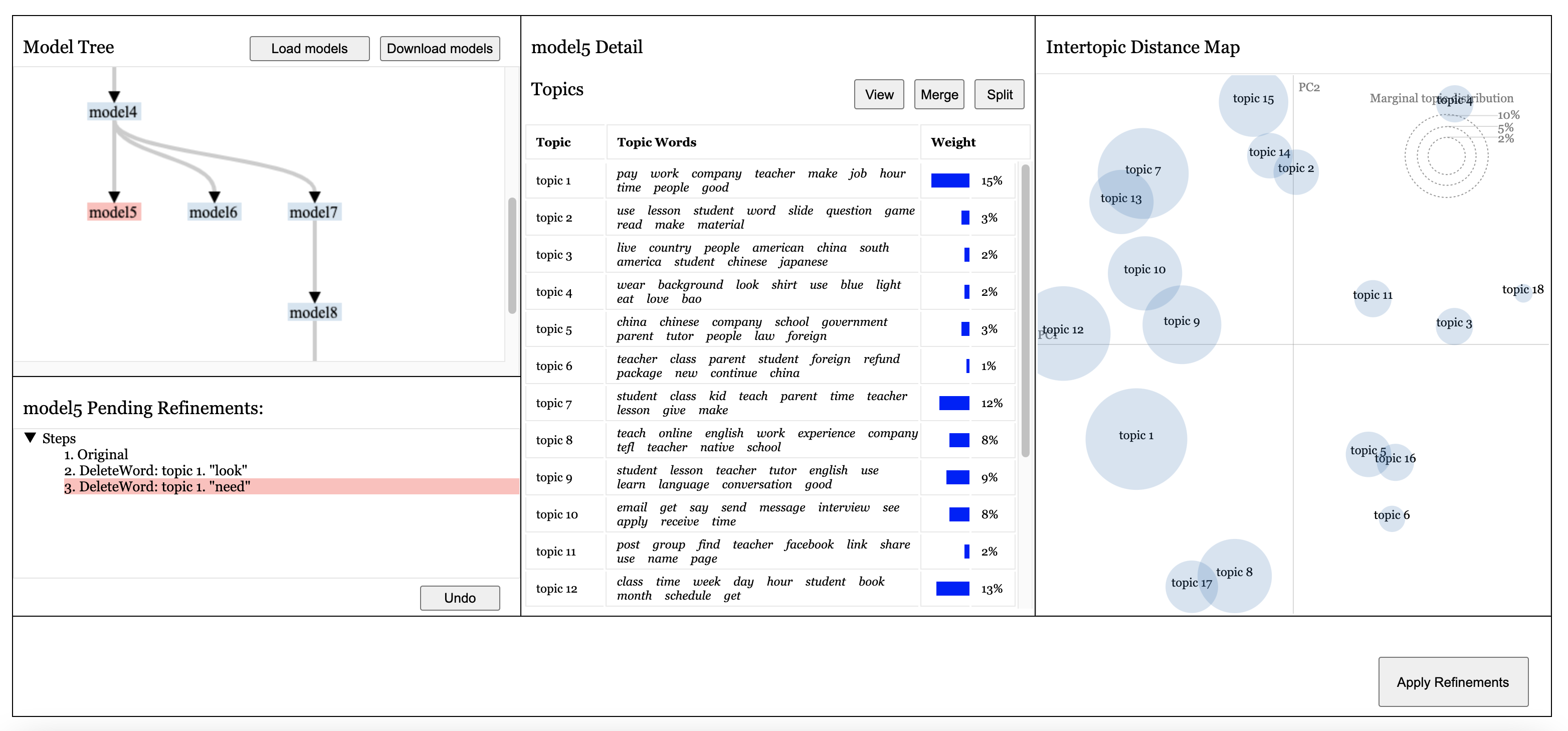
- A model history panel maintains a complete record of all model versions, allowing users to compare, revert, or explore different refinement branches.
- A novel topic words suggestion feature recommends relevant, coherent words for topics based on semantic similarity and co-occurrence patterns in the corpus.
- The interface supports real-time model updates and visualisation of topic-word distributions, document-topic assignments, and refinement history.
- User studies and two detailed use cases were conducted to evaluate the system’s usability and effectiveness in real-world topic modelling tasks.
Experimental results
Research questions
- RQ1How can a human-in-the-loop topic modelling system support iterative, non-destructive refinement while enabling users to compare multiple model variants?
- RQ2To what extent does integrating a topic words suggestion feature improve the quality and coherence of user-provided feedback?
- RQ3Can the system effectively support both full-corpus and targeted topic modelling, particularly when users have specific thematic interests?
- RQ4How does the system’s ability to track and revert changes impact user confidence and model refinement quality?
- RQ5What is the impact of the system on topic coherence and precision in real-world research applications?
Key findings
- The system enabled researchers to train 23 models and create five refinement branches in a real-world use case, demonstrating high engagement with iterative refinement.
- After user refinement, average precision for topic categorisation improved from 0.3 in the initial model to 0.96 in the final model, indicating a substantial improvement in topic relevance.
- The topic coherence score increased from 0.404 in the initial model to 0.434 in the final refined model (Model 23), showing enhanced topic quality.
- Of 62 word additions, 41 (66%) were based on system-suggested words, indicating strong utility and relevance of the suggestion feature.
- The system’s model history and rollback functionality were critical for user confidence, as users frequently explored and reverted multiple refinement paths.
- Latency increased with dataset size—34 seconds for 20,000 tweets versus 14 seconds for 8,990 tweets—highlighting a performance challenge for large-scale deployment.
Read this paper
Open the full text in the Nubint reader and ask about any passage as you read.
Read this paper on NubintThis review was generated by AI from the original paper. Please check the paper before citing it.