
[Paper Review] A Variational Perspective on Solving Inverse Problems with Diffusion Models
The paper introduces RED-diff, a variational sampler for solving inverse problems with diffusion priors, using a KL-based objective and a denoising-based regularization that leverages all diffusion timesteps.
Diffusion models have emerged as a key pillar of foundation models in visual domains. One of their critical applications is to universally solve different downstream inverse tasks via a single diffusion prior without re-training for each task. Most inverse tasks can be formulated as inferring a posterior distribution over data (e.g., a full image) given a measurement (e.g., a masked image). This is however challenging in diffusion models since the nonlinear and iterative nature of the diffusion process renders the posterior intractable. To cope with this challenge, we propose a variational approach that by design seeks to approximate the true posterior distribution. We show that our approach naturally leads to regularization by denoising diffusion process (RED-Diff) where denoisers at different timesteps concurrently impose different structural constraints over the image. To gauge the contribution of denoisers from different timesteps, we propose a weighting mechanism based on signal-to-noise-ratio (SNR). Our approach provides a new variational perspective for solving inverse problems with diffusion models, allowing us to formulate sampling as stochastic optimization, where one can simply apply off-the-shelf solvers with lightweight iterates. Our experiments for image restoration tasks such as inpainting and superresolution demonstrate the strengths of our method compared with state-of-the-art sampling-based diffusion models.
Motivation & Objective
- Motivate universal, training-free solving of diverse inverse problems using diffusion priors.
- Overcome intractable posterior challenges by adopting variational inference to approximate p(x0|y).
- Develop a regularization-by-denoising perspective (RED-diff) that leverages denoisers across diffusion timesteps.
- Provide a practical, efficient sampling mechanism via stochastic optimization with lightweight iterates.
Proposed method
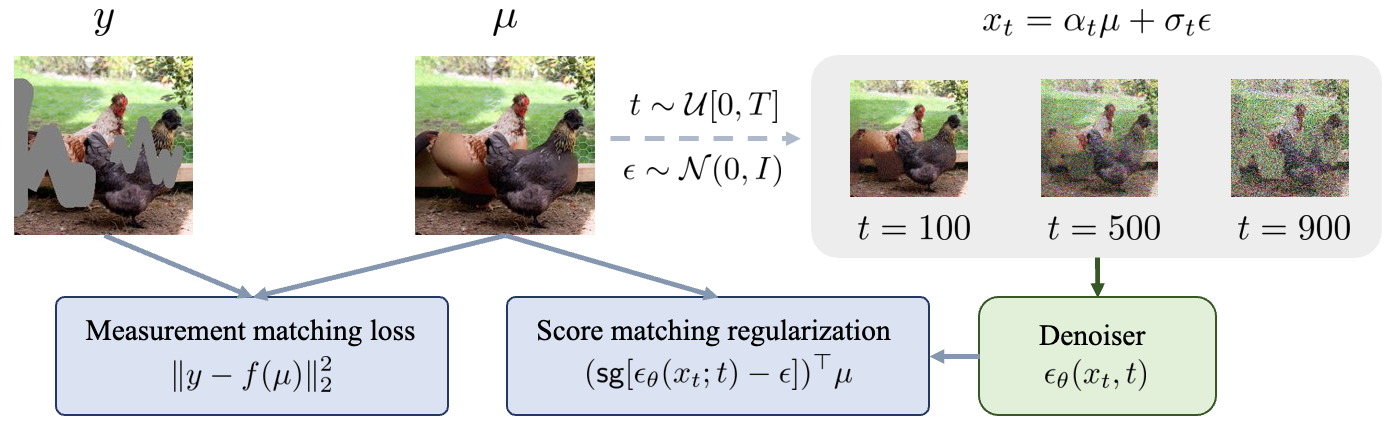
- Formulate posterior inference as KL minimization between q(x0|y) and p(x0|y).
- Derive a variational bound that yields a score-matching regularization term via the diffusion prior.
- Introduce a weighted score-matching objective that uses denoising at multiple diffusion steps (RED-diff).
- Show that the gradient of the regularization term can be computed without backpropagating through the score network when using a suitable weight function.
- Approximate sampling as stochastic optimization over mu with a simple, tractable loss combining a reconstruction term and a regularization term.
- Connect the approach to the REGULARIZATION-BY-DENOISING (RED) framework and discuss optimization advantages.
Experimental results
Research questions
- RQ1Can a variational KL framework yield a principled posterior inference for x0 given y in diffusion-model-based inverse problems?
- RQ2Does incorporating denoising scores from all diffusion timesteps with appropriate weighting improve restoration quality over existing methods?
- RQ3Can sampling be formulated as efficient stochastic optimization with lightweight iterates without requiring score Jacobians?
- RQ4How does RED-diff perform on linear and nonlinear image restoration tasks compared with state-of-the-art samplers?
- RQ5What are the practical effects of timesteps weighting and sampling strategy on fidelity and perceptual quality?
Key findings
- RED-diff outperforms state-of-the-art samplers (DPS, Pi-GDM, and DDRM) on image inpainting in terms of PSNR, SSIM, KID, LPIPS, and top-1 accuracy.
- The method yields lightweight iterates with no score Jacobian, improving memory efficiency and GPU friendliness.
- A weighting mechanism based on denoising SNR upweights earlier diffusion steps and downweights later steps for better regularization.
- Descending timestep sampling (from T to 1) improves fidelity and perceptual quality versus other sampling strategies.
- Ablations show that denoiser weighting and time-sampling strategies are key knobs for balancing content vs. detail and stability.
- On nonlinear inverse problems (phase retrieval, HDR, deblurring, etc.), RED-diff demonstrates superior metrics versus DPS, and outperforms Pi-GDM and DDRM where applicable.

Read this paper
Open the full text in the Nubint reader and ask about any passage as you read.
Read this paper on NubintThis review was generated by AI from the original paper. Please check the paper before citing it.