
[Paper Review] A Versatile Graph Learning Approach through LLM-based Agent
This paper proposes Auto2Graph, a framework that uses LLM-based autonomous agents to automate graph learning across diverse tasks and data. By decomposing user requests into intent detection, AutoGraph-based solution configuration, and response generation, the method enables end-to-end, low-code graph learning with performance comparable to human-designed and AutoML baselines across node and graph classification tasks.
Designing versatile graph learning approaches is important, considering the diverse graphs and tasks existing in real-world applications. Existing methods have attempted to achieve this target through automated machine learning techniques, pre-training and fine-tuning strategies, and large language models. However, these methods are not versatile enough for graph learning, as they work on either limited types of graphs or a single task. In this paper, we propose to explore versatile graph learning approaches with LLM-based agents, and the key insight is customizing the graph learning procedures for diverse graphs and tasks. To achieve this, we develop several LLM-based agents, equipped with diverse profiles, tools, functions and human experience. They collaborate to configure each procedure with task and data-specific settings step by step towards versatile solutions, and the proposed method is dubbed GL-Agent. By evaluating on diverse tasks and graphs, the correct results of the agent and its comparable performance showcase the versatility of the proposed method, especially in complex scenarios.The low resource cost and the potential to use open-source LLMs highlight the efficiency of GL-Agent.
Motivation & Objective
- Address the challenge of automating graph learning across diverse real-world graph data and tasks with minimal human intervention.
- Overcome limitations of existing AutoML (AutoGraph) approaches that require extensive prior knowledge and lack task-aware automation.
- Enable non-expert users to perform complex graph learning by automating intent detection, architecture design, and hyperparameter tuning.
- Develop a unified framework that handles node-level and graph-level learning tasks through agent-driven decomposition and execution.
- Demonstrate the feasibility of LLM-based agents in making human-like, accurate decisions across the graph learning pipeline.
Proposed method
- Leverage Large Language Models (LLMs) as autonomous agents to interpret user queries and decompose complex graph learning tasks into structured subtasks.
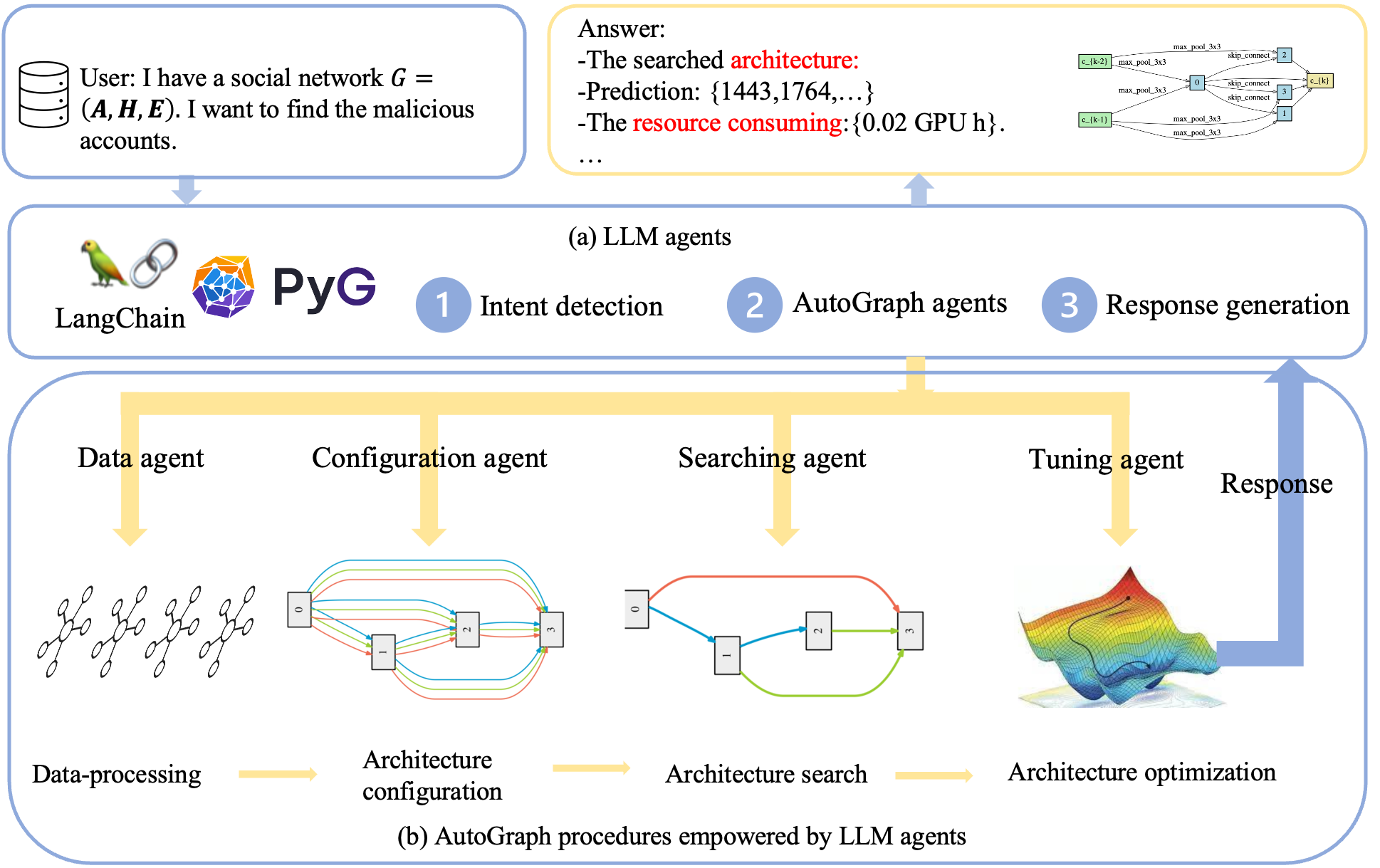
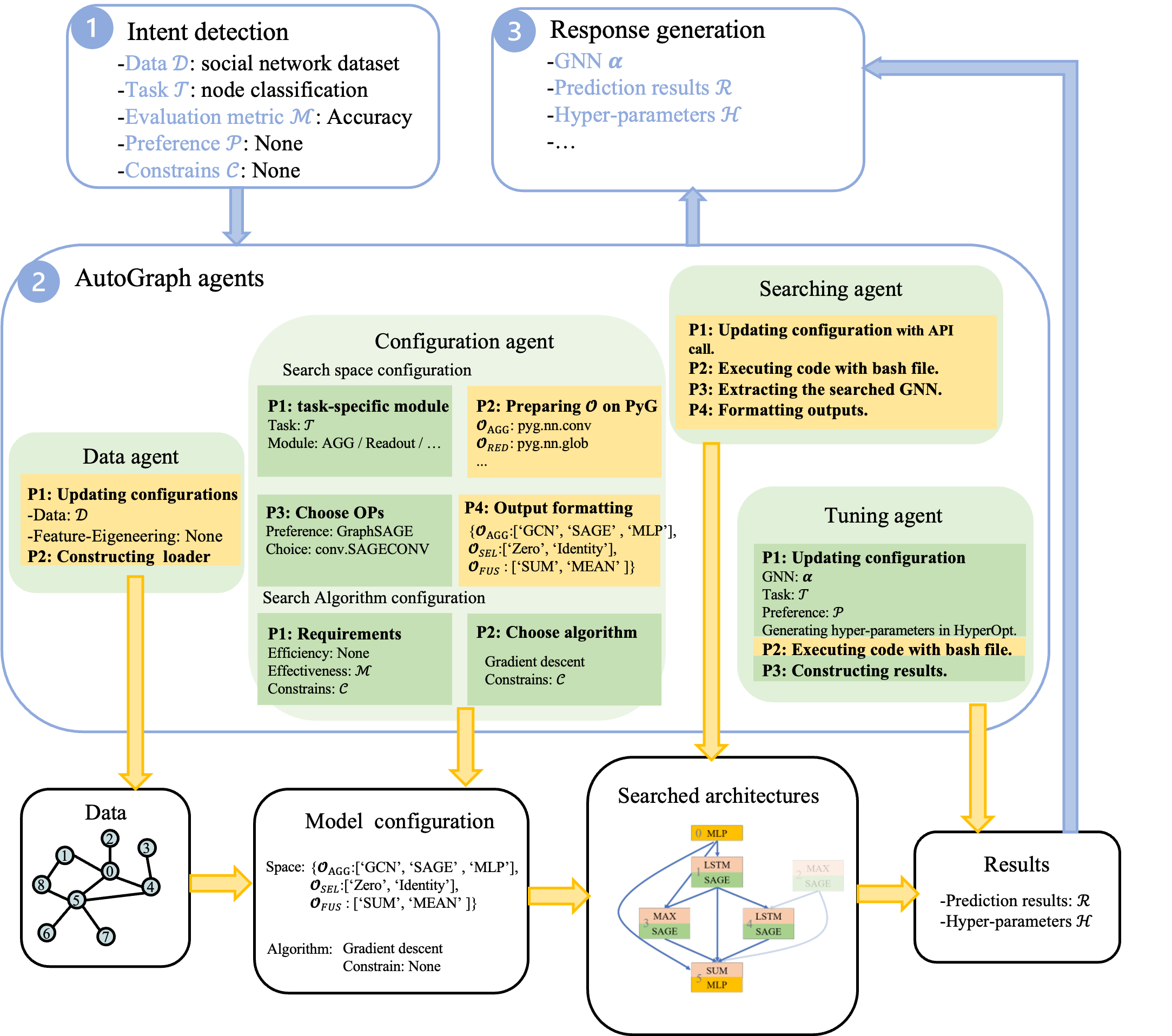
- Implement a three-stage agent planning pipeline: (1) intent detection to identify learning targets (node/edge/graph-level), (2) AutoGraph agent configuration for architecture and hyperparameter selection, and (3) response generation with solution execution.
- Design four specialized AutoGraph agents to manage core procedures: data preprocessing, AutoML configuration, neural architecture search, and hyperparameter fine-tuning.
- Integrate AutoML techniques within the agent workflow to optimize GNN architectures and hyperparameters automatically, reducing reliance on expert knowledge.
- Use few-shot prompting and chain-of-thought reasoning in LLMs to guide agents through complex, multi-step graph learning workflows.
- Apply the framework end-to-end on node and graph classification tasks using standard benchmarks, with agents generating and executing solutions autonomously.
Experimental results
Research questions
- RQ1Can LLM-based agents effectively detect and interpret diverse graph learning intents from natural language user queries?
- RQ2Can autonomous agents automate the full pipeline of graph learning, including data processing, architecture search, and hyperparameter tuning, without expert intervention?
- RQ3How does the performance of agent-generated solutions compare to human-designed and AutoML baselines across diverse graph datasets?
- RQ4To what extent can LLM agents make decisions comparable to human experts in graph learning workflows?
- RQ5Can the framework generalize across different graph learning tasks (node vs. graph classification) with minimal prompt engineering?
Key findings
- Auto2Graph achieves competitive performance on node classification tasks, with 86.81% accuracy on Cora, 96.40% on Photo, 92.47% on Computers, and 96.93% on Physics, matching or exceeding human-designed and AutoML baselines.
- On graph classification tasks, Auto2Graph outperforms or matches state-of-the-art methods, achieving 82.14% on NCI1 and 81.25% on NCI109, surpassing DGCNN and DiffPool in most cases.
- The framework demonstrates human-like decision-making in agent interactions, with agents correctly selecting appropriate procedures and hyperparameters during evaluation on the NCI1 dataset.
- Performance remains strong even when using only basic aggregation and readout operations, indicating that the agent-driven framework can be enhanced with advanced operations via feedback.
- The method significantly reduces the need for prior knowledge and coding expertise, enabling non-experts to perform complex graph learning tasks through natural language prompts.
- The agent-based approach enables end-to-end automation of graph learning, from intent detection to solution generation, with minimal manual configuration.
Read this paper
Open the full text in the Nubint reader and ask about any passage as you read.
Read this paper on NubintThis review was generated by AI from the original paper. Please check the paper before citing it.