
[Paper Review] A wideband, high-resolution vector spectrum analyzer for integrated photonics
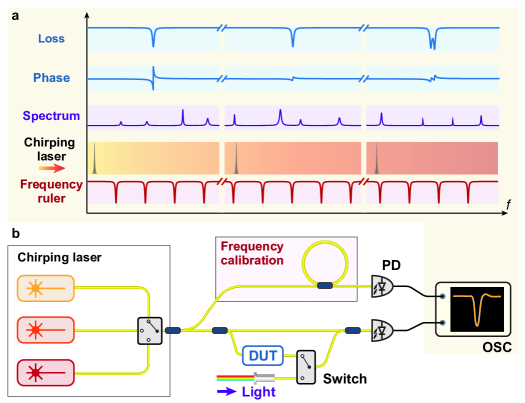
This paper presents a fiber-based, wideband vector spectrum analyzer (VSA) with 55.1 THz bandwidth, 471 kHz frequency resolution, and 56 dB dynamic range, enabling high-resolution characterization of integrated photonic devices and broadband laser sources. It uses a chirped continuous-wave laser referenced to a phase-stable fiber cavity to coherently map optical frequency responses into the time domain via beat signals, eliminating the need for high-speed modulators or active feedback control.
The analysis of optical spectra - emission or absorption -- has been arguably the most powerful approach for discovering and understanding matters. The invention and development of many kinds of spectrometers have equipped us with versatile yet ultra-sensitive diagnostic tools for trace gas detection, isotope analysis, and resolving hyperfine structures of atoms and molecules. With proliferating data and information, urgent and demanding requirements have been placed today on spectrum analysis with ever-increasing spectral bandwidth and frequency resolution. These requirements are especially stringent for broadband laser sources that carry massive information, and for dispersive devices used in information processing systems. In addition, spectrum analyzers are expected to probe the device's phase response where extra information is encoded. Here we demonstrate a novel vector spectrum analyzer (VSA) that is capable of characterizing passive devices and active laser sources in one setup. Such a dual-mode VSA can measure loss, phase response and dispersion properties of passive devices. It also can coherently map a broadband laser spectrum into the RF domain. The VSA features a bandwidth of 55.1 THz (1260 to 1640 nm), frequency resolution of 471 kHz, and dynamic range of 56 dB. Meanwhile, our fiber-based VSA is compact and robust. It requires neither high-speed modulators and photodetectors, nor any active feedback control. Finally, we successfully employ our VSA for applications including characterization of integrated dispersive waveguides, mapping frequency comb spectra, and coherent light detection and ranging (LiDAR). Our VSA presents an innovative approach for device analysis and laser spectroscopy, and can play a critical role in future photonic systems and applications for sensing, communication, imaging, and quantum information processing.
Motivation & Objective
- To develop a high-resolution, wideband vector spectrum analyzer (VSA) for characterizing passive and active photonic devices in integrated photonics.
- To overcome limitations of conventional optical spectrum analyzers (OSAs) and optical vector network analyzers (OVNAs) in spectral resolution, bandwidth, and phase response measurement.
- To enable simultaneous measurement of loss, phase, dispersion, and full spectral profiles of broadband lasers using a single, robust, and transportable setup.
- To achieve precise frequency calibration without active feedback or high-speed components, enhancing system stability and field deployability.
Proposed method
- A chirped continuous-wave (CW) laser is used to coherently map the frequency-domain transfer function of a device under test (DUT) into the time domain via beat signals.
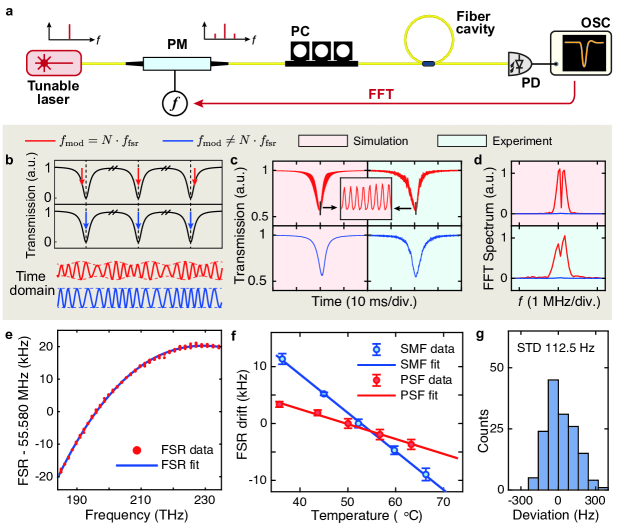
- A phase-stable fiber cavity with a free spectral range (FSR) of 55.58 MHz serves as a frequency ruler for precise calibration of the laser’s instantaneous frequency during chirping.
- The system operates in dual mode: as an OVNA to measure the linear transfer function (LTF) and dispersion of passive devices, and as an OSA to analyze broadband frequency comb spectra.
- Time-domain traces from photodetectors are captured by an oscilloscope, and spectral reconstruction is achieved through cross-correlation and calibration against the reference cavity.
- Multiple extended-cavity diode lasers (ECDLs) can be cascaded to extend the spectral bandwidth by seamlessly stitching individual laser traces.
- Mode hopping in ECDLs is self-calibrated using a high-FSR microresonator (e.g., Si3N4) and a Vernier-like calibration scheme to maintain frequency accuracy.
Experimental results
Research questions
- RQ1Can a fiber-based VSA achieve sub-megahertz frequency resolution and terahertz-wide bandwidth without high-speed modulators or active feedback?
- RQ2How accurately can a chirped laser system map optical frequency responses into the time domain using a passive frequency reference?
- RQ3To what extent can a single VSA setup simultaneously characterize passive photonic devices and broadband laser sources with high dynamic range and phase sensitivity?
- RQ4Can the system maintain long-term stability and precision in field-deployable applications such as LiDAR and spectroscopy?
- RQ5What is the performance limit of spectral resolution and bandwidth when extending the system with multiple ECDLs and calibrated microresonators?
Key findings
- The VSA achieves a spectral bandwidth of 55.1 THz (1260–1640 nm), enabling full characterization of broadband integrated photonic components across the C and L bands.
- The system demonstrates a frequency resolution of 471 kHz, enabling fine spectral detail extraction from complex optical signals such as frequency combs.
- The dynamic range of the VSA reaches 56 dB, supporting high-sensitivity detection of weak spectral features.
- In LiDAR mode, the system achieves a distance resolution of 7.6 μm and a precision of 20.3 nm, validated over 4625 measurements.
- The VSA successfully maps the dispersion and loss profiles of integrated dispersive waveguides, confirming accurate phase and group delay measurements.
- The system operates without high-speed modulators, photodetectors, or active feedback, relying instead on passive frequency calibration, resulting in a compact, robust, and transportable design.
Read this paper
Open the full text in the Nubint reader and ask about any passage as you read.
Read this paper on NubintThis review was generated by AI from the original paper. Please check the paper before citing it.