
[Paper Review] AA-RMVSNet: Adaptive Aggregation Recurrent Multi-view Stereo Network
AA-RMVSNet proposes a recurrent multi-view stereo network with adaptive aggregation modules: an intra-view module for context-aware, multi-scale feature extraction and an inter-view module for pixel-wise view selection to handle occlusion. It achieves state-of-the-art performance, ranking 1st on the Tanks and Temples benchmark with a 61.51 mean F-score and competitive results on DTU, demonstrating superior accuracy and completeness in 3D reconstruction.
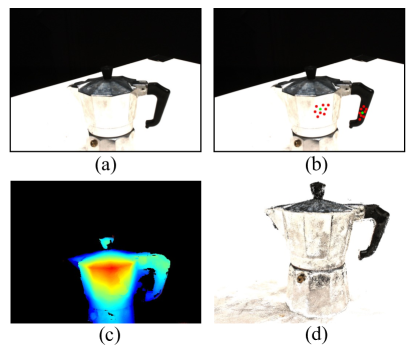
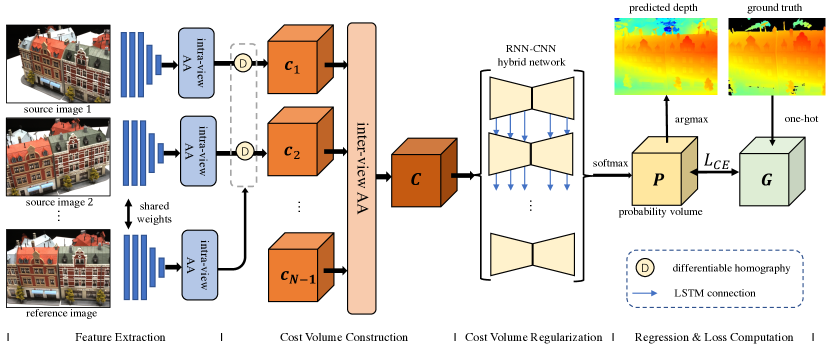
In this paper, we present a novel recurrent multi-view stereo network based on long short-term memory (LSTM) with adaptive aggregation, namely AA-RMVSNet. We firstly introduce an intra-view aggregation module to adaptively extract image features by using context-aware convolution and multi-scale aggregation, which efficiently improves the performance on challenging regions, such as thin objects and large low-textured surfaces. To overcome the difficulty of varying occlusion in complex scenes, we propose an inter-view cost volume aggregation module for adaptive pixel-wise view aggregation, which is able to preserve better-matched pairs among all views. The two proposed adaptive aggregation modules are lightweight, effective and complementary regarding improving the accuracy and completeness of 3D reconstruction. Instead of conventional 3D CNNs, we utilize a hybrid network with recurrent structure for cost volume regularization, which allows high-resolution reconstruction and finer hypothetical plane sweep. The proposed network is trained end-to-end and achieves excellent performance on various datasets. It ranks $1^{st}$ among all submissions on Tanks and Temples benchmark and achieves competitive results on DTU dataset, which exhibits strong generalizability and robustness. Implementation of our method is available at https://github.com/QT-Zhu/AA-RMVSNet.
Motivation & Objective
- To address challenges in 3D reconstruction of thin structures and low-textured surfaces using deep learning.
- To improve robustness under varying occlusion in complex scenes by adaptive view aggregation.
- To reduce memory consumption while maintaining high-resolution reconstruction through a hybrid LSTM architecture.
- To enhance feature representation and cost volume regularization for improved depth map accuracy and completeness.
Proposed method
- Introduces an intra-view adaptive aggregation module using deformable convolution and multi-scale feature fusion to enhance context-aware feature extraction.
- Proposes an inter-view cost volume aggregation module that generates pixel-wise attention maps to prioritize well-matched view pairs.
- Employs a hybrid network with recurrent LSTM structure for cost volume regularization, enabling high-resolution and fine-grained plane sweep.
- Utilizes end-to-end training with lightweight modules to maintain memory efficiency while improving performance.
- Applies adaptive aggregation in both feature extraction and view selection stages to enhance robustness across diverse scene types.
Experimental results
Research questions
- RQ1Can adaptive intra-view feature aggregation improve depth estimation on thin and textureless structures?
- RQ2Can pixel-wise inter-view view selection via attention maps reduce the impact of occlusion in complex scenes?
- RQ3Does a recurrent LSTM-based cost volume regularization outperform 3D CNNs in accuracy and memory efficiency?
- RQ4How do the proposed adaptive modules compare in performance and memory cost when combined?
Key findings
- AA-RMVSNet achieves a 61.51 mean F-score on the Tanks and Temples benchmark, ranking 1st among all submissions.
- On the DTU dataset, the method reduces the overall average depth error to 0.357 mm, a 8.7% improvement over the baseline.
- The intra-view adaptive aggregation improves completeness by 0.28 while adding only 1.74 GB memory, and inter-view AA boosts accuracy by 0.31 with 0.11 GB overhead.
- The full model achieves high-resolution depth maps at 800×600 resolution using only 4.25 GB memory, demonstrating strong memory efficiency.
- Visualizations show significant improvement in reconstructing thin objects and occluded regions compared to R-MVSNet and other baselines.
Read this paper
Open the full text in the Nubint reader and ask about any passage as you read.
Read this paper on NubintThis review was generated by AI from the original paper. Please check the paper before citing it.