
[Paper Review] Ab initio calculation of carrier mobility in semiconductors including ionized-impurity scattering
This paper presents an ab initio approach to calculating carrier mobility in semiconductors by simultaneously including electron-phonon and ionized-impurity scattering within the Boltzmann transport equation using the EPW code. The method models impurities as randomly distributed Coulomb centers and achieves good agreement with experimental data for Si, 3C-SiC, and GaP across varying temperatures and impurity concentrations, demonstrating that screening and effective mass corrections significantly improve predictive accuracy beyond Matthiessen’s rule.
The past decade has seen the emergence of ab initio computational methods for calculating phonon-limited carrier mobilities in semiconductors with predictive accuracy. More realistic calculations ought to take into account additional scattering mechanisms such as, for example, impurity and grain-boundary scattering. In this work, we investigate the effect of ionized-impurity scattering on the carrier mobility. We model the impurity potential by a collection of randomly distributed Coulomb scattering centers, and we include this relaxation channel into the ab initio Boltzmann transport equation, as implemented in the EPW code. We demonstrate this methodology by considering silicon, silicon carbide, and gallium phosphide, for which detailed experimental data are available. Our calculations agree reasonably well with experiments over a broad range of temperatures and impurity concentrations. For each compound investigated here, we compare the relative importance of electron-phonon scattering and ionized-impurity scattering, and we critically assess the reliability of Matthiessen's rule. We also show that an accurate description of dielectric screening and carrier effective masses cam improve quantitative agreement with experiments.
Motivation & Objective
- To develop a predictive ab initio framework for carrier mobility that includes ionized-impurity scattering alongside electron-phonon scattering.
- To assess the relative contributions of phonon and impurity scattering in key semiconductors such as Si, 3C-SiC, and GaP.
- To evaluate the validity and limitations of Matthiessen’s rule in multi-scattering environments.
- To improve quantitative agreement with experiments by incorporating dielectric screening and accurate carrier effective masses.
Proposed method
- The study employs the ab initio Boltzmann transport equation (ai-BTE) as implemented in the EPW code to compute carrier mobility.
- Ionized-impurity scattering is modeled via a random distribution of Coulomb potential centers, representing ionized donors or acceptors.
- The impurity potential is treated in the static screening approximation using the high-frequency dielectric constant.
- Carrier-phonon scattering is computed from electron-phonon matrix elements obtained via density-functional perturbation theory (DFPT).
- Mobility is calculated by solving the linearized BTE with both scattering mechanisms included on equal footing.
- Corrections for dielectric screening and carrier effective masses are applied to enhance agreement with experimental data.
Experimental results
Research questions
- RQ1How does ionized-impurity scattering quantitatively affect carrier mobility in semiconductors at varying temperatures and impurity concentrations?
- RQ2What is the relative contribution of ionized-impurity scattering compared to phonon scattering in Si, 3C-SiC, and GaP?
- RQ3To what extent does Matthiessen’s rule accurately predict mobility when both scattering mechanisms are present?
- RQ4How do corrections for dielectric screening and carrier effective mass improve the predictive power of ab initio mobility calculations?
Key findings
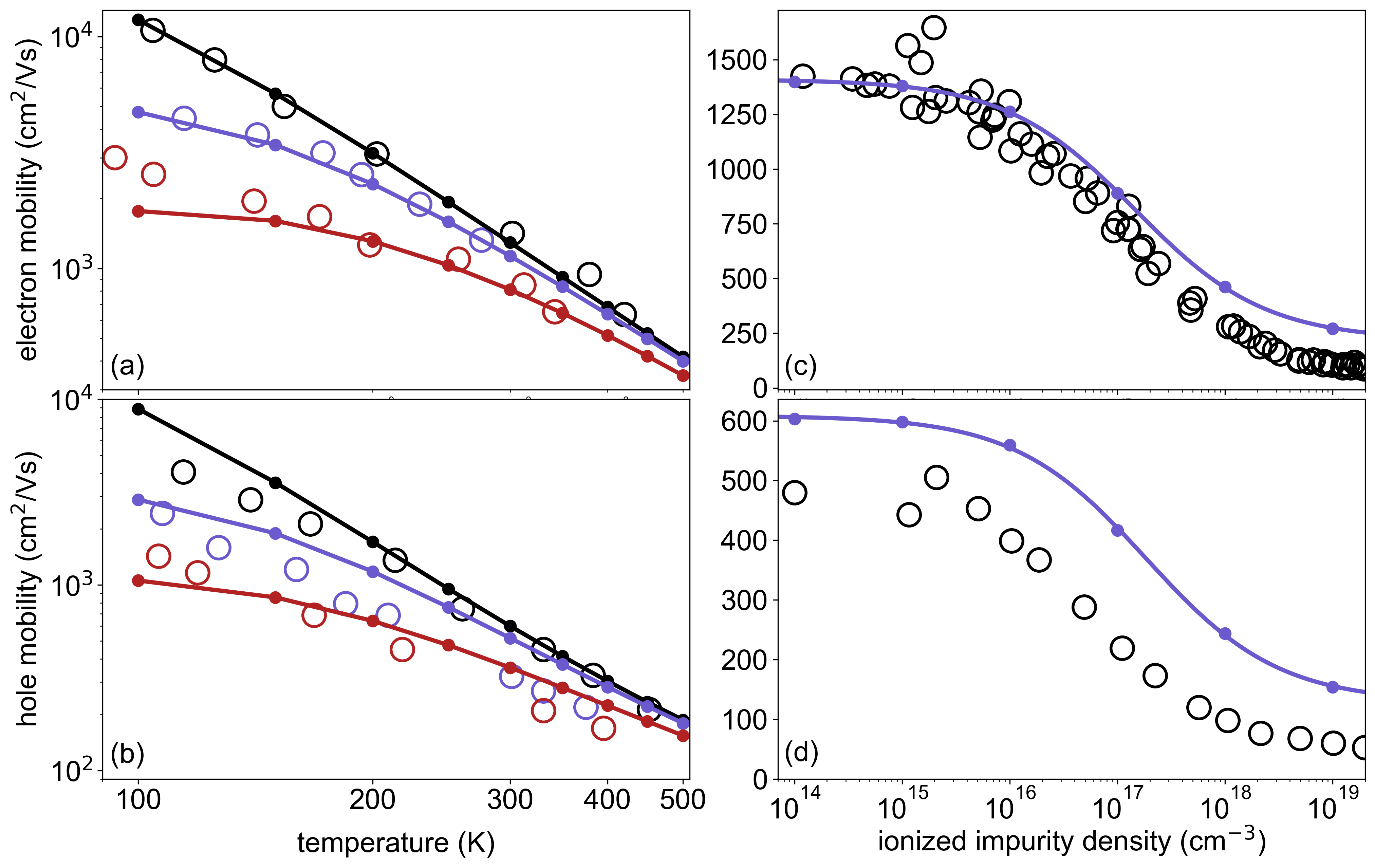
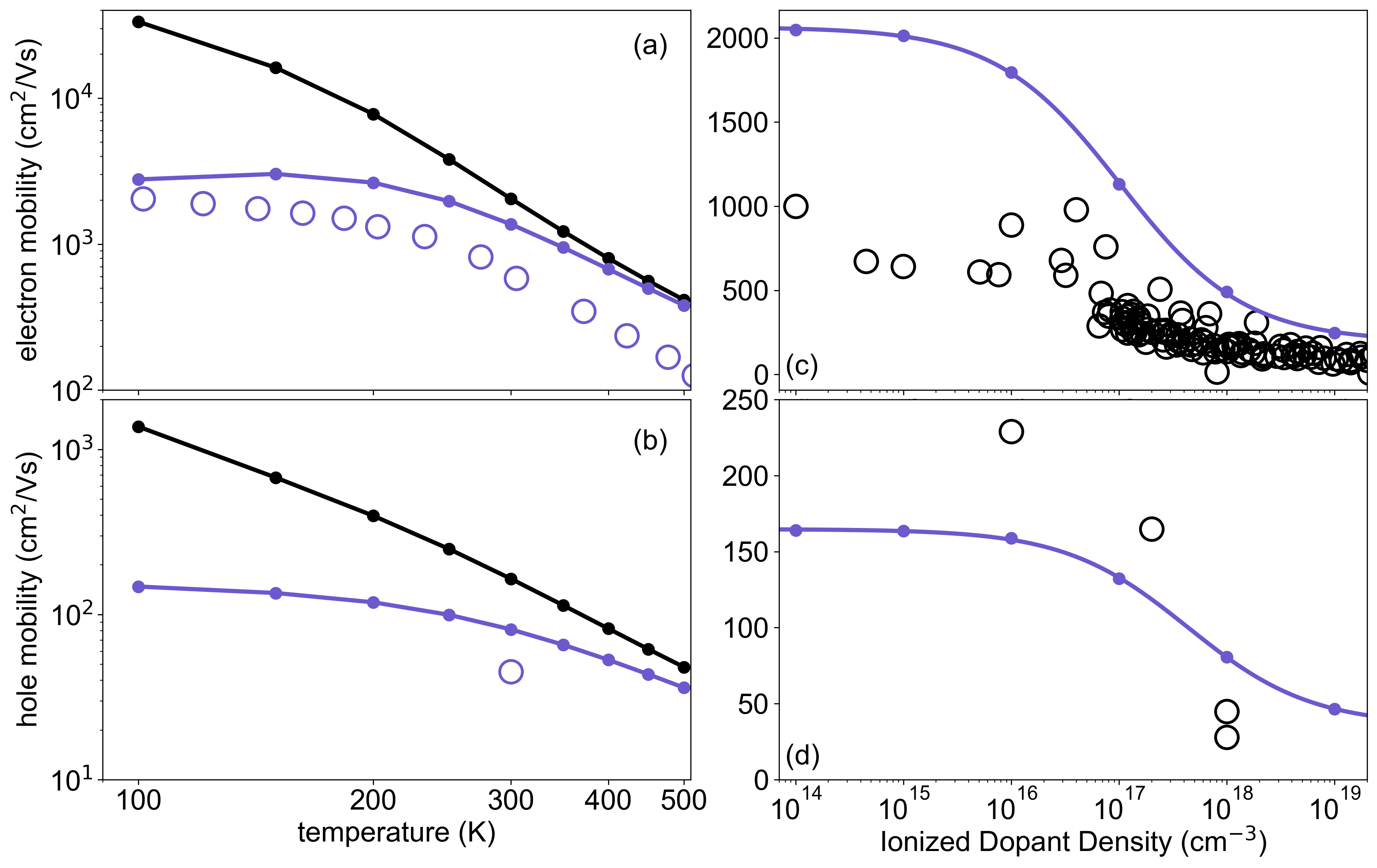
- The ab initio method including both electron-phonon and ionized-impurity scattering shows good quantitative agreement with experimental mobility data across a broad range of temperatures and impurity concentrations in Si, 3C-SiC, and GaP.
- For Si, the inclusion of screening and effective mass corrections reduces the deviation from experiment by up to 30% at room temperature and 10^17 cm⁻³ impurity concentration.
- In GaP, ionized-impurity scattering dominates over phonon scattering at room temperature for impurity concentrations above 10^18 cm⁻³, especially for holes.
- The study finds that Matthiessen’s rule systematically underestimates mobility when both scattering mechanisms are significant, particularly at intermediate temperatures and impurity levels.
- Scattering rate analysis shows that ionized-impurity scattering becomes dominant at high carrier energies and low temperatures, especially in 3C-SiC and GaP.
- Incomplete dopant ionization significantly affects mobility at low impurity concentrations, and accounting for it improves agreement with low-doping experimental data in Si.
Read this paper
Open the full text in the Nubint reader and ask about any passage as you read.
Read this paper on NubintThis review was generated by AI from the original paper. Please check the paper before citing it.