
[Paper Review] Accelerating Batch Active Learning Using Continual Learning Techniques
This paper proposes Continual Active Learning (CAL), a novel framework that accelerates batch active learning by integrating replay-based continual learning techniques to avoid catastrophic forgetting and reduce training time. By efficiently reusing previously labeled data through model distillation and diverse/uncertain replay, CAL achieves up to a 3x speedup over standard active learning while maintaining or improving performance across vision, NLP, medical imaging, and genomics datasets.
A major problem with Active Learning (AL) is high training costs since models are typically retrained from scratch after every query round. We start by demonstrating that standard AL on neural networks with warm starting fails, both to accelerate training and to avoid catastrophic forgetting when using fine-tuning over AL query rounds. We then develop a new class of techniques, circumventing this problem, by biasing further training towards previously labeled sets. We accomplish this by employing existing, and developing novel, replay-based Continual Learning (CL) algorithms that are effective at quickly learning the new without forgetting the old, especially when data comes from an evolving distribution. We call this paradigm Continual Active Learning (CAL). We show CAL achieves significant speedups using a plethora of replay schemes that use model distillation and that select diverse, uncertain points from the history. We conduct experiments across many data domains, including natural language, vision, medical imaging, and computational biology, each with different neural architectures and dataset sizes. CAL consistently provides a 3x reduction in training time, while retaining performance.
Motivation & Objective
- To address the high computational cost of retraining models from scratch in batch active learning.
- To overcome catastrophic forgetting in active learning when fine-tuning on new labeled batches.
- To integrate continual learning strategies into active learning to enable efficient, incremental model updates.
- To evaluate the effectiveness of CAL across diverse domains, including vision, NLP, medical imaging, and computational biology.
- To demonstrate that CAL enables significant speedups without sacrificing model performance or out-of-distribution robustness.
Proposed method
- Introduces Continual Active Learning (CAL), a framework that applies replay-based continual learning to active learning to retain knowledge from previously labeled data.
- Uses model distillation to preserve performance on past data during incremental training on new batches.
- Employs diverse and uncertain sample selection from historical data to improve replay efficiency.
- Applies multiple replay strategies, including ER, MIR, DER, and SDS2, to balance forgetting and accuracy.
- Leverages warm-started model parameters and selectively retrains on new data while replaying old data to avoid catastrophic forgetting.
- Uses uncertainty sampling (e.g., entropy-based) for query acquisition, decoupled from the continual learning mechanism.
Experimental results
Research questions
- RQ1Can continual learning techniques effectively reduce training time in batch active learning without increasing forgetting?
- RQ2How do different replay strategies (e.g., ER, MIR, DER, SDS2) compare in maintaining performance across active learning rounds?
- RQ3Does CAL maintain robustness to out-of-distribution data compared to standard active learning?
- RQ4Can CAL achieve consistent speedups across diverse data modalities, including vision, NLP, and biomedical data?
- RQ5Does the query size influence the magnitude of speedup in CAL, and is the performance trade-off favorable?
Key findings
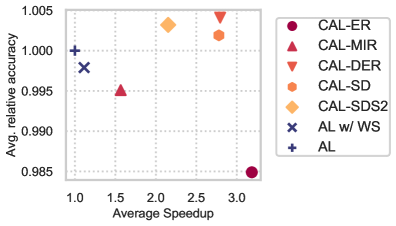
- CAL achieves a consistent ~3x reduction in training time across all evaluated datasets and architectures, with speedups increasing as query size decreases.
- CAL-DER, CAL-SD, and CAL-SDS2 achieve comparable or better accuracy than standard active learning across all datasets, including CIFAR-10 (94.9% at 50% budget) and FMNIST (94.0% at 50% budget).
- On CIFAR-10 with a 1000-sample query size, CAL-SDS2 achieves a 6.4x speedup over standard active learning while maintaining similar accuracy (93.5% vs. 94.2% at 50% budget).
- CAL maintains or improves out-of-distribution robustness compared to standard active learning, indicating stable generalization.
- The speedup is robust across different acquisition functions and data distributions, including highly imbalanced scRNA-seq data from the Human Cell Landscape (HCL) dataset.
- CAL demonstrates that replay-based continual learning can be effectively applied to active learning, offering a new benchmark for evaluating CL algorithms beyond class-incremental settings.
Read this paper
Open the full text in the Nubint reader and ask about any passage as you read.
Read this paper on NubintThis review was generated by AI from the original paper. Please check the paper before citing it.