
[Paper Review] Accelerating Guided Diffusion Sampling with Splitting Numerical Methods
This paper proposes STSP4, a splitting numerical method that accelerates guided diffusion sampling by decoupling the conditional function from the diffusion process, enabling reuse of high-order numerical solvers. It achieves ImageNet256 generation quality comparable to a 250-step DDIM baseline using 32–58% fewer sampling steps, with consistent improvements across text-to-image, colorization, inpainting, and super-resolution tasks.
Guided diffusion is a technique for conditioning the output of a diffusion model at sampling time without retraining the network for each specific task. One drawback of diffusion models, however, is their slow sampling process. Recent techniques can accelerate unguided sampling by applying high-order numerical methods to the sampling process when viewed as differential equations. On the contrary, we discover that the same techniques do not work for guided sampling, and little has been explored about its acceleration. This paper explores the culprit of this problem and provides a solution based on operator splitting methods, motivated by our key finding that classical high-order numerical methods are unsuitable for the conditional function. Our proposed method can re-utilize the high-order methods for guided sampling and can generate images with the same quality as a 250-step DDIM baseline using 32-58% less sampling time on ImageNet256. We also demonstrate usage on a wide variety of conditional generation tasks, such as text-to-image generation, colorization, inpainting, and super-resolution.
Motivation & Objective
- To address the lack of acceleration techniques for guided diffusion sampling, which remains slow despite advances in unguided diffusion sampling.
- To investigate why high-order numerical methods fail in guided settings, where conditional functions disrupt stability and convergence.
- To develop a method that reuses high-order solvers on the diffusion term while handling the conditional function separately through operator splitting.
- To demonstrate consistent performance gains across diverse conditional generation tasks, including text-to-image, inpainting, and super-resolution.
- To provide a theoretically grounded, stable, and efficient sampling framework that reduces sampling time without sacrificing generation quality.
Proposed method
- The method uses Strang splitting to decompose the guided diffusion ODE into two parts: the standard diffusion term and the conditional gradient term.
- High-order numerical solvers (e.g., PLMS4) are applied to the diffusion term, which is well-behaved and amenable to such methods.
- The conditional function term is solved separately using a lower-order method (e.g., Euler), ensuring stability despite its non-smooth or rapidly varying nature.
- The splitting framework allows independent optimization of numerical methods for each component, improving overall stability and convergence.
- The approach is generalized to various conditional generation tasks by plugging in task-specific conditional functions during sampling.
- Theoretical stability analysis is performed using a linear test equation, deriving conditions under which the numerical solution remains bounded and convergent.

Experimental results
Research questions
- RQ1Why do high-order numerical methods fail in guided diffusion sampling despite their success in unguided settings?
- RQ2Can operator splitting methods stabilize high-order solvers when applied to the conditional function in guided diffusion?
- RQ3To what extent can high-order solvers be reused on the diffusion component without compromising stability?
- RQ4How does the proposed method compare in quality and speed to baseline sampling methods like DDIM across diverse conditional generation tasks?
- RQ5What is the theoretical stability limit of the proposed splitting-based numerical scheme under varying step counts and conditional function strengths?
Key findings
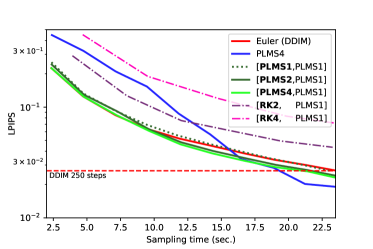
- The proposed STSP4 method achieves image quality on ImageNet256 equivalent to a 250-step DDIM baseline while reducing sampling time by 32–58%.
- STSP4 outperforms baseline methods in FID, LPIPS, and Perception/Recall metrics when using the same number of sampling steps.
- The method maintains high-quality generation across diverse conditional tasks, including text-to-image, colorization, inpainting, and super-resolution.
- Stability analysis shows that STSP4 remains convergent even at low step counts, with theoretical guarantees for convergence up to a minimum number of steps.
- The failure threshold for STSP4 is lower than for Euler and PLMS2, indicating greater robustness at reduced step counts.
- Operator splitting successfully decouples the poorly behaved conditional function from the well-behaved diffusion term, enabling effective reuse of high-order solvers.
Read this paper
Open the full text in the Nubint reader and ask about any passage as you read.
Read this paper on NubintThis review was generated by AI from the original paper. Please check the paper before citing it.