
[Paper Review] Accelerating LLM Inference with Staged Speculative Decoding
The paper introduces staged speculative decoding, combining tree-structured speculative batches with a second-stage draft model, to accelerate small-batch on-device LLM inference while preserving output quality, achieving up to 3.16x speedup on GPT-2-L.
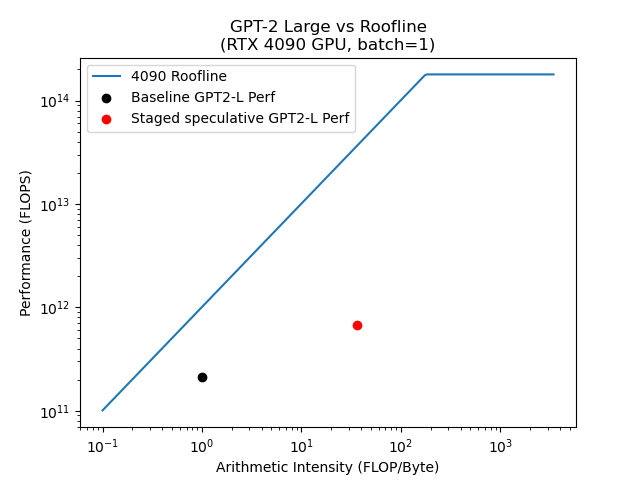
Recent advances with large language models (LLM) illustrate their diverse capabilities. We propose a novel algorithm, staged speculative decoding, to accelerate LLM inference in small-batch, on-device scenarios. We address the low arithmetic intensity of small-batch inference by improving upon previous work in speculative decoding. First, we restructure the speculative batch as a tree, which reduces generation costs and increases the expected tokens per batch. Second, we add a second stage of speculative decoding. Taken together, we reduce single-batch decoding latency by 3.16x with a 762M parameter GPT-2-L model while perfectly preserving output quality.
Motivation & Objective
- Address the low arithmetic intensity of small-batch LLM inference on devices.
- Extend speculative decoding to increase throughput without sacrificing model distribution fidelity.
- Improve practical on-device LLM performance for latency-sensitive and privacy-preserving applications.
Proposed method
- Reformulate speculative batches as a tree to increase expected tokens per batch and enable parallelism.
- Introduce a second stage of speculation by adding a draft 2 model to accelerate decoding.
- Sample and decode across oracle, draft, and draft-2 models with tree-structured batches to maximize leaf count and reuse KV caches.
Experimental results
Research questions
- RQ1Can tree-structured speculative batches increase tokens-per-batch and reduce bandwidth in small-batch LLM inference?
- RQ2Does adding a second-stage draft model further accelerate decoding without changing the output distribution?
- RQ3What is the observed speedup and bandwidth reduction on on-device hardware for staged speculative decoding compared to baseline and standard speculative decoding?
Key findings
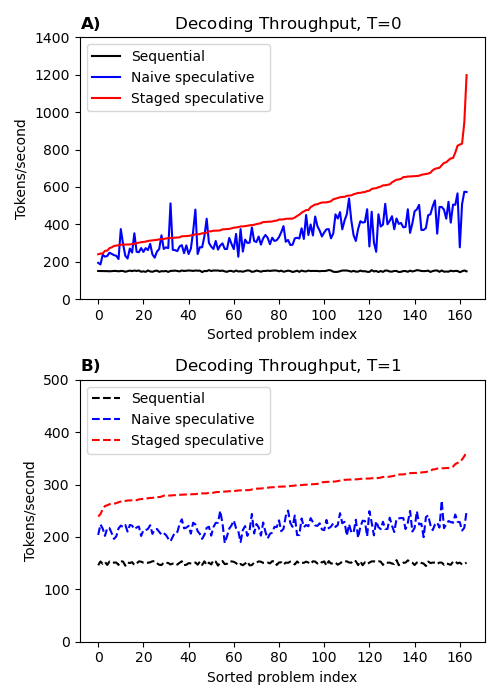
- Staged speculative decoding achieves a 3.16x average speedup over baseline single-batch inference for deterministic decoding on GPT-2-L (762M) on an RTX 4090.
- Staged speculative decoding reduces memory bandwidth relative to both baseline and standard speculative decoding (deterministic: 0.23x vs 1.00 baseline; 0.31x for baseline vs 0.23x staged; Topk: 0.35x staged versus 0.48x speculative).
- With top-k sampling (k=50, T=1), staged speculative provides an average speedup of 1.98x over baseline and 1.36x over standard speculative decoding.
- The approach demonstrates improved throughput on HumanEval prompts with varying difficulty, highlighting that benefits vary with content entropy.
Read this paper
Open the full text in the Nubint reader and ask about any passage as you read.
Read this paper on NubintThis review was generated by AI from the original paper. Please check the paper before citing it.