
[Paper Review] accelerating wrf i/o performance with adios2 and network-based streaming
This paper proposes integrating ADIOS2 as a high-performance I/O backend in the Weather Research and Forecasting (WRF) model to overcome persistent I/O bottlenecks. By leveraging ADIOS2’s Sustainable Staging Transport (SST) with UCX data transport, node-local burst buffers, and in-line compression, the authors achieve over a tenfold reduction in I/O time and a 50% improvement in overall time-to-solution, demonstrating that modern I/O frameworks can dramatically accelerate legacy HPC applications with minimal code changes.
With the approach of Exascale computing power for large-scale High Performance Computing (HPC) clusters, the gap between compute capabilities and storage systems is growing larger. This is particularly problematic for the Weather Research and Forecasting Model (WRF), a widely-used HPC application for high-resolution forecasting and research that produces sizable datasets, especially when analyzing transient weather phenomena. Despite this issue, the I/O modules within WRF have not been updated in the past ten years, resulting in subpar parallel I/O performance. This research paper demonstrates the positive impact of integrating ADIOS2, a next-generation parallel I/O framework, as a new I/O backend option in WRF. It goes into detail about the challenges encountered during the integration process and how they were addressed. The resulting I/O times show an over tenfold improvement when using ADIOS2 compared to traditional MPI-I/O based solutions. Furthermore, the study highlights the new features available to WRF users worldwide, such as the Sustainable Staging Transport (SST) enabling Unified Communication X (UCX) DataTransport, the node-local burst buffer write capabilities and in-line lossless compression capabilities of ADIOS2. Additionally, the research shows how ADIOS2's in-situ analysis capabilities can be smoothly integrated with a simple WRF forecasting pipeline, resulting in a significant improvement in overall time to solution. This study serves as a reminder to legacy HPC applications that incorporating modern libraries and tools can lead to considerable performance enhancements with minimal changes to the core application.
Motivation & Objective
- To address the growing I/O performance bottleneck in WRF, which has not been updated in over a decade despite increasing compute-power disparities.
- To evaluate the integration of ADIOS2 as a next-generation I/O backend for WRF, enabling high-throughput, scalable data I/O.
- To demonstrate performance improvements in I/O write times and overall time-to-solution using ADIOS2’s advanced features like burst buffer support and in-situ analysis.
- To enable modern data management capabilities—such as lossless/lossy compression and two-way data coupling—within the WRF ecosystem.
Proposed method
- Integrating ADIOS2 as a new I/O backend in WRF, replacing traditional MPI-I/O and PnetCDF backends.
- Utilizing ADIOS2’s Sustainable Staging Transport (SST) engine with Unified Communication X (UCX) for high-performance, low-latency data transport.
- Leveraging node-local burst buffers to accelerate write operations by offloading data from main memory to fast local storage.
- Applying in-line lossless and lossy compression within ADIOS2 to increase effective I/O bandwidth.
- Implementing in-situ analysis pipelines using ADIOS2’s data coupling and streaming capabilities to reduce post-processing overhead.
- Configuring the QueueLimit parameter in ADIOS2’s SST transport to optimize asynchronous data transfer performance for both UCX and EVPATH middleware.
Experimental results
Research questions
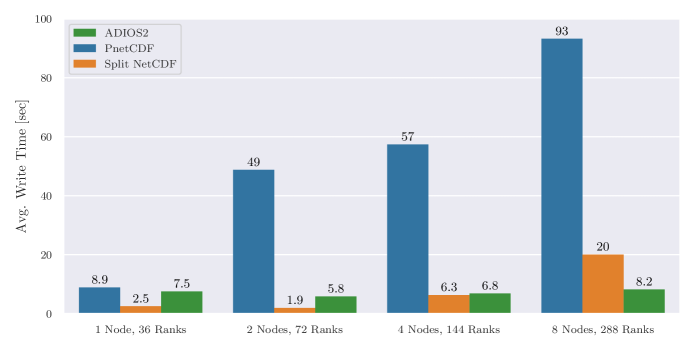
- RQ1Can ADIOS2 significantly reduce I/O write times in WRF compared to traditional MPI-I/O and PnetCDF backends?
- RQ2How does the integration of UCX-based transport in ADIOS2’s SST engine impact data transfer performance and latency in WRF?
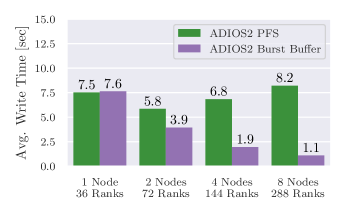
- RQ3To what extent do burst buffer and in-line compression capabilities in ADIOS2 improve effective I/O throughput in WRF simulations?
- RQ4Can in-situ analysis pipelines using ADIOS2 reduce the overall time-to-solution in WRF forecasting workflows?
- RQ5What is the performance impact of tuning the QueueLimit parameter in ADIOS2’s SST engine for different transport backends?
Key findings
- ADIOS2 integration reduced WRF I/O write times by over tenfold compared to traditional MPI-I/O and PnetCDF backends.
- Using the ADIOS2 SST engine with UCX transport achieved a 50% reduction in overall time-to-solution for a WRF forecasting pipeline.
- The UCX-based data transport outperformed the EVPATH middleware layer in both throughput and latency, especially at scale.
- Optimizing the QueueLimit parameter to 0 (asynchronous) significantly improved performance for both UCX and EVPATH transports.
- The integration enabled node-local burst buffer writes and in-line lossless compression, enhancing I/O efficiency without modifying WRF’s core code.
- The study demonstrated that ADIOS2’s in-situ analysis capabilities can be seamlessly integrated into WRF, reducing reliance on post-processing and accelerating scientific workflows.
Read this paper
Open the full text in the Nubint reader and ask about any passage as you read.
Read this paper on NubintThis review was generated by AI from the original paper. Please check the paper before citing it.