
[Paper Review] Accurate deep learning sub-grid scale models for large eddy simulations
Two families of deep learning sub-grid scale models for LES are developed: a tensor basis neural network with full invariance and a simpler Galilean-invariant network; the simpler model learns SGS stresses more effectively and both perform well in a priori and a posteriori tests for channel flow at Reτ ≈ 395 and 590.
We present two families of sub-grid scale (SGS) turbulence models developed for large-eddy simulation (LES) purposes. Their development required the formulation of physics-informed robust and efficient Deep Learning (DL) algorithms which, unlike state-of-the-art analytical modeling techniques can produce high-order complex non-linear relations between inputs and outputs. Explicit filtering of data from direct simulations of the canonical channel flow at two friction Reynolds numbers $Re_τ\approx 395$ and 590 provided accurate data for training and testing. The two sets of models use different network architectures. One of the architectures uses tensor basis neural networks (TBNN) and embeds the simplified analytical model form of the general effective-viscosity hypothesis, thus incorporating the Galilean, rotational and reflectional invariances. The other architecture is that of a relatively simple network, that is able to incorporate the Galilean invariance only. However, this simpler architecture has better feature extraction capacity owing to its ability to establish relations between and extract information from cross-components of the integrity basis tensors and the SGS stresses. Both sets of models are used to predict the SGS stresses for feature datasets generated with different filter widths, and at different Reynolds numbers. It is shown that due to the simpler model's better feature learning capabilities, it outperforms the invariance embedded model in statistical performance metrics. In a priori tests, both sets of models provide similar levels of dissipation and backscatter. Based on the test results, both sets of models should be usable in a posteriori actual LESs.
Motivation & Objective
- Incorporate physical invariances (Galilean, rotational, and reflectional) into DL-based SGS modeling for wall-bounded turbulence.
- Leverage an analytical SGS stress expansion within a DL framework to improve robustness and consistency.
- Compare a tensor-basis neural network (A1) with an invariance-embedded expansion and a simpler network (A2) focusing on Galilean invariance.
- Evaluate model performance using DNS-derived data filtered at various widths and Reynolds numbers to enable reliable LES closure.
Proposed method
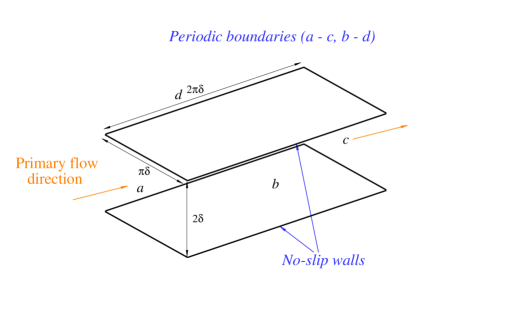
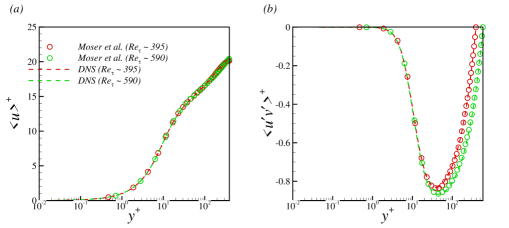
- Two DL/SNS model families trained on explicitly filtered DNS data of channel flow at Reτ ≈ 395 and 590.
- Architecture A1: tensor-basis neural network (TBNN) embedding the Pope–Lund–Novikov SGS expansion form to enforce Galilean, rotational, and reflectional invariances.
- Architecture A2: simpler network that uses the integrity basis tensors and invariant inputs but emphasizes Galilean invariance only.
- Input features derived from the symmetric and anti-symmetric parts of the resolved velocity gradient (S, R) and invariant scalars from them.
- Use of a spectrally sharp cutoff filter for explicit filtering to preserve Galilean invariance in SGS predictions.
- A priori and a posteriori evaluation of predicted SGS stresses across multiple filter widths and Reynolds numbers.
Experimental results
Research questions
- RQ1Can DL-based SGS models reproduce SGS stresses accurately for wall-bounded turbulence when trained on explicitly filtered DNS data?
- RQ2Do invariance properties embedded in the DL architectures (Galilean, rotational, reflectional) improve model performance for SGS predictions in wall-bounded flows?
- RQ3How do the two architectures (A1 with full invariance via TBNN vs A2 with Galilean invariance only) compare in both a priori and a posteriori assessments at different filter widths and Reynolds numbers?
- RQ4Are the learned SGS models robust across different DNS-derived training/testing datasets and grid resolutions?
Key findings
- Both model families provide similar levels of dissipation and backscatter in a priori tests.
- The simpler architecture (A2) with better feature learning capabilities outperforms the invariance-embedded model (A1) in statistical metrics.
- Despite different architectures, both models are deemed usable in a posteriori LES applications based on test results.
- The invariance-embedded approach (A1) benefits from embedding the analytical SGS expansion form, while A2 benefits from stronger feature extraction from cross-components of basis tensors.
- Training used explicitly filtered DNS data at two Reτ values, with SGS stresses predicted for various filter widths and Reynolds numbers.
Read this paper
Open the full text in the Nubint reader and ask about any passage as you read.
Read this paper on NubintThis review was generated by AI from the original paper. Please check the paper before citing it.