
[Paper Review] ACDMSR: Accelerated Conditional Diffusion Models for Single Image Super-Resolution
ACDMSR proposes a fast, conditional diffusion model for single image super-resolution by using a pre-trained super-resolution model's output as a conditional image, enabling high-quality, photo-realistic results. The method achieves state-of-the-art performance in both quantitative metrics and perceptual quality on benchmark datasets like Set5, Urban100, and BSD100, significantly outperforming prior diffusion-based and CNN-based approaches in visual fidelity while maintaining competitive PSNR and SSIM scores.
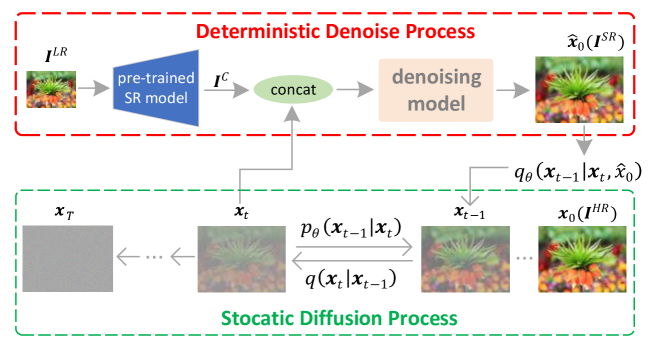
Diffusion models have gained significant popularity in the field of image-to-image translation. Previous efforts applying diffusion models to image super-resolution (SR) have demonstrated that iteratively refining pure Gaussian noise using a U-Net architecture trained on denoising at various noise levels can yield satisfactory high-resolution images from low-resolution inputs. However, this iterative refinement process comes with the drawback of low inference speed, which strongly limits its applications. To speed up inference and further enhance the performance, our research revisits diffusion models in image super-resolution and proposes a straightforward yet significant diffusion model-based super-resolution method called ACDMSR (accelerated conditional diffusion model for image super-resolution). Specifically, our method adapts the standard diffusion model to perform super-resolution through a deterministic iterative denoising process. Our study also highlights the effectiveness of using a pre-trained SR model to provide the conditional image of the given low-resolution (LR) image to achieve superior high-resolution results. We demonstrate that our method surpasses previous attempts in qualitative and quantitative results through extensive experiments conducted on benchmark datasets such as Set5, Set14, Urban100, BSD100, and Manga109. Moreover, our approach generates more visually realistic counterparts for low-resolution images, emphasizing its effectiveness in practical scenarios.
Motivation & Objective
- To address the slow inference speed of diffusion models in single image super-resolution (SISR), which limits practical deployment.
- To improve perceptual quality in SISR by leveraging conditional diffusion modeling beyond traditional PSNR-optimized methods.
- To investigate whether pre-super-resolved features from a pre-trained model can serve as effective conditionals for diffusion-based SISR.
- To develop a simple yet effective post-processing framework that enhances image realism without retraining the diffusion model from scratch.
Proposed method
- The method uses a pre-trained super-resolution model (e.g., RRDB, EDSR, RCAN, SwinIR) to generate a conditional image from the input low-resolution (LR) image.
- This conditional image is then used as a guide in a diffusion model that performs deterministic iterative denoising to refine the HR output.
- The diffusion model is trained to predict noise in the reverse denoising process, but the final output is generated using image-predicted loss, which improves perceptual quality.
- The framework is applied as a post-processing step to existing SR models, enabling fast inference with minimal architectural changes.
- The method supports various scale factors and is evaluated on multiple benchmarks including Set5, Set14, Urban100, BSD100, and Manga109.
Experimental results
Research questions
- RQ1Can using a pre-super-resolved image as a conditional input improve the quality of diffusion-based super-resolution?
- RQ2How does the choice of conditional image (e.g., LR, EDSR, RCAN, SwinIR, or RRDB output) affect the final SR result?
- RQ3Does training the diffusion model to predict the image rather than the noise lead to better perceptual quality?
- RQ4Can a simple post-processing diffusion framework achieve state-of-the-art performance without retraining the main SR model?
Key findings
- On the Urban100 dataset at 4× scale, ACDMSR with SwinIR as the conditional model achieved a PSNR of 25.947 and SSIM of 0.6743, outperforming all baselines in both metrics.
- The LPIPS score was reduced to 0.0834 when using RCAN as the conditional model, indicating superior perceptual quality compared to other methods.
- The image-predicted loss variant outperformed the noise-predicted loss in both PSNR and LPIPS, confirming its superiority in learning image distribution for SR.
- Visual results on diverse content (e.g., text, animals, humans) showed that ACDMSR generates sharper textures and more realistic details than baseline methods.
- The method achieved state-of-the-art performance on Set5, Set14, BSD100, and Manga109, with consistent gains in perceptual quality despite slightly lower PSNR than some CNN-based models.
Better researchstarts right now
From reading papers to final review, dramatically reduce your research time.
No credit card · Free plan available
This review was created by AI and reviewed by human editors.