
[Paper Review] ACLM: A Selective-Denoising based Generative Data Augmentation Approach for Low-Resource Complex NER
ACLM proposes a selective-denoising, conditional generation-based data augmentation method for low-resource complex NER, using BART fine-tuned on a novel text reconstruction task with attention-map-augmented keyword selection to preserve named entities and contextually relevant keywords. It significantly outperforms baselines by 1%–36% across monolingual, cross-lingual, and multilingual settings, generating more coherent, diverse, and factual augmentations that mitigate context-entity mismatch.
Complex Named Entity Recognition (NER) is the task of detecting linguistically complex named entities in low-context text. In this paper, we present ACLM Attention-map aware keyword selection for Conditional Language Model fine-tuning), a novel data augmentation approach based on conditional generation to address the data scarcity problem in low-resource complex NER. ACLM alleviates the context-entity mismatch issue, a problem existing NER data augmentation techniques suffer from and often generates incoherent augmentations by placing complex named entities in the wrong context. ACLM builds on BART and is optimized on a novel text reconstruction or denoising task - we use selective masking (aided by attention maps) to retain the named entities and certain keywords in the input sentence that provide contextually relevant additional knowledge or hints about the named entities. Compared with other data augmentation strategies, ACLM can generate more diverse and coherent augmentations preserving the true word sense of complex entities in the sentence. We demonstrate the effectiveness of ACLM both qualitatively and quantitatively on monolingual, cross-lingual, and multilingual complex NER across various low-resource settings. ACLM outperforms all our neural baselines by a significant margin (1%-36%). In addition, we demonstrate the application of ACLM to other domains that suffer from data scarcity (e.g., biomedical). In practice, ACLM generates more effective and factual augmentations for these domains than prior methods. Code: https://github.com/Sreyan88/ACLM
Motivation & Objective
- To address data scarcity in low-resource complex NER, where standard data augmentation fails due to context-entity mismatch.
- To generate coherent, diverse, and factual augmentations that preserve the true word sense of complex named entities.
- To overcome limitations of existing methods that replace or rephrase entities without maintaining linguistic and contextual consistency.
- To develop a conditional generation framework that introduces new context patterns around entities rather than altering the entities themselves.
- To demonstrate transferability of the method to other low-resource domains, including biomedical and scientific text.
Proposed method
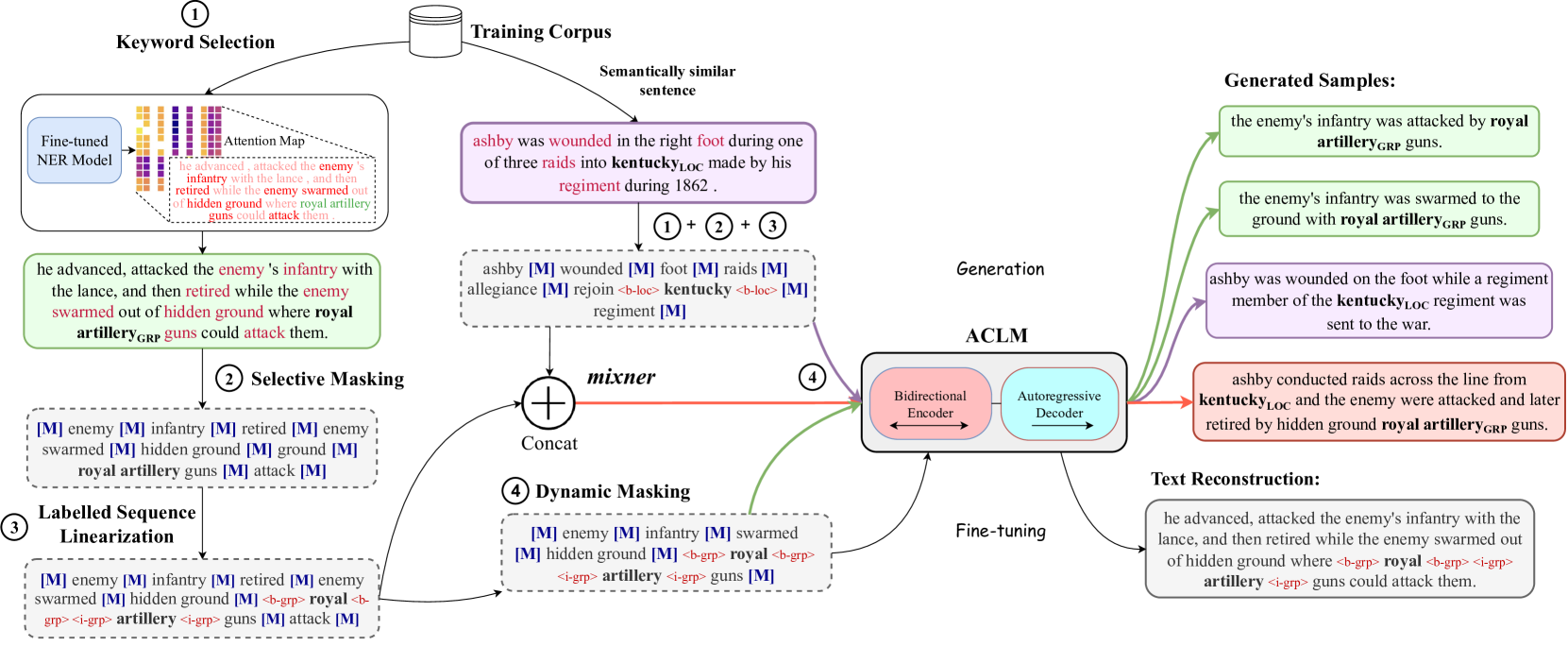
- ACLM fine-tunes BART on a modified denoising objective, using selective masking that retains named entities and contextually relevant keywords derived from attention maps.
- Keywords are identified via attention map analysis to preserve semantically and syntactically relevant context around complex entities.
- The corrupted input (template) consists of masked non-entity words, except for named entities and selected keywords, which are used as input for generation.
- The model generates full sentences conditioned on the template, producing diverse and contextually coherent augmentations.
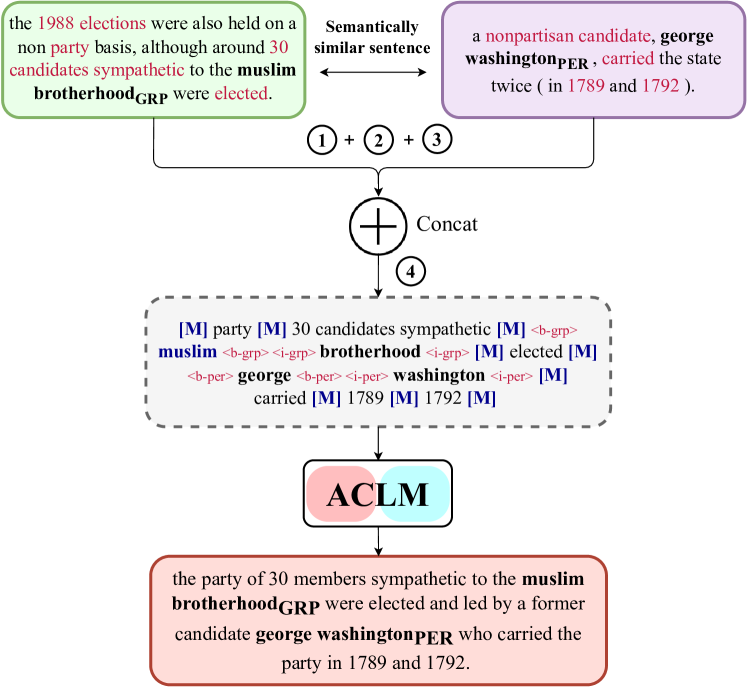
- A mixner strategy further enhances generation diversity by combining multiple templates during inference.
- External knowledge is not required, but the method is designed to be extensible to knowledge integration in future work.
Experimental results
Research questions
- RQ1Can a conditional generation-based data augmentation method effectively address data scarcity in low-resource complex NER without introducing context-entity mismatch?
- RQ2How does selective masking guided by attention maps improve the quality and coherence of generated augmentations compared to random or entity-only masking?
- RQ3To what extent can ACLM generate diverse, factual, and contextually appropriate augmentations that preserve the original word sense of complex named entities?
- RQ4Does ACLM generalize across low-resource settings and domains beyond news, such as biomedical and scientific text?
- RQ5How does the model’s performance compare to existing neural baselines in terms of NER F1-score and generation quality metrics?
Key findings
- ACLM outperforms all neural baselines by 1% to 36% in F1-score across monolingual, cross-lingual, and multilingual low-resource complex NER settings.
- On MultiCoNER with only 500 training samples, ACLM achieves a 31.8% performance drop compared to 23% for the SOTA method, indicating superior robustness.
- In quantitative generation evaluation, ACLM achieves the highest diversity scores (22.48 for Entity, 5.67 for Length) and lowest perplexity (80.77) at 200 training samples.
- On biomedical datasets like BC2GM and NCBI Disease, ACLM improves F1 by 5.8–6.0 points over baselines, demonstrating strong transferability.
- Qualitative analysis shows ACLM generates more coherent, detailed, and contextually appropriate augmentations than MELM or LwTR, which often produce incoherent or minimally altered outputs.
- ACLM avoids context-entity mismatch, unlike MELM and LwTR, which frequently swap entities across semantic categories (e.g., movie for book), leading to factual errors.
Read this paper
Open the full text in the Nubint reader and ask about any passage as you read.
Read this paper on NubintThis review was generated by AI from the original paper. Please check the paper before citing it.