
[Paper Review] ACORN: Performant and Predicate-Agnostic Search Over Vector Embeddings and Structured Data
ACORN introduces a predicate-agnostic, performant hybrid search system that efficiently queries both vector embeddings and structured data by extending HNSW with predicate subgraph traversal. It achieves 2–1,000× higher query throughput at 0.9 recall than prior methods, supporting arbitrary, high-cardinality predicates without performance degradation.
Applications increasingly leverage mixed-modality data, and must jointly search over vector data, such as embedded images, text and video, as well as structured data, such as attributes and keywords. Proposed methods for this hybrid search setting either suffer from poor performance or support a severely restricted set of search predicates (e.g., only small sets of equality predicates), making them impractical for many applications. To address this, we present ACORN, an approach for performant and predicate-agnostic hybrid search. ACORN builds on Hierarchical Navigable Small Worlds (HNSW), a state-of-the-art graph-based approximate nearest neighbor index, and can be implemented efficiently by extending existing HNSW libraries. ACORN introduces the idea of predicate subgraph traversal to emulate a theoretically ideal, but impractical, hybrid search strategy. ACORN's predicate-agnostic construction algorithm is designed to enable this effective search strategy, while supporting a wide array of predicate sets and query semantics. We systematically evaluate ACORN on both prior benchmark datasets, with simple, low-cardinality predicate sets, and complex multi-modal datasets not supported by prior methods. We show that ACORN achieves state-of-the-art performance on all datasets, outperforming prior methods with 2-1,000x higher throughput at a fixed recall.
Motivation & Objective
- To address the performance and expressivity limitations of existing hybrid search systems that rely on pre-filtering, post-filtering, or specialized indices with restricted predicate sets.
- To enable efficient search over large, unbounded, and diverse predicate sets—such as range, equality, and regex filters—without prior knowledge of the query workload.
- To design a system that maintains high search efficiency and low construction overhead, even under high selectivity or low correlation between vector similarity and structured predicates.
- To support both high-throughput production workloads (ACORN-γ) and resource-constrained environments (ACORN-1) with minimal engineering overhead.
- To provide a practical, HNSW-compatible extension that enables predicate-agnostic search without sacrificing the performance characteristics of state-of-the-art ANN indexing.
Proposed method
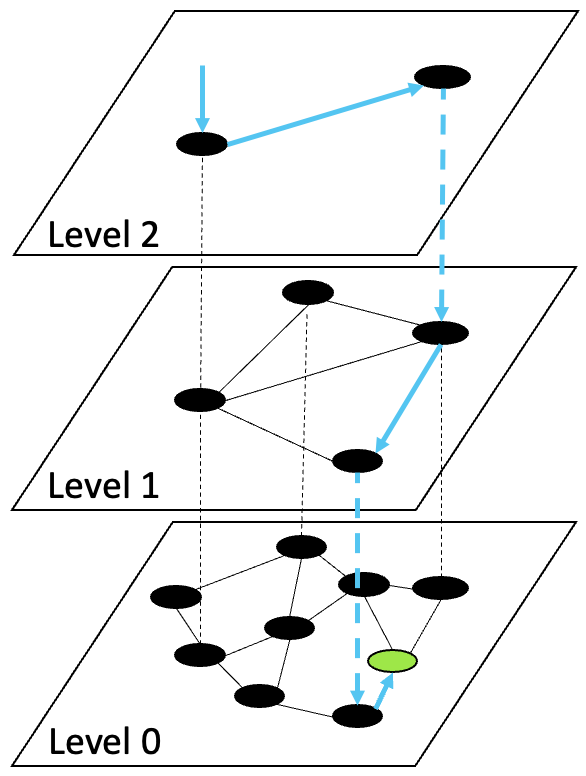
- ACORN introduces predicate subgraph traversal, a search strategy that dynamically explores the subgraph of the HNSW index induced by nodes satisfying the query’s structured predicates.
- It extends the HNSW indexing algorithm with a predicate-agnostic construction process that prunes and reweights edges to preserve graph structure and search efficiency in the presence of predicate constraints.
- ACORN-γ uses a parameterized edge pruning and expansion strategy during index construction to optimize for search performance, emulating ideal subgraph quality metrics like low SCC count, optimal height, and balanced out-degree.
- ACORN-1 employs a lightweight construction method that reduces index size and build time by limiting edge expansion, at the cost of slightly reduced search performance.
- The system integrates seamlessly with existing HNSW libraries, enabling deployment without major architectural changes.
- It leverages HNSW’s hierarchical structure to maintain logarithmic search complexity while enabling efficient filtering through subgraph traversal rather than brute-force or full-graph exploration.
Experimental results
Research questions
- RQ1Can a hybrid search system achieve high performance across diverse, high-cardinality predicate sets without prior knowledge of the query workload?
- RQ2Does predicate subgraph traversal over a modified HNSW index outperform traditional pre-filtering and post-filtering strategies in terms of throughput and recall?
- RQ3Can a predicate-agnostic index construction method preserve the structural properties of HNSW—such as graph height and connectivity—while supporting arbitrary structured predicates?
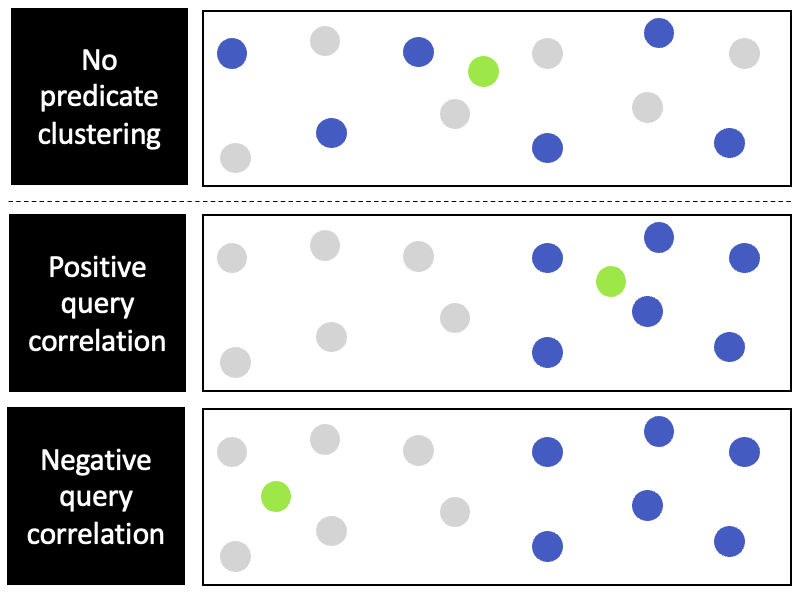
- RQ4How does ACORN scale across datasets with varying predicate selectivity, attribute correlation, and data size compared to existing systems?
- RQ5To what extent can a lightweight variant (ACORN-1) maintain high search performance while reducing construction time and memory overhead?
Key findings
- ACORN-γ achieves 2–1,000× higher query throughput at 0.9 recall than prior methods across both benchmark and complex multi-modal datasets.
- On the TripClick dataset, ACORN-γ maintains high subgraph quality, with an average of 1.2 strongly connected components per level, indicating robust connectivity in predicate subgraphs.
- ACORN-γ’s predicate subgraphs exhibit a graph height of 12.5 and an average out-degree of 14.3 across uncompressed levels, closely approximating HNSW’s optimal structural properties.
- ACORN-1 reduces time-to-initial-response (TTI) by 9–53× compared to ACORN-γ, making it suitable for resource-constrained deployments.
- ACORN outperforms systems like Milvus, Weaviate, and FAISS-IVF in both low- and high-cardinality predicate workloads, especially under low-correlation or high-selectivity conditions.
- The predicate-agnostic construction method enables support for unbounded and diverse predicate sets, including range, equality, and regex filters, without performance degradation.
Read this paper
Open the full text in the Nubint reader and ask about any passage as you read.
Read this paper on NubintThis review was generated by AI from the original paper. Please check the paper before citing it.