
[Paper Review] Acoustic event detection for multiple overlapping similar sources
This paper proposes an onset-duration-offset (ODO) model for acoustic event detection in polyphonic, overlapping natural sounds—particularly zebra finch calls—where multiple identical sources can call simultaneously. By modeling onsets, durations, and offsets probabilistically without assuming fixed polyphony or strict temporal patterns, the ODO method achieves higher accuracy and robustness than HMM-based approaches, especially in event counting and transcription under high overlap.
Many current paradigms for acoustic event detection (AED) are not adapted to the organic variability of natural sounds, and/or they assume a limit on the number of simultaneous sources: often only one source, or one source of each type, may be active. These aspects are highly undesirable for applications such as bird population monitoring. We introduce a simple method modelling the onsets, durations and offsets of acoustic events to avoid intrinsic limits on polyphony or on inter-event temporal patterns. We evaluate the method in a case study with over 3000 zebra finch calls. In comparison against a HMM-based method we find it more accurate at recovering acoustic events, and more robust for estimating calling rates.
Motivation & Objective
- Address the limitation of existing acoustic event detection (AED) methods that assume monophonic scenes or fixed numbers of simultaneous sources.
- Develop a method robust to high polyphony and organic variability in natural sounds, such as overlapping bird calls.
- Enable accurate event counting and transcription in recordings with unknown numbers of similar sources, relevant for ecological monitoring.
- Evaluate the method on a large-scale zebra finch call dataset to assess performance under realistic, complex acoustic conditions.
Proposed method
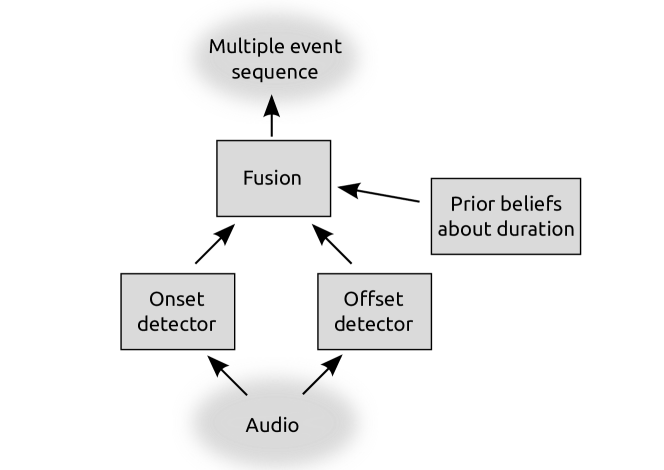
- Model acoustic events using a two-dimensional space defined by onset time $ t $ and duration $ \tau $, with posterior probability $ p_{\text{evt}}(t,\tau|\mathbf{y}) \propto p_{\text{on}}(t|\mathbf{y}) \, p_{\text{off}}(t+\tau|\mathbf{y}) \, p_{\text{dur}}(\tau) $.
- Use random forest regression to estimate onset and offset detection probabilities from time-differenced spectrograms.
- Learn a Gaussian Mixture Model (GMM) prior over event durations to improve robustness and accuracy.
- Combine onset, offset, and duration probabilities using a probabilistic framework that allows unbounded polyphony.
- Compare the ODO model against a factorial HMM-based system and a combined ODO+HMM system, using cross-validation on a zebra finch call dataset.
- Apply spectral median subtraction for noise reduction and use 50% overlapped Hann-windowed spectrograms with 2048-point frames.
Experimental results
Research questions
- RQ1Can a probabilistic onset-duration-offset model detect overlapping acoustic events more accurately than HMM-based methods in polyphonic natural sound scenes?
- RQ2How does incorporating a learned duration prior affect detection performance in the presence of high variability and polyphony?
- RQ3To what extent is the ODO model robust to variations in event density between training and testing data?
- RQ4Does the ODO model outperform HMM-based systems in both event transcription and event counting tasks?
- RQ5Can the ODO model effectively handle unbounded polyphony without assuming a fixed number of simultaneous sources?
Key findings
- The ODO model achieved an F-measure of approximately 37% on event transcription, which is on par with state-of-the-art methods for similar tasks.
- The ODO model with a learned GMM duration prior significantly outperformed the version with a flat duration prior, demonstrating the value of modeling duration variability.
- The HMM-based system performed substantially worse than the ODO model in both transcription and counting tasks, particularly under mismatched training and test conditions.
- The combined ODO+HMM system improved over the standalone HMM but still failed to match the performance of the standalone ODO model.
- All systems showed performance degradation under mismatched event densities, indicating a need for improved robustness to wide variations in event density.
- The raw onset detector output performed notably worse than full systems, confirming that the ODO framework significantly enhances detection beyond the base detector.
![Figure 2: Schematic diagram of how probabilities are combined in the onset-duration-offset event detection model. Each source of probabilistic information is a marginal with respect to a different direction in the [onset $\times$ duration] space.](https://ar5iv.labs.arxiv.org/html/1503.07150/assets/x2.png)
Better researchstarts right now
From reading papers to final review, dramatically reduce your research time.
No credit card · Free plan available
This review was created by AI and reviewed by human editors.